Venice’s Festa della Salute centres on a pilgrimage to the Basilica of Santa Maria della Salute, with candle offerings, public worship and a temporary votive bridge. Visitors can join this devotional observance or watch quietly, while food stalls bring a more informal gathering to the surrounding waterfront.
Come for the pilgrimage and its traditions, not for unrestricted sightseeing during services. The feast commemorates the city’s deliverance from plague, and its religious purpose shapes both what you see and how you take part.
Date, programme and costs
- Annual date
- 21 November
- Main observance
- One day
- Votive bridge crossing
- Free, on foot
- Main rotunda admission
- Free; no ticket or required donation
- Public worship reservations
- No requirement published
- Optional spending
- Candles, food and accommodation
Festa della Salute means the Feast of Health, honouring the Virgin Mary. It suits you if you want to experience Venice’s devotional traditions, whether you attend worship or observe respectfully. For a wider choice of celebrations, Venice festivals worth planning around offers the broader recurring calendar.
The Patriarchate usually publishes the religious programme in mid-November, about a week before the feast. On the Basilica della Salute’s official website, open “La Festa della Madonna della Salute – Il Pellegrinaggio annuale” (the feast and annual pilgrimage) for the services and organised pilgrimage. Use the municipal notices for the bridge’s pedestrian arrangements.
The municipality’s Live news portal carries visitor and pedestrian-management notices, while the formal measures appear as municipal ordinances on the Comune di Venezia website. These announcements concern how you move around the celebration, distinct from the religious programme.
Arrange a nearby room ahead if staying in Dorsoduro or central Venice matters to you. Rooms can be harder to find around the feast, alongside other November demand, including the Biennale. As an ordinary planning estimate, allow roughly €120–€250 per night for a mid-range double room for two, but central locations and stronger demand push you towards the upper end or beyond. Staying near the basilica lets you spend more of the visit at the observance rather than travelling across the city.
The votive bridge, pilgrimages and Mass
| Moment | Recurring day | Usual timing | Location |
|---|---|---|---|
| Votive bridge opening | A few days before the feast | — | Zattere–Salute area |
| Youth pilgrimage | Eve of the feast | Evening | Campo San Maurizio → Salute basilica |
| Principal Mass | Feast day | 10:00 | Salute basilica |
The votive bridge gives the pilgrimage a temporary approach, but crossing while the bridge is open is not the same as attending the feast. Its opening period extends beyond the main observance, so a crossing on a surrounding day brings you to the basilica without necessarily encountering the feast-day gathering.
The organised youth pilgrimage is an annual part of the celebration. Its shared destination is the basilica, where the procession becomes an act of worship rather than simply a walk through Venice. The Patriarch of Venice normally presides at the principal Mass, the central formal service of the feast.
Candle visits and repeated services give the observance its continuing rhythm. You do not have to build your visit around the principal Mass to encounter the tradition: people come to make an offering and pray as well as to join a congregation. Choose whether you want to attend a service or make a quieter devotional visit, and let that purpose guide your time inside.
Crossing the bridge and visiting the basilica
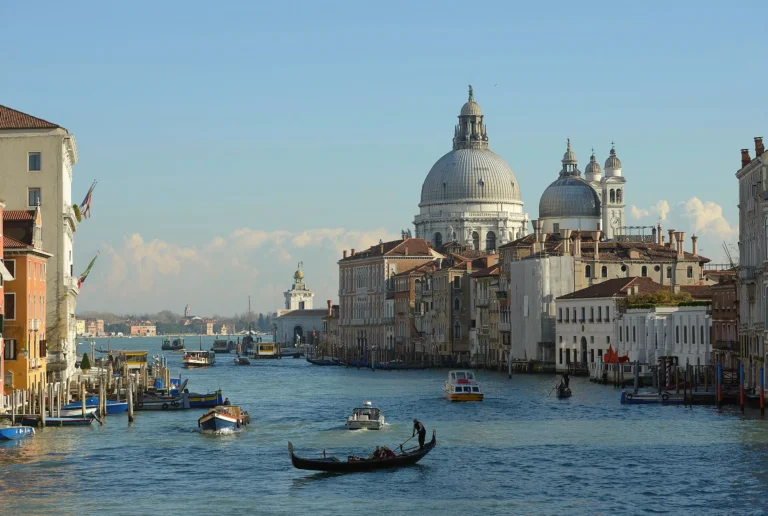
At the end of the pilgrimage, the Basilica of Santa Maria della Salute is worth your time for the way the feast connects a historic promise with present-day worship. The celebration commemorates Venice’s 1630 vow to build a church dedicated to the Virgin Mary if the city was delivered from plague. The basilica fulfilled that vow. Visiting during the observance lets you see the continuing tradition, not just its architectural setting.
The temporary votive bridge connects the Zattere, near the Gesuati church, with the area around the basilica. Treat the crossing as part of the pilgrimage rather than a place to stop for a prolonged view: other participants need to keep moving towards the church. Once you reach the basilica, leave room for those arriving to pray.
For a candle offering, participants bring a lit candle or votive taper into the church and place it at the designated offering stands. Use the offering stands rather than leaving a candle elsewhere. Watch how the offering is being managed before approaching, and keep the path clear after placing yours. Buying a candle is a personal choice, not a condition of entering.
Visitors who are not worshippers are welcome too. You can observe quietly without taking part in prayers or making an offering. Wear suitable church clothing, with shoulders and knees covered, and remove a hat inside. If you remain during worship, keep conversation outside and leave photography aside while the service is taking place. Give people praying space, and do not move through the congregation simply to reach a sightseeing viewpoint.
- Name
- Basilica of Santa Maria della Salute
- Location
- Dorsoduro, Venice Maps
- Site
- basilicasalutevenezia.it
- Hours
- 09:00–12:00, 15:00–17:30
- Essential fact
- The basilica at the entrance to the Grand Canal in Dorsoduro is the focus of the Salute pilgrimage.
Castradina and the festival stalls
After your basilica visit, castradina, a slow-cooked mutton and cabbage stew, connects the meal to the feast. Traditionally eaten for the Salute celebration, it recalls food Venetians relied on during the plague and its aftermath. It is usually made with salted, smoked mutton, cabbage and onions, simmered slowly until the meat softens and flavours the broth. Choose castradina if you want the feast’s traditional dish rather than only a snack.
Around the basilica, especially along the waterfront and its nearby approaches, recurring stalls sell fried doughnuts, roasted nuts, sweets and other street food. These make a more informal stop after the devotional visit, but keep eating outside the church and away from its entrances.
For an ordinary sit-down meal, allow roughly €25–€45 per person, with drinks and a fuller order moving the bill upwards. A small candle or taper might cost around €2–€5, with larger candles costing more. Both are optional purchases, separate from admission.
Crowds and access
When leaving the stalls or approaching the basilica again, allow extra time and be willing to take a different approach. A planned meeting on the other side of the bridge can become awkward if access is diverted. Keep companions together before joining a crowd, and avoid stopping at narrow entrances to decide where to go next.
Inside, access to the basilica or sacristy may be temporarily restricted during liturgical celebrations. The smaller, or minor, rotunda is reserved for worship and services, not general sightseeing. Keep sightseeing separate from attendance at worship. If your aim is to look around rather than join a service, let the celebration finish and follow staff directions about which spaces you may enter. The ordinary visiting hours do not make every part of the church available throughout the feast.
Sources & fact-checking
Checks against the sources below cover: services and opening hours.
- Basilica Santa Maria della Salute — service
- Venezia Unica — opening hours
- Comune di Venezia — opening hours
- Comune di Venezia — service
- Patriarcato di Venezia — service
- Patriarchate of Venice (Basilica della Salute) — service
- Patriarchate of Venice — service
- Comune di Venezia; the pedestrian-safety ordinance is issued by the Local Police Command. — service
- Patriarcato di Venezia — opening hours
- Festa della Salute: l’omelia del Patriarca
- Patriarchate of Venice (Diocesan Youth Ministry) — opening hours
- Festa della Salute: oltre mille giovani in pellegrinaggio con il Patriarca