Travelling to Florence by train is straightforward from Rome, Milan and Pisa, with services arriving at Firenze Santa Maria Novella railway station and the walled historic centre within walking distance. From London, it is feasible but involves Paris and usually Milan, so allow 12–16 hours door to door, not just the time shown on the timetable. From Rome, Milan and Pisa, typical door-to-door rail journeys take 2 hours 15 minutes to 3 hours 15 minutes, 2 hours 45 minutes to 4 hours and 1 hour 30 minutes to 2 hours 30 minutes respectively. Advance one-way fares are about €9–€70 per person on Italian routes, while London fares start at roughly £120 when booked ahead. Flying from London can be faster once airport access and waiting are included. The useful choice depends on whether you value a city-centre arrival, generous luggage handling and a lower-stress journey over the shortest elapsed time.
Origins, stations and operators for Florence trains
| Origin | Departure station | Florence arrival station | Line-haul time | Door-to-door time | Typical advance fare, one way | Frequency | Operator |
|---|---|---|---|---|---|---|---|
| London | London St Pancras International | Firenze Santa Maria Novella | 10h30-12h30 | 12-16h | £120-£300 | 1-3 practical sequences/day | Eurostar, SNCF Voyageurs, Trenitalia |
| Rome | Roma Termini or Roma Tiburtina | Firenze Santa Maria Novella | 1h30-1h45 | 2h15-3h15 | €20-€60 | 30+/day | Trenitalia, Italo |
| Milan | Milano Centrale | Firenze Santa Maria Novella | 1h55-2h15 | 2h45-4h | €25-€70 | 20+/day | Trenitalia, Italo |
| Pisa | Pisa Centrale | Firenze Santa Maria Novella | 50-70 min | 1h30-2h30 | €9-€25 | 30+/day | Trenitalia |
The three Italian routes are domestic journeys into Firenze Santa Maria Novella railway station, usually shortened to Santa Maria Novella or SMN. High-speed trains from Rome and Milan use Trenitalia’s Frecciarossa or Italo services. Pisa is a regional journey, so the train is slower and seat reservations are not the same part of the booking process. Firenze Campo di Marte and Firenze Rifredi also serve the city, but they are not the central terminal used for the comparisons above. If your accommodation is inside the walled historic centre, SMN is normally the most useful arrival point because it avoids a second cross-city transfer.
London has no direct train to Florence. The practical rail connection runs from London St Pancras to Paris by Eurostar, across Paris between Gare du Nord and Gare de Lyon, then towards Milan and Florence using SNCF Voyageurs and Trenitalia services, with an Italian high-speed leg to SMN. Allow at least 60 minutes for the cross-Paris connection when tickets are separate, in addition to the 35-60-minute transfer itself. The London line-haul figure excludes the walk or local ride to your London station, the Paris transfer and waiting between trains, which is why the door-to-door range is the more useful comparison.
Rome is the strongest rail choice for a short city-centre journey: frequent high-speed departures make the timetable flexible, and the fare is often lowest when booked ahead. Milan remains practical for a north-to-south Italian itinerary, although its longer run makes the price and departure time more important. Pisa suits travellers already arriving at Pisa Centrale or combining the two Tuscan cities; regional trains trade a lower fare for less predictable seating and a longer journey. London is the specialist rail option, chosen for avoiding an airport rather than for speed. The figures are comparable because every door-to-door range includes the same elements: reaching the departure station, connection or waiting time, arrival at SMN and the final walk or local ride.
Door-to-door times and the last leg from Santa Maria Novella
A Florence train timetable gives only the movement between stations. For a usable journey estimate, add the trip from your accommodation to the departure station, a sensible margin at each connection and the final leg from SMN to your stay. That produces roughly 12-16 hours from a London address, 2 hours 15 minutes to 3 hours 15 minutes from central Rome, 2 hours 45 minutes to 4 hours from Milan and 1 hour 30 minutes to 2 hours 30 minutes from Pisa. The range is wider on the international route because Paris requires a station change.
London’s rail sequence takes about 12–16 hours
Yes, you can travel from the UK to Florence by train, but it is a connected international journey rather than a direct service. A workable sequence from a central London address is:
Central London departure point
Before departure · 30-60 min
Reach St Pancras with your luggage and allow 30-60 minutes for the local journey.
London St Pancras International
2h15
Take Eurostar to Paris Gare du Nord. The scheduled crossing is about 2h15.
Paris Gare du Nord to Gare de Lyon
35-60 min
Cross Paris by RER or taxi. Allow 35-60 minutes, then keep a connection margin of at least 60 minutes between separate tickets.
Paris Gare de Lyon to Milano Centrale
6h40-7h30
Take the booked high-speed service towards Milan. The rail leg takes about 6h40-7h30, depending on the service and routing.
Milano Centrale to Firenze Santa Maria Novella
1h55-2h15
Continue by Frecciarossa or Italo to Florence; the high-speed run takes about 1h55-2h15.
Arrival in central Florence
10-25 min
Walk or take a taxi from the station to your accommodation.
~749 min of travel
This sequence gives a rail time of about 10 hours 30 minutes to 12 hours 30 minutes. With the London station approach, the Paris transfer, a protected connection and the final walk, the realistic door-to-door total is approximately 12-16 hours. A missed cross-Paris connection is costly, so the margin matters more than choosing the tightest available change.
The historic centre is a short walk from the station
Yes. From the main concourse at Firenze Santa Maria Novella railway station, the nearest streets inside the walled historic centre are about 800 metres away, around 10 minutes on foot. Allow 15-20 minutes for a central address near the Duomo or Piazza della Signoria, and longer for a hotel deeper into the pedestrian streets. Leave the station across Piazza della Stazione and head east towards the cathedral area; the route is flat, but paving and crowds make wheeled luggage slower than the distance suggests.
A taxi is the practical alternative with heavy cases, reduced mobility or a late arrival, using the rank outside the station rather than carrying luggage across the centre. Allow about 5–10 minutes to a central historic-centre address and roughly €10–€15, depending on the address and any applicable supplements. A local bus can shorten the walk for some addresses, but it is less convenient with several bags and does not remove the need to reach a nearby stop. For most central stays in daylight, walking remains the simplest last leg; for a late arrival, the taxi avoids relying on a bus departure.
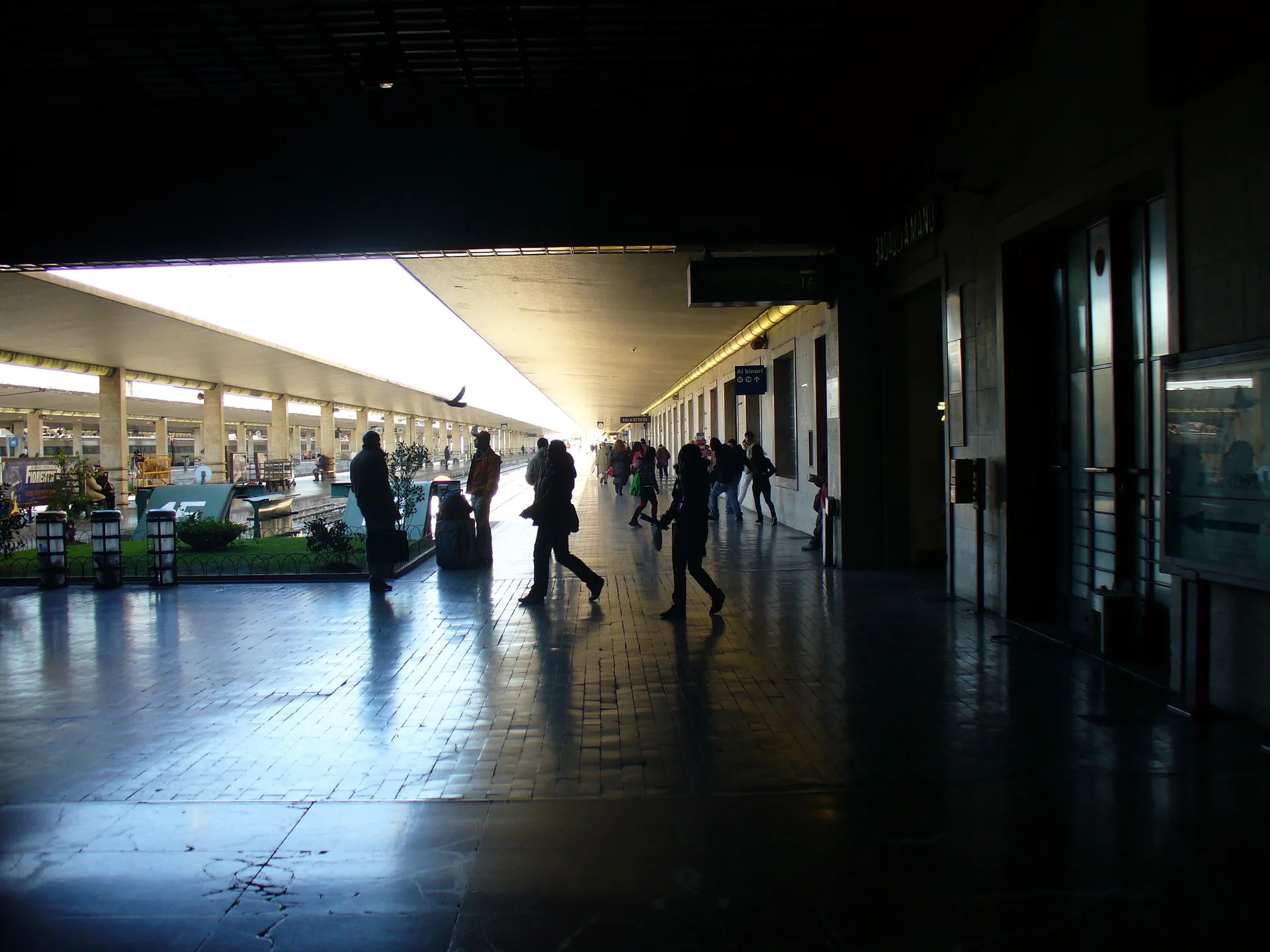
Freepenguin · CC BY-SA 3.0
Fares, booking and the rail trade-off
- Florence terminal
- Firenze Santa Maria Novella railway station
- Door-to-door duration
- About 1 hour 30 minutes to 16 hours, depending on origin
- Typical one-way fare
- €9–€70 from Italian origins; £120–£300 from London, per person and booked ahead
- Train frequency
- 30+ daily from Rome, 20+ from Milan, 30+ from Pisa; 1–3 practical London connections daily
Trenitalia and Italo compete on the Rome and Milan high-speed routes. Trenitalia’s Frecciarossa services and Italo both include a reserved seat, while regional trains from Pisa use open seating and a simpler fare structure. The London journey combines Eurostar for London-Paris with SNCF Voyageurs or Trenitalia for the onward international and Italian legs; those tickets also carry a reserved seat on the relevant long-distance trains.
For Italian high-speed trains, the lowest advance tiers are limited and tied to the chosen departure. Trenitalia sells Base, Economy and Super Economy fare families; Italo uses Low Cost, Economy and Flex. The cheapest tickets can restrict changes or refunds, while flexible fares cost more and are useful when your arrival at the station is uncertain. Pisa regional tickets are less dependent on early purchase: the main saving comes from choosing the correct train rather than reserving a particular seat. Eurostar and the long-distance French or Italian legs are best booked as soon as your travel date is firm, because the lowest London fares disappear first.
Booked ahead, Rome and Milan can fall into the €20-€70 range shown above; buying on the day can push a high-speed one-way ticket towards €50-€100 or more. Pisa remains the inexpensive option at about €9-€25. From London, £120-£300 is a realistic advance range for the combined rail journey, with late purchase and flexible tickets commonly higher. The timetable therefore matters twice: it determines the journey length and the fare tier still available.
Rail is strongest when you want to arrive in the city centre with your luggage and avoid airport transfers. Its weakness is clearest on the London route, where the connection count and total hours change the value of the ticket.
Rail compared with flying or driving
Pros
- Rome to Florence takes about 2h15-3h15 door to door, and Milan to Florence about 2h45-4h, often beating airport access and security time.
- Advance domestic fares of €20-€70 can undercut the full cost of a flight once airport transfers and baggage are added.
- SMN is central, so the final walk is about 800 m to the historic centre; trains offer more usable luggage space and no airport-style liquid restriction.
Cons
- London to Florence takes 12-16 hours door to door, compared with roughly 6-9 hours for a flight once airport access, check-in, arrival and the Pisa or Bologna transfer are included.
- A London rail fare of £120-£300 booked ahead can exceed a £50-£200 flight before baggage and ground transport, especially for a late booking.
- Driving adds motorway tolls, fuel, parking and congestion, and leaves the car outside much of the walled historic centre; rail is less practical when your itinerary depends on rural Tuscany.
FAQ: Florence by train
The three answers below cover the practical rail questions that matter when you are choosing Florence as a train destination.
Can you get a train from the UK to Florence?
Yes, you can get from the UK to Florence by train, but there is no direct service. From London, take Eurostar from St Pancras to Paris, cross the city from Gare du Nord to Gare de Lyon, then continue towards Milan and Florence on SNCF Voyageurs and Trenitalia services. The full journey to central Florence takes about 12-16 hours door to door, including station access, the Paris transfer, connection time and the final walk from SMN. The main drawback compared with flying is the longer total journey, not the feasibility.
Is Florence walkable from the train station?
Yes, Florence is walkable from the train station for most central stays. Firenze Santa Maria Novella railway station is about 800 metres from the nearest part of the walled historic centre, roughly 10 minutes on foot, or 15-20 minutes to addresses around the Duomo and Piazza della Signoria. Leave via the main concourse and walk east towards the cathedral area. With heavy luggage, reduced mobility or a late arrival, take a taxi from the station rank; a local bus is another option for an address beyond the easiest walking route.
Where can you go from Florence by train?
From Florence, direct or commonly used rail routes include Rome, Milan and Pisa. Rome is served by frequent Trenitalia Frecciarossa and Italo trains, Milan by the same high-speed operators, and Pisa by frequent Trenitalia regional services. The domestic journeys arrive at or connect through Florence’s central SMN station, although some local services use Campo di Marte or Rifredi. London is different: it is not a direct destination from Florence or a direct service to Florence, but a connecting international journey through Paris, followed by the Italian high-speed network.