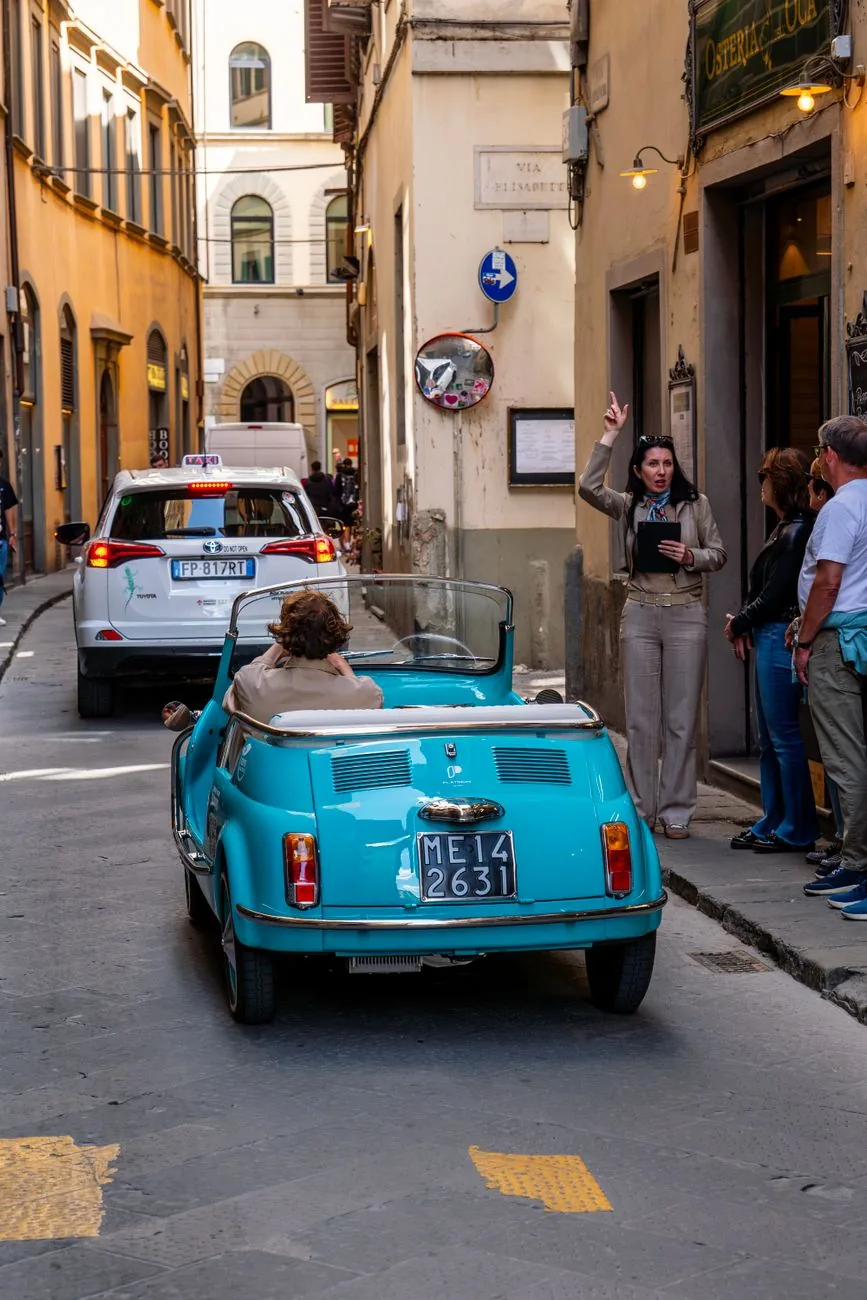
Driving in Florence is manageable on permitted roads, but it is the wrong default for a short stay in the walkable centre. The historic core is covered by a camera-controlled ZTL, parking is costly, and a road route into Florence does not mean you can drive to your central address. Choose public transport when your base is inside or near the centre; choose a car when you have confirmed parking outside the restricted area, substantial luggage, or several Tuscan day trips planned. Tourists can drive in Italy, but the useful decision is where the car will stay after you arrive.
Is driving in Florence difficult? The quick comparison
So, is driving in Florence difficult? It is not especially difficult on ordinary roads around the city, but it becomes demanding when you approach the historic centre: one-way streets, bus lanes, restricted entrances and limited parking leave little room for a wrong turn. Can tourists drive in Florence, Italy? Yes, provided the licence and vehicle are valid and you stay on permitted roads. This quick comparison sets Florence driving against public transport using the same practical tests.
| Criterion | Driving | Public transport |
|---|---|---|
| Centre access | Road access around the centre; central arrival depends on ZTL permission and a confirmed parking space | Tram, bus or train to an edge stop, then a walk of roughly 5-20 minutes |
| Door-to-door time | Often 20-45 minutes from the city edge to a garage, plus the final walk | Roughly 25-50 minutes, including waiting and the final walk |
| Total cost pattern | Fuel plus garage or parking; a central day can cost about €20-€35 before fuel | €1.70 for a 90-minute urban journey; multiply the fare for each traveller |
| Parking burden | You must find and reach a legal space without crossing a restricted gate | No parking search; the vehicle stays outside the centre |
| Luggage | Best for several bags, child equipment or a multi-stop load | Straightforward with light luggage; stairs, crowded vehicles and the final walk add effort |
| Countryside day trips | Flexible for Chianti, hill towns and several stops in one day | Works for planned rail or bus trips, but rural connections take longer and offer less flexibility |
For a central hotel and a walking-focused visit, public transport usually removes the two largest sources of delay: finding a legal place to leave the car and reaching it without entering the ZTL. A car earns its keep when the journey continues into the Tuscan countryside or when luggage makes changes and walking difficult. In both cases, calculate the final leg before choosing: a car parked outside the centre still needs a tram, bus or walk, while a public-transport arrival may bring you closer to the pedestrian streets.
ZTL access and the historic centre
- Practical area
- Much of Florence’s walled historic centre
- Daytime restriction
- Monday-Friday 07:30-20:00; Saturday 07:30-16:00
- Night restriction
- In the summer period, Thursday-Saturday 23:00-03:00
- Gate signs
- Illuminated signs show whether the entrance is active or inactive
- Authorised access
- A hotel or garage can register an eligible vehicle; this is not a general visitor permit
The ZTL, or limited-traffic zone, uses controlled entrances and cameras to restrict unauthorised private vehicles across much of the walled historic centre. The daytime restriction runs Monday to Friday from 07:30 to 20:00 and on Saturday from 07:30 to 16:00. Sundays and public holidays are outside those daytime hours. During the summer night-control period, additional restrictions run from 23:00 to 03:00 on Thursday, Friday and Saturday nights. At each gate, an illuminated sign indicates whether the restriction is active.
Reading the route before you enter
Do
- Set the destination to a confirmed garage or an edge car park, not just to a central street address.
- Check the approach on the map and follow signs for the named car park before the final turn.
- Treat a hotel or garage registration as valid only after the operator has arranged the authorised access.
- Read the illuminated gate sign and turn away while an active restriction is showing.
Don’t
- Assume a normal parking ticket gives permission to enter the ZTL.
- Follow a sat-nav’s shortest route through the historic centre without checking the gate.
- Enter because the road looks open or other vehicles are passing.
- Treat a hotel booking as a generic visitor permit.
Public transport avoids this particular risk: a tram or bus can reach the centre without you driving through a controlled gate, and you can complete the last stretch on foot from an edge stop. Driving through during an active restriction can lead to a camera-recorded penalty even if the route was suggested by your sat-nav. The safe driving choice is therefore a planned destination outside the restricted streets, unless an eligible hotel or garage has already arranged access for your vehicle.
Parking costs and the final public-transport leg
After reaching Florence, compare the whole arrival rather than the road journey alone. A central garage puts you nearer to the sights but commonly costs about €20-€35 for a day, depending on the facility and stay length. Villa Costanza, the park-and-ride at the western edge of the tram network, costs €7 for 24 hours. The saving is substantial, but you exchange a central parking space for a tram ride, a wait and a final walk.
| Arrival choice | Representative cost | Time to central Florence | Main practical trade-off |
|---|---|---|---|
| Central garage | About €20-€35 per day, plus fuel | About 15-30 minutes from garage to a central destination | Shorter final walk, but higher cost and a careful approach around the ZTL |
| Villa Costanza park-and-ride | €7 per 24 hours, plus tram fares | About 30-45 minutes, including tram, wait and walk | Lower parking cost; the T1 ride from the edge takes about 22 minutes |
| Urban public transport | €1.70 for one 90-minute journey | About 25-50 minutes from an arrival point, depending on changes | No car or parking burden; luggage must be carried through stops and on the final walk |
Villa Costanza parking is available 24 hours, while the T1 tram runs from about 05:00 until 00:30 from Sunday to Thursday and until about 02:00 on Friday and Saturday. Plan to board by roughly 00:00 on ordinary nights, or by about 01:30 on Friday and Saturday, rather than relying on the final scheduled movement. Buy the €1.70 urban ticket at a tram-stop machine, an authorised retailer or the official app; validate a paper ticket before travel. Heavy bags and pushchairs favour a central garage or a taxi for the final leg, while a late arrival favours driving only if the garage is confirmed and reachable without an active ZTL.
The choice changes with the people travelling. One traveller with a small bag can absorb a wait and a 10-minute walk; a family with cases may value the shorter transfer more than the parking saving. Public transport is also the cleaner option when the car would sit unused for several days. A park-and-ride works best when you arrive before the last tram and can manage the connection, not when the saving leaves you stranded at the edge of the city.
Balanced pros and cons for each option
Neither option wins on every criterion. Driving gives you control over luggage and routes beyond Florence, but the city-centre part of the journey is constrained by the ZTL and parking. Public transport reaches the walkable core more simply, although fixed services and a final walk matter when you arrive late or carry a lot. The following two choices use the same test: what you gain in flexibility, time and access, and what you accept in cost and handling.
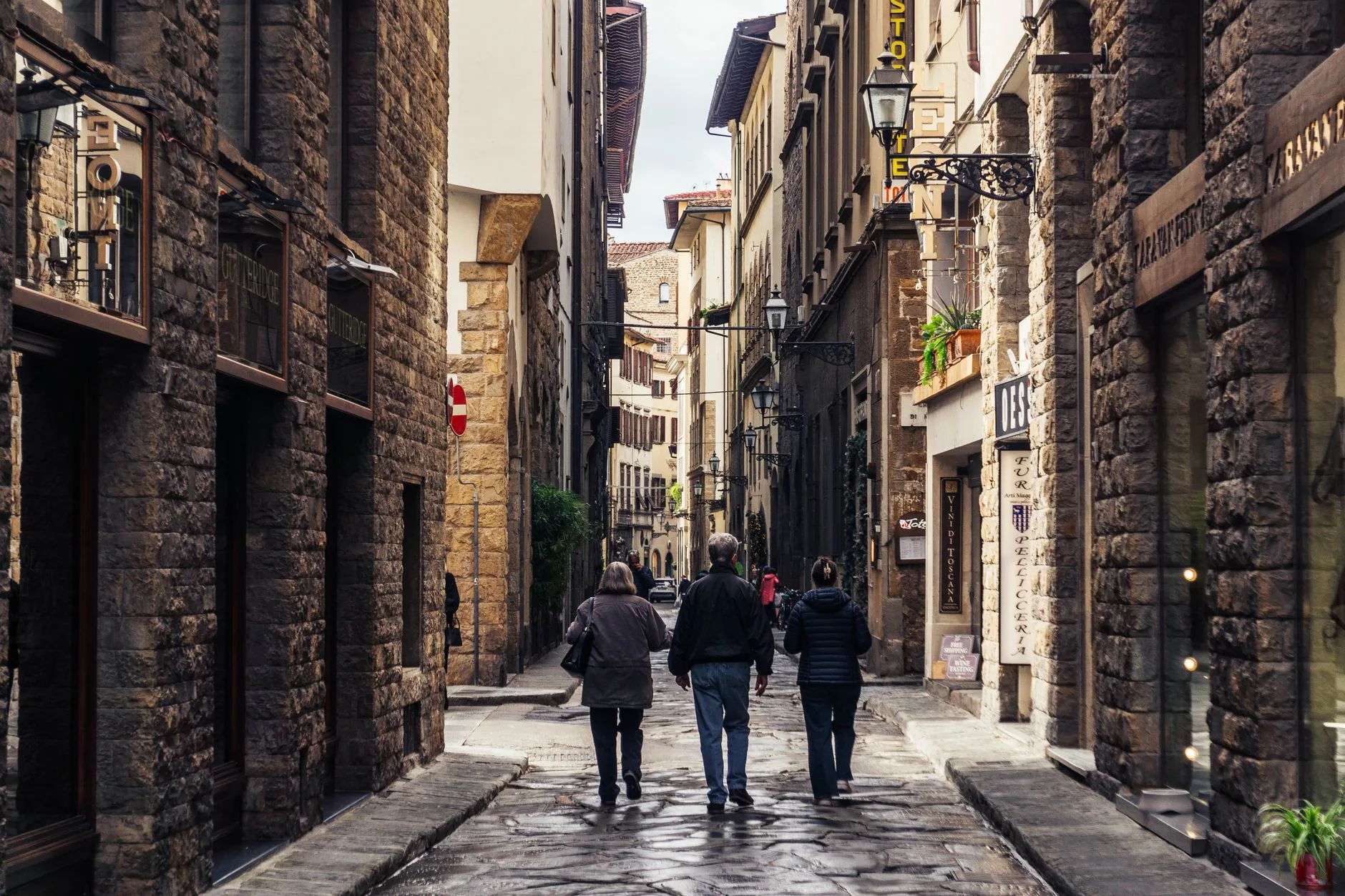
Raylarında Şehrin · Pexels License
Driving: when the car earns its place
A car is useful when Florence is one stop in a wider road trip. You can carry cases, child seats and shopping without changing vehicles, leave when you choose, and link several hill towns or countryside sights in one day. The benefit disappears if the vehicle has no confirmed space outside the restricted centre: traffic, a long approach and a paid garage can consume the time that the car was meant to save.
Driving in Florence
Pros
- Carries heavy luggage and children’s equipment without a station transfer.
- Gives flexible departure times for Chianti, hill towns and scattered rural sights.
- Makes several countryside stops practical in one day.
- Keeps door-to-door control when accommodation has usable parking outside the restricted area.
Cons
- ZTL gates and camera enforcement make an unplanned central approach risky.
- Traffic and one-way streets can turn a short road distance into a slow arrival.
- A central garage commonly costs about €20-€35 per day before fuel.
- You still walk or use public transport after leaving the car, especially for pedestrian streets.
Public transport reverses that calculation: it is strongest for the centre and weakest when the day’s destinations are spread across the countryside. The trade-off is easier to accept when your accommodation is central and your sightseeing remains within walking distance.
Public transport: when leaving the car behind works
Leaving the car behind works particularly well for a short city stay. Tram, bus and rail services let you approach the centre without negotiating a controlled gate or paying for a space, and walking then becomes part of the visit rather than the consequence of remote parking. The limits are practical: you follow timetables, may change services, and must handle bags over pavements, platforms and the final stretch.
Public transport in Florence
Pros
- Reaches the central area without a visitor driving through the ZTL.
- Avoids garage charges, parking searches, traffic stress and damage from tight streets.
- Works well for a central base where the main sights are walkable.
- Costs less for a solo traveller or couple carrying light luggage.
- Lets you leave the car unused during a city-focused stay.
Cons
- Fixed services limit very late arrivals and early departures.
- A change, a wait or a final 10-20-minute walk adds time with luggage.
- Pushchairs, cases and tired children make crowded vehicles less convenient.
- Rural day trips may require slow connections or taxis and offer less flexibility.
The balanced answer is simple: a car buys reach beyond Florence, not easy access to its historic core. Public transport buys centre access, not unlimited freedom after the last service. Choose the option whose disadvantages occur least often during your own trip.
Choose by journey type, luggage and time
For a short stay in the central, walkable area, choose public transport. That is also the better choice when your hotel has no confirmed parking, your sightseeing stays within Florence, or you want to avoid the ZTL entirely. Reaching the city by road is not the same as reaching a central address by car: the car may stop several streets or a tram ride away, and a central garage can cost more than the transport you were trying to avoid.
Choose driving when you are carrying substantial luggage, travelling with children and equipment, staying outside the restricted centre with usable parking, or planning several Tuscan day trips. The condition is confirmed parking, not simply the ability to reach Florence by motorway. An outer-area hotel with a reliable space can make the car efficient; a central hotel that says only “parking nearby” does not. This is the practical test behind Florence driving or public transport: decide where the vehicle will remain, then price and time the final leg.
A late arrival can favour a car if the route to a confirmed garage remains outside the active ZTL and you arrive before the garage’s access limit; otherwise, public transport is safer only when a service and final walk are available. Children do not automatically settle the question: a pushchair and multiple bags favour a nearby garage, while a central stay with light luggage favours the tram or a short walk. In bad weather, shorten the final transfer with a central garage or taxi rather than driving into an unplanned restricted street.
FAQ: driving and public transport in Florence
These answers address the practical points that decide whether to drive, park at the edge or leave the car behind.
Is driving in Florence difficult?
Driving in Florence is manageable on permitted roads outside the restricted centre, but it is difficult for an unfamiliar visitor inside it. The ZTL uses camera-controlled entrances, while narrow historic streets, one-way approaches, traffic and scarce parking leave little margin for a missed turn. Reaching Florence by road is therefore different from reaching a central address by car. Plan an edge car park or public-transport arrival, and do not rely on a sat-nav to cross the historic centre by its shortest route.
Can tourists drive in Florence, Italy?
Tourists may drive in Florence and Italy on roads where their licence and vehicle are valid. That legal permission does not authorise entry into Florence’s camera-controlled ZTL, where an active restriction applies to unauthorised private vehicles. An eligible hotel or garage can arrange registration for access, but a booking is not a generic visitor permit. The safer alternative is to confirm parking outside the restricted centre, leave the car there, and complete the journey by tram or on foot.
How much is a ZTL ticket in Florence?
There is no normal generic ZTL ticket that visitors buy to enter Florence’s restricted centre. An eligible hotel or garage may arrange authorised access, while an unauthorised camera-recorded entry can bring a penalty of €83-€332 before any applicable payment reduction or additional procedure costs. A normal parking ticket is not ZTL permission, and neither is a sat-nav route. Avoid the charge by parking outside the active zone unless authorised access has been registered in advance.
How to avoid the ZTL in Florence?
To avoid the ZTL in Florence, identify the walled historic centre first, choose a signed garage or edge park-and-ride, and check the approach before the final turn. Read the illuminated gate sign at every entrance; do not follow a shortest-route setting blindly, because it can send you through a controlled gate. Use hotel or garage access only when registration has been arranged. Public transport removes the driving risk, but a late arrival still requires a service and final-walk plan.