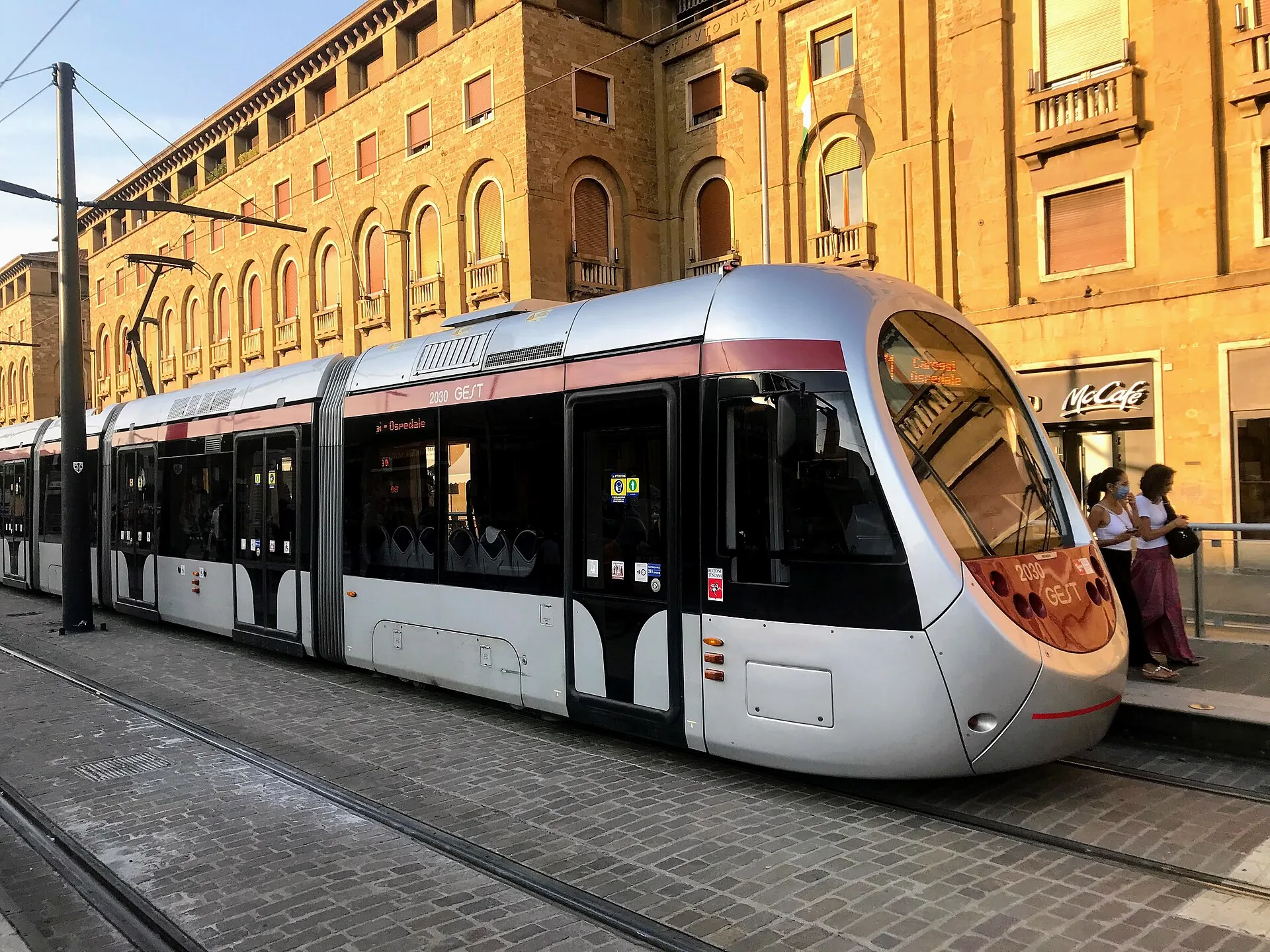
For getting around Florence without a car, walk through the historic centre and use public transport when distance, hills, luggage or late hours change the calculation. Trams are paid, not free, and T2 reaches Florence Airport; buses cover hills and gaps in the tram network. Taxis and hired bikes have narrower uses. Your ticket choice matters because the standard urban fare is time-limited, while the centre often needs no ticket at all.
Use the route below as a decision guide rather than a sightseeing list: start with the walking distances, then choose tickets, trams, buses or a taxi for the journey you actually need.
The Historic Centre Is Mostly Walkable
Yes, Florence is highly walkable for visitors. Between Piazza del Duomo and Ponte Vecchio, the route is about 800 metres and about 11 minutes on foot. That central area also includes the Uffizi and Piazza della Signoria, Santa Croce and Firenze Santa Maria Novella, so you usually do not need public transport between the main historic sights. This is the useful starting point for planning things to do in Florence, and it also suits a one-day Florence itinerary.
The calculation changes beyond the compact core. Use a tram for T2 to Florence Airport or along the Novoli corridor, and T1 towards the Cascine, Rifredi or Careggi. Choose a bus for Piazzale Michelangelo, Fiesole and other hills. Heat, steep approaches, heavy luggage and a short stay can make a taxi worthwhile; bikes are more useful on open, flatter routes than on cobbled pedestrian streets.
| Mode | When it is worth using |
|---|---|
| Walking | Historic centre sights, short stays and most central connections. |
| Tram | Airport, Cascine and northern or western districts on the T1 or T2 corridors. |
| Bus | Hills, Fiesole, outer districts and routes without a direct tram. |
| Taxi | Late travel, luggage, reduced mobility, rain or an awkward last mile. |
| Bike or scooter hire | A flatter journey outside the busiest pedestrian streets, if a legal parking space is available. |
Florence Public Transport: Tickets, Validation and Passes
Florence’s ordinary urban fare is a single ticket for tram and urban bus journeys. Buy one for each ride you need, then compare the total with any day or multi-day urban product whose price and coverage apply to your routes.
Buying and Validating Single Tickets
A single urban journey costs €2.00, is valid for 90 minutes in Florence from validation or activation, and the fare was checked in August. Buy through the official at bus app, an authorised retailer, an Autolinee Toscane ticket office, a tram-stop machine or an available onboard driver sale. You can also use Blink, TABNET, URBI, Telepass or DropTicket, send “FIRENZE” by SMS to 4880105, or use Tip Tap contactless with a bank card, phone or wearable.
Validate a paper ticket when you first board. Activate a digital ticket immediately before or as you board; buy an SMS ticket at least two minutes beforehand and wait for the reply. Contactless is valid only after the green OK confirmation. On urban services, tap each time you board; on mixed-fare, suburban or fast services, tap on and off. Keep paper tickets intact and legible until you leave the vehicle, and keep digital proof on the purchasing device with sufficient battery. The Florence urban ticket covers the T2 tram to the airport, so you do not need a separate airport tram ticket.
Keep a Florence ticket valid
Do
- Buy through an official channel.
- Validate paper tickets at first boarding.
- Activate digital tickets at first use and wait for the SMS reply.
- Keep the ticket or digital proof available for inspection.
- Check that the journey is urban and that contactless shows green OK.
Don’t
- Board with an unvalidated or inactive ticket.
- Use a ticket for the wrong route or omit a required tap.
- Assume every airport service has the same fare without checking its mode.
Travelling without a valid ticket, including one not validated or activated, can bring an administrative fine. On urban services the stated scale is €40 + €3 if paid within 15 days, €80 + €3 from day 16 to day 60, or €240 + €3 after day 60. The usual airport tram run is covered, but this urban rule should not be extended automatically to regional trains.
A Pass Pays from the Break-Even Ride
Use separate €2.00 urban tickets for occasional journeys. Each is valid for 90 minutes in Florence, so two rides cost €4.00, three cost €6.00 and four cost €8.00. A day or multi-day product is worth considering only when its price covers the same Florence urban network and is no higher than the single tickets you would otherwise buy.
For a visitor staying in the walkable centre, separate tickets usually fit the pattern: central days often involve no paid ride, with an occasional tram to the airport or an outer district. Do not treat a generic regional or rail pass as a Florence urban day pass, and do not assume that a product covers the T2 airport tram without explicit urban-network coverage.
Trams Reach the Airport and Outer Districts
Florence trams are paid public transport, not free. The two visitor-relevant lines are T1 Leonardo and T2 Vespucci. T2 links Peretola Airport with the San Marco-Università end of the northern centre via Novoli and the Santa Maria Novella area; the airport-city run is about 20 minutes. T1 crosses western and northern Florence between Villa Costanza and Careggi Ospedale, serving the Cascine, Porta al Prato, Statuto and Rifredi. Use a valid urban ticket or contactless fare, rather than expecting a free airport ride.
- Name
- Firenze Santa Maria Novella railway station
- Location
- Central Florence Maps
- Site
- prm.rfi.it/qo_prm/QO_Partenze_SiPMR.aspx?Id=1226&lin=&dalle=04.00&alle=08.00&ora=04.00
- Essential fact
- Florence’s central railway station and a practical interchange for tram and bus journeys.
At Firenze Santa Maria Novella railway station, treat the station as a walking interchange, not one bus terminal. Trams use Alamanni–Stazione S.M.N. on Via Luigi Alamanni and Valfonda–Stazione S.M.N. by Via Valfonda and Piazza Adua. Read the line number and terminus: T1 toward Villa Costanza or Careggi, T2 toward Peretola Aeroporto or San Marco-Università. From Ponte Vecchio, the station is about 1.3 km, or about 18 minutes on foot. A tram earns its time outside the core; use a bus for Piazzale Michelangelo or Fiesole, and a taxi for luggage, rain or an awkward final approach. Temporary wind-damage limits currently affect both lines, so normal times may not apply; check live service information before boarding.
- T1 normal service
- Villa Costanza to Careggi: first 05:00, last 00:12 Sunday-Thursday and 01:38 Friday-Saturday; reverse first 04:44, last 00:12 and 01:41.
- T2 normal service
- Airport to San Marco: first 05:00, last 23:58 Sunday-Thursday and 01:15 Friday-Saturday; reverse first 05:10, last 00:20 and 01:50.
- Night network
- No separate tram night network; regular T1/T2 run daily, extended to about 02:00 on Friday and Saturday nights.
- Closures
- No recurring weekly or annual tram closure. Works, weather and events can change service.
Buses Fill the Gaps Beyond Tram Lines
Buses are Florence’s hill-and-edge-of-town tool. They make more sense than walking for Piazzale Michelangelo, Fiesole, the Oltrarno hills and outer districts beyond the tram corridors. In the historic centre, walking is usually simpler; where T1 or T2 runs directly, the tram is often easier to follow. Route-specific times depend on the line and direction, so do not infer a departure time from the network’s general operating window.
Enter the exact origin stop and destination in the current AT Bus planner, then match the stop panel’s route number and final destination with the vehicle display. Lines serving similar hills can run in opposite directions, so read the arrow and upcoming-stop list rather than choosing by number alone. Signal clearly to the driver and press the stop button before alighting. If roadworks, events or strikes move a stop, use the notice and replacement map at the stop as well as app alerts; a temporary boarding point may differ by direction.
- Day network
- Approximately 05:00-22:00; route-specific first and final stops vary by timetable.
- Night network
- A dedicated network of 24 lines runs every day from 22:00 to 02:00.
- Published limit
- The experimental night network runs through 31 October; it operates daily, with no weekly closure.
Taxis Solve Late and Awkward Journeys
Use a taxi when the extra door-to-door cost solves a real problem: late travel, heavy luggage, rain, reduced mobility, a steep last mile or a group sharing the fare. Find one at an official rank such as Santa Maria Novella, the Duomo, Santa Croce or Piazza della Repubblica, or order a licensed taxi through a local taxi app or phone dispatch. A hotel or restaurant can call if the apps fail. App-based ride-hailing operates in Florence through a premium service available 24/7, but ordinary city taxis cannot be requested through that service.
Florence taxis use a meter. The urban start is €3.80 on weekdays, €6.10 on public holidays and €7.70 at night, 22:00-06:00, with minimum fares of €5.80, €8.10 and €9.70 respectively. After the start, the meter charges €1.10/km in bands 1-2 and €2.10/km in band 3; waiting below the threshold is €30.10/hour in band 1 and €37.70/hour in bands 2-3. The tariff was checked in August. Supplements include €1.20 per luggage item, €1.20 from the fourth passenger, an outside-Florence supplement of €1.20 for listed neighbouring municipalities, €2.50 for a call and €3.10 for a departure from the airport. Cards are typically accepted, though availability varies by vehicle; app payment may also be available. Confirm the terminal works and keep some cash. If none arrives, retry dispatch, then switch to a bus, tram or walk rather than waiting indefinitely.
Bikes and Scooters Need Careful Route Choice
Hired bikes can work for a flatter journey outside Florence’s busiest pedestrian streets, but they are not a better default for central sightseeing. Cobbles, narrow streets, traffic, hills and the need to finish at a legal parking space make a short rental less convenient than walking. A bike suits a longer edge-of-town ride if you are comfortable in traffic; a bus is simpler for Piazzale Michelangelo or Fiesole, and a tram is clearer on its airport or outer-district corridors. Florence has public-road bike sharing, while public-road hired e-scooter sharing is not currently operating.
Hire normally starts in the service app and ends only when the bicycle is returned in a designated sharing space. Follow the direction of travel and road signs, yield to pedestrians, use cycle lanes where present and never ride on pavements. Do not leave the bicycle in pedestrian areas, no-parking areas, entrances, carriageways or crossings. For hired bicycles, no separate maximum-speed or helmet requirement applies; follow the signed road rules. Public-road hired e-scooters are not operating, so no shared-scooter speed, helmet or pedestrian-area rule applies; private rental areas are a different arrangement and cannot be treated as street parking.