Michelangelo’s David, Botticelli’s Birth of Venus and Primavera, the cathedral’s marble exterior and a view back across Florence all fit into a brisk day on foot from Santa Maria Novella, ending over dinner in Santo Spirito. Reserve both galleries separately before setting out. The outdoor stops give you room to look up from the paintings without turning the day into a third museum visit.
The station-to-hill walking route
- Best days
- Tuesday–Sunday; both galleries close on Mondays
- Start and finish
- Firenze Santa Maria Novella station, 08:45 → Piazza Santo Spirito, dinner
- Accademia
- Separate €20 standard admission; optional timed reservation adds €4; planned entry 09:10
- Uffizi
- Separate €29 advance named admission; planned entry 13:50
Firenze Santa Maria Novella is the central rail arrival point. A Monday cannot deliver this two-gallery day: make it an outdoor walk instead, or move the visit to Tuesday–Sunday. The Uffizi’s five-day ticket includes Pitti Palace and Boboli Gardens, not the Accademia. For popular spring and autumn dates, allow several weeks for the Accademia and two to three weeks for the Uffizi, while July and August Accademia mornings can need six to eight weeks. Quieter winter dates generally allow a week or two for the Accademia and a few days for a flexible Uffizi slot.
Times are estimates from your start time
- on foot
- 8.2 km
- getting around
- 1 h 57
- the day
- 08:45 20:50
Firenze Santa Maria Novella station
08:4510 min
Set out from Florence’s central rail station.
15 min1.1 kmOpen in Google MapsShow mapHide map
Accademia Gallery
09:101 h 15 min
Focus on David and the historic musical instruments.
4 min300 mOpen in Google MapsShow mapHide map
Piazza della Santissima Annunziata, optional
10:3020 min
See the Renaissance porticoes if the morning is running comfortably.
6 min500 mOpen in Google MapsShow mapHide map
Piazza del Duomo
10:551 h 5 min
Circle the cathedral exterior, dome and bell tower.
5 min400 mOpen in Google MapsShow mapHide map
Lunch at San Lorenzo
12:0555 min
Choose a casual lunch around the square.
8 min650 mOpen in Google MapsShow mapHide map
Porcellino fountain, optional
13:1015 min
Pause by the bronze boar at Mercato Nuovo.
3 min250 mOpen in Google MapsShow mapHide map
Piazza della Signoria
13:3020 min
See the sculpture and Palazzo Vecchio from the square.
Next doorUffizi Galleries
13:501 h 50 min
Concentrate on selected Renaissance painting rooms.
3 min250 mOpen in Google MapsShow mapHide map
Ponte Vecchio
15:4015 min
Cross the Arno past the bridge’s shops.
5 min400 mOpen in Google MapsShow mapHide map
Pitti Palace exterior
16:0020 min
Look across the broad palace façade.
32 min2 kmOpen in Google MapsShow mapHide map
San Miniato al Monte
16:5535 min
Look at the marble façade and, when open, the interior mosaic.
8 min550 mOpen in Google MapsShow mapHide map
View from Piazzale Michelangelo
17:351 h 28 min
Take an unhurried look across the city from the terrace.
27 min1.9 kmOpen in Google MapsShow mapHide map
Dinner in Santo Spirito
19:301 h 20 min
Settle in around the square for a sit-down meal.
Ends around 20:50
The mapped legs add up to about 8.2 km and about 2 hours on foot, and the long stretch after Pitti climbs to San Miniato. See the cathedral and Pitti Palace from outside, leaving time for two galleries and an evening on the hill. Dinner begins at a customary local hour. A return to the station is a separate journey.
From the Accademia, the route bends through the cathedral and civic squares before crossing the river. At Piazzale Michelangelo the open terrace faces back towards the dome, and the street-level view gives a sense of that outlook before you climb.
Accademia and Piazza del Duomo
From Santa Maria Novella, the Accademia earns its morning stop with Michelangelo’s David: look at how the figure’s weight settles onto one leg and how its gaze directs you around the sculpture. Beyond it, the collection of historic musical instruments offers a different glimpse of Florence’s artistic life. Keep your visit focused on these two collections so there is time for the cathedral square.
- Name
- Galleria dell’Accademia
- Location
- Via Ricasoli, Florence Maps
- Site
- galleriaaccademiafirenze.it
- Hours
- Mon Closed
- Tue–Sun 08:15–18:50
- Typical visit
- 1 hour 15 minutes
- Essential fact
- Home to Michelangelo’s David.
- Price
- €20
- €2 EU citizens aged 18–25
- Free under 18
Show 1 more
€4 ticket and timed-entry booking

Jörg Bittner Unna · CC BY 3.0 · Edited
If the morning is comfortable, Piazza della Santissima Annunziata is a short outdoor detour for its Renaissance porticoes. Otherwise go straight to Piazza del Duomo. The Accademia’s regular last admission is 18:10, but this route visits in the morning, well before that limit.
At Piazza del Duomo, Florence Cathedral’s patterned marble façade, Brunelleschi’s dome and Giotto’s bell tower are worth circling rather than seeing from a single viewpoint. The planned stop stays outside: cathedral entry is a different visit from a reserved dome climb, and climbing the dome would take time from the afternoon gallery or the hill. If you want the climb, give it a less compressed day.

Liridon · CC BY-SA 4.0 · Edited
San Lorenzo and Piazza della Signoria
From Piazza del Duomo, turn towards Piazza di San Lorenzo for lunch near the basilica’s broad, unfinished façade. A casual lunch typically costs €12–20 per person, depending on whether you choose a sandwich at a counter or sit down for a simple plate. Lampredotto, a Florentine tripe sandwich, is one local choice, but if that does not appeal, the area also has straightforward pasta and panini. The clock reaches the square before the usual 12:30–14:30 sit-down lunch period, so a counter meal is the easier fit if kitchens have not opened yet.
After lunch, the optional Porcellino fountain at Mercato Nuovo adds a pause beside its bronze boar before Piazza della Signoria. Drop the fountain stop if the Uffizi entry is approaching, because it is the sculpture in the next square that earns the longer look.
In Piazza della Signoria, compare the copy of David outside Palazzo Vecchio with the original you saw in the Accademia. Under the open-sided Loggia dei Lanzi, sculpture remains visible without another ticket, while the fortress-like Palazzo Vecchio gives the square its civic setting. Stay outside Palazzo Vecchio on this route: a visit to its rooms would take a substantial slice of the time reserved for the Uffizi.
Uffizi, Ponte Vecchio and Pitti Palace
From Piazza della Signoria, enter the Uffizi for a selective encounter with Renaissance painting rather than a race through every gallery. Botticelli’s Birth of Venus and Primavera give you two works to seek out, so leave time to look closely at their figures and settings. Carry a small bag for the gallery visit: bulky bags can require cloakroom handling, which makes a tight entry slot less comfortable.
- Name
- Uffizi Galleries
- Location
- Piazzale degli Uffizi, Florence Maps
- Site
- uffizi.it
- Hours
- Mon Closed
- Tue–Sun 08:15–18:30
- Typical visit
- 1 hour 50 minutes
- Essential fact
- Major collection of Renaissance painting beside Piazza della Signoria.
- Price
- €25 Single named ticket · bought on the day of entry
- €29 Single named ticket · bought before the visit date
- €16 Afternoon ticket · entry from 4 p.m. onwards
4 more fares
€20 Afternoon ticket · bought before the visit date€2 eligible reduced-price visitorsFree eligible visitors€70 groups of 11 or more
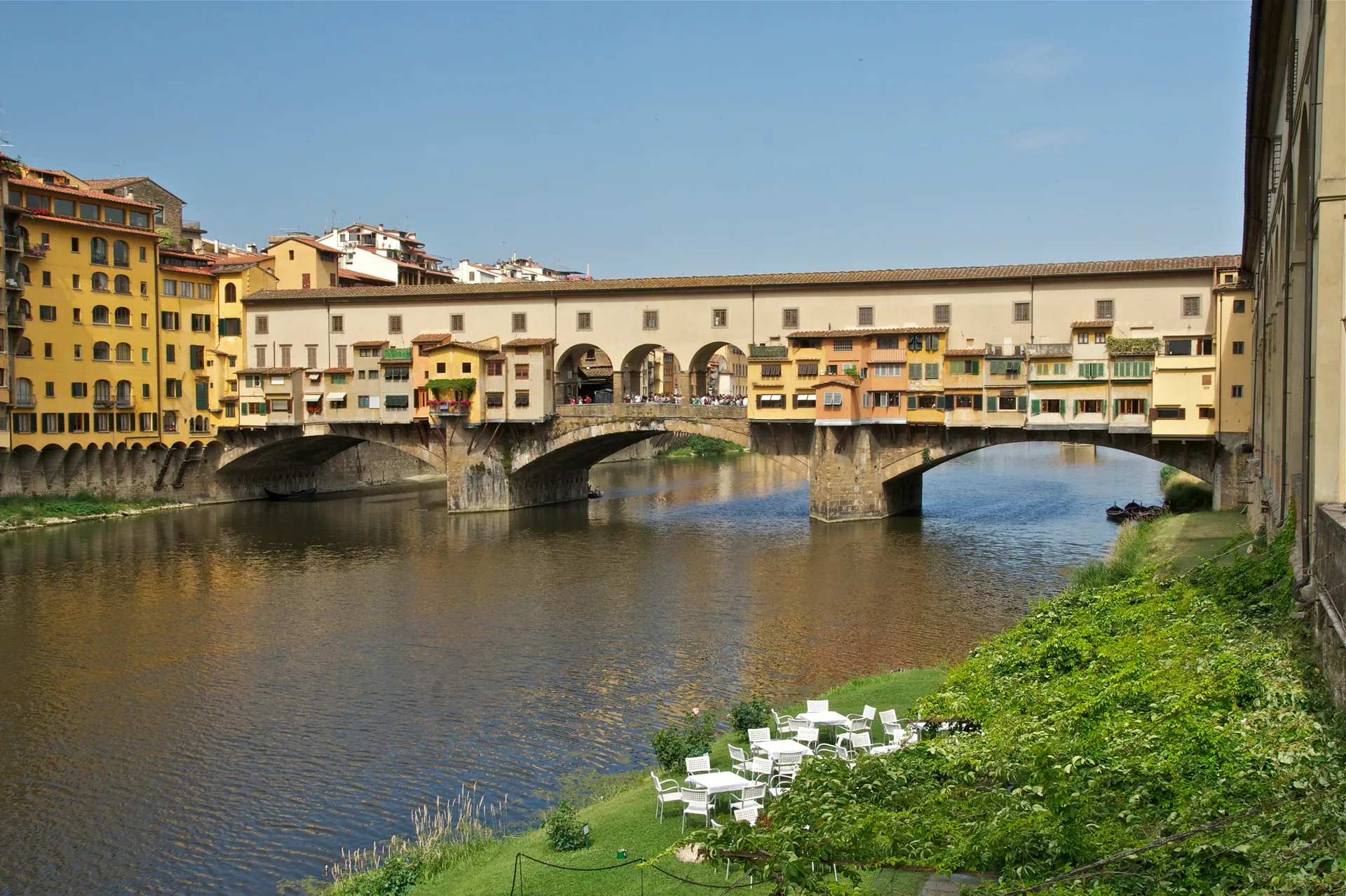
If you have longer for the collections, a two-day Florence itinerary lets the Accademia and Uffizi sit on separate days. Here the afternoon still belongs partly to the river: Ponte Vecchio crosses the Arno with shops built along its sides, making the bridge itself worth seeing rather than treating it solely as a crossing.
Jebulon · CC0 · Edited
Across the river, the broad front of Pitti Palace is the stopping point, not another ticketed interior. Entering the palace or Boboli Gardens would each need a further museum- or garden-length visit, while staying outside preserves the climb to San Miniato and the open view above the city. The palace’s scale is still clear from the square in front of it.
San Miniato, Piazzale Michelangelo and dinner
From the Pitti Palace exterior, the route climbs towards San Miniato al Monte. Its patterned marble façade is worth reaching in its own right, and the interior mosaic gives another reason to step inside when visiting is permitted. The ascent is steep and includes steps, so take a bus or taxi up towards the viewpoint if the climb is unsuitable, then visit the church only if the remaining approach works for you. Services can interrupt visitor access even during the normal opening periods.
- Name
- San Miniato al Monte
- Location
- Above Piazzale Michelangelo, Florence Maps
- Site
- sanminiatoalmonte.it
- Hours
- Mon–Sat 09:30–13:00, 15:30–19:00
- Sun 08:15–13:00, 15:30–19:00
- Typical visit
- 35 minutes
- Essential fact
- Hilltop church reached on the way to the evening viewpoint.
- Price
- Free

Zairon · CC BY 4.0 · Edited
Below the church, Piazzale Michelangelo opens a broad view towards the cathedral dome and the Arno. Late-afternoon light is especially useful for looking back over the centre, though the route’s long pause will meet sunset only at some times of year. In poor weather, shorten the exposed terrace stop and head down for a more sheltered evening in Santo Spirito.

PROPOLI87 · CC BY-SA 4.0 · Edited
Descend to Piazza Santo Spirito, a neighbourhood square with a church frontage and places to eat around it. A sit-down dinner typically costs €30–55 per person, with a simple meal near the lower end and more courses or a steak taking you higher. Bistecca alla fiorentina, the traditional Florentine T-bone steak, is often priced by weight, so establish the portion and total before ordering. Restaurants commonly begin dinner around 19:00–19:30, and the route arrives at the later end of that window. If you have a train to catch, allow a separate journey back to Santa Maria Novella after dinner.
Sources & fact-checking
Checks against the sources below cover: fares and charges, services, opening hours, and closures. Route times and distances were calculated from geolocated stops.
- Uffizi Galleries — fares and charges
- Uffizi Galleries – Rules and Regulations
- Abbazia di San Miniato al Monte — opening hours
- Umbrellas in museums (Rules)
- Galleria dell’Accademia di Firenze e Musei del Bargello (GAMB) — opening hours
- Galleria dell’Accademia di Firenze — closures
- Galleria dell’Accademia di Firenze e Musei del Bargello — fares and charges
- Cathedral of Santa Maria del Fiore | Opera Duomo, Florence | Official Site
- Brunelleschi’s Dome: All the New Entry Rules from March 1, 2025
- Combined ticket for the Uffizi, Pitti Palace and Boboli Gardens
- Piazzale Michelangiolo – Rotonda Barbetti/Stazione FS SMN
- Florence night network map