You can drink New Orleans municipal tap water and use it to brush your teeth outside a boil-water advisory, provided there is no concern about the particular tap or building’s plumbing. An advisory affecting your location changes that answer: use bottled water or properly boiled tap water for consumption.
For a hotel stay, restaurant meal or bottle refill, distinguish the municipal supply from the tap you are using. Ask about the particular tap if you have a plumbing concern, and establish whether an advisory affects your location before using it.
Tap-water safety and water quality
- Routine use
- Drinking and brushing teeth, outside an advisory and subject to tap-specific concerns
- Report period
- 2025 Annual Water Quality Report: 2024 monitoring results
- Compliance
- All listed regulated contaminants met federal quality standards in both systems
- Service area
- Both banks of the Mississippi River: East Bank supplied by Carrollton Water Treatment Plant; West Bank by Algiers Water Treatment Plant
Systemwide compliance does not establish the condition of every individual tap. At your accommodation, take any concern about the particular tap seriously.
The report illustrates that distinction: one East Bank lead sample exceeded the action level, although the system’s overall lead result remained below it. This is not a reason to reject every municipal tap, but it is a reason to take a building-specific concern seriously. At your accommodation, the useful question is whether the particular tap is suitable for drinking, rather than whether the property simply receives city water.
Hotel and rental taps
A hotel or rental tap can supply drinking water under the same ordinary-use conditions as other municipal taps, but the building’s plumbing matters. Older New Orleans buildings may retain lead pipes or fixtures. Lead can enter water through the service line, plumbing or fixtures on its way to your glass, even though there is no detectable lead in water leaving the treatment plants.
If staff cannot resolve a concern about your tap, choose bottled water for drinking and food preparation. A lead-reduction filter is a plumbing precaution, while an advisory brings its own safe-water instructions. A tap that you would normally use still falls under an advisory if its supply is affected.
Precautions at your accommodation
Do
- Use cold tap water for drinking, cooking and making baby formula.
- For lead reduction, use a filter meeting NSF Standard 53.
- Ask accommodation staff whether the particular tap is suitable for drinking.
Don’t
- Use hot tap water for consumption: lead dissolves more easily in it.
- Treat boiling as a way to remove lead: it does not.
- Assume the municipal water-quality result settles a concern about the building’s plumbing.
Restaurant water, ice and bottle refills
Restaurant drinking water must be potable and come from an approved source. Food-service establishments must provide enough suitable water for drinking and food preparation. Ice must also be made from approved-source water and handled hygienically, so its source matters as much as the water in your glass.
Ask staff for drinking water or a bottle refill, and ask where the ice comes from if you are unsure. During an advisory, ask how the restaurant is supplying safe water and ice before accepting them. Refill arrangements depend on the venue, so a request is not a guarantee of a free refill.
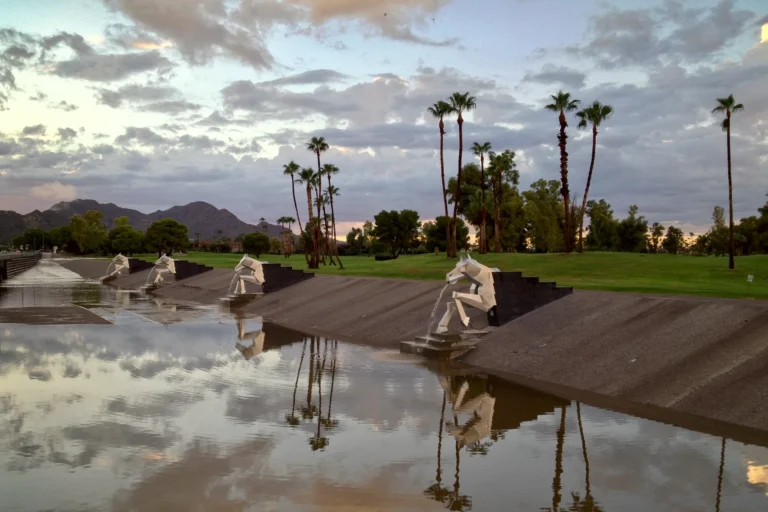
Refill only from a tap intended for drinking or an identified drinking-water fountain. A suitable accommodation tap is another option. An ornamental fountain or other decorative water feature is not a drinking-water source. If the source is unclear, ask staff rather than filling your bottle.
During a boil-water advisory
- Bring tap water to a rolling boil, with large bubbles rising from the bottom to the top of the pot.
- Keep it boiling for at least 1 minute, then turn off the heat and let it cool.
- Store the cooled water in a clean, covered container.
The Sewerage & Water Board of New Orleans (SWBNO) issues precautionary advisories when pressure drops below 20 psi. Notices name affected neighbourhoods or districts and use boundary streets and landmarks to identify the area, with a linked map. Use those large-scale boundaries to establish whether your location is included. Ask accommodation or restaurant staff which supply they use.
SWBNO publishes notices on its Boil Water Advisories page and in press releases. The city’s NOLA Ready incident updates also carry advisories. For NOLA Ready emergency alerts, text NOLAREADY to 77295.
Keep hot water out of children’s reach while it cools, and use a heat-safe container when handling it. At a rental, choose a stable place for cooling away from the edge of a counter.

User:Ragesoss · CC BY-SA 3.0 · Edited
- Discard ice made from affected tap water, including trays, dispensers and ice makers. Make replacement ice with bottled or boiled water.
- Healthy adults may shower or bathe in tap water without swallowing it. Babies and young children should have sponge baths or baths with boiled water. People with open wounds or weakened immune systems should bathe with boiled water. Those with weakened immune systems should also use safe water for handwashing and showering.
- Laundry can be done as usual.
- For dishes, use a dishwasher rinse temperature of 150°F or a sanitise cycle. Alternatively, hand-wash normally, then soak for 1 minute in 1 gallon of water mixed with 1 teaspoon of bleach.
The bathing, laundry and dishwashing exceptions do not make untreated tap water suitable for consumption. Keep your drinking and food-preparation water separate from water used for these permitted household tasks.
When an advisory is lifted
Wait for official cancellation before resuming ordinary tap-water use. Restored pressure starts the clearance process, rather than ending the advisory.
SWBNO collects samples and tests for total coliform bacteria. A positive sample is also tested for E. coli, while a sample with no coliform needs no further testing. Results typically take about 24 hours. Clear results go to the Louisiana Department of Health for concurrence before SWBNO lifts the advisory.
Once your area is officially cleared, normal use can resume, subject to any separate concern about your accommodation’s plumbing.
Sources & fact-checking
Checks against the sources below cover: services.
- Lead Awareness
- Sewerage & Water Board of New Orleans — service
- U.S. Environmental Protection Agency — service
- Sewerage & Water Board of New Orleans (SWBNO), in consultation with the Louisiana Department of Health — service
- Precautionary Boil Water Advisory Canceled for Memorial Park Neighborhood
- Precautionary Boil Water Advisory Issued for Portion of New Orleans East
- Sewerage & Water Board of New Orleans (SWBNO); City of New Orleans (NOLA Ready) — service
- Sewerage & Water Board of New Orleans (SWBNO), in consultation with the Louisiana Department of Health (LDH) — service
- Testing in Progress: Precautionary Boil Water Advisory Issued for Westbank New Orleans
- New Orleans Health Department — service
- Louisiana Department of Health, Office of Public Health — service
- SWBNO Consumer Confidence Report
- Water Purification Process