Lyon rewards a visit that brings together its Renaissance streets, Roman hilltop and food traditions. Old Lyon and Fourvière show different layers of the city, while a traditional restaurant meal gives its culinary reputation something more tangible than a market browse. Beyond that core, you can choose art galleries, silk-workers’ streets or time beside the rivers.
Ten sights and experiences to choose from
| Experience | Adult admission | Visit time | Arrival point | Walk from Place Bellecour |
|---|---|---|---|---|
| 1. Old Lyon | — | — | Place Saint-Jean | about 650 metres |
| 2. Fourvière | Free | 30–45 minutes | Fourvière Basilica | about 2.1 km |
| 3. Roman theatres and museum | Grounds free; museum €4/€7* | 1½–2 hours | Lugdunum complex | about 2 km |
| 4. Les Halles | Free; food extra | — | Les Halles de Lyon Paul Bocuse | about 1.9 km |
| 5. Presqu’île and a bouchon | — | — | Place des Terreaux | about 1.3 km |
| 6. Croix-Rousse | — | — | Cour des Voraces | about 1.8 km |
| 7. Museum of Fine Arts | €8, permanent collection | 1½–2 hours | Museum of Fine Arts | about 1.1 km |
| 8. Parc de la Tête d’Or | — | — | Porte des Enfants du Rhône | about 2.9 km |
| 9. Musée des Confluences | €12 | 2–3 hours | Musée des Confluences | about 3.1 km |
| 10. Saône riverbanks | — | — | Quai Romain Rolland | about 750 metres |
Prioritise Old Lyon, Fourvière and a bouchon meal. Lyon is worth visiting for the combination of Renaissance architecture, Roman remains and the food traditions it is best known for. The entries rank first by how much they reveal of the city’s history and food culture, then offer distinct art and outdoor choices.
Distances end at the named arrival points, but district walks leave you free to explore further. Choose the Museum of Fine Arts, Lugdunum or Musée des Confluences in rain, and outdoor walks in cooler weather.
1. Old Lyon and its hidden passageways
Old Lyon is the strongest introduction to the historic city, with Renaissance buildings, narrow streets and courtyards that reward looking beyond the main façades. Start around Place Saint-Jean, beside the cathedral, then explore the lanes rather than treating the district as a single monument.
Traboules are covered passageways through buildings. La Longue Traboule links a succession of courtyards, and the passage between 27 Rue Saint-Jean and 6 Rue des Trois-Maries gives you another concrete opening into the quarter’s interior. Unlike the public streets, these passages run through occupied residential buildings.
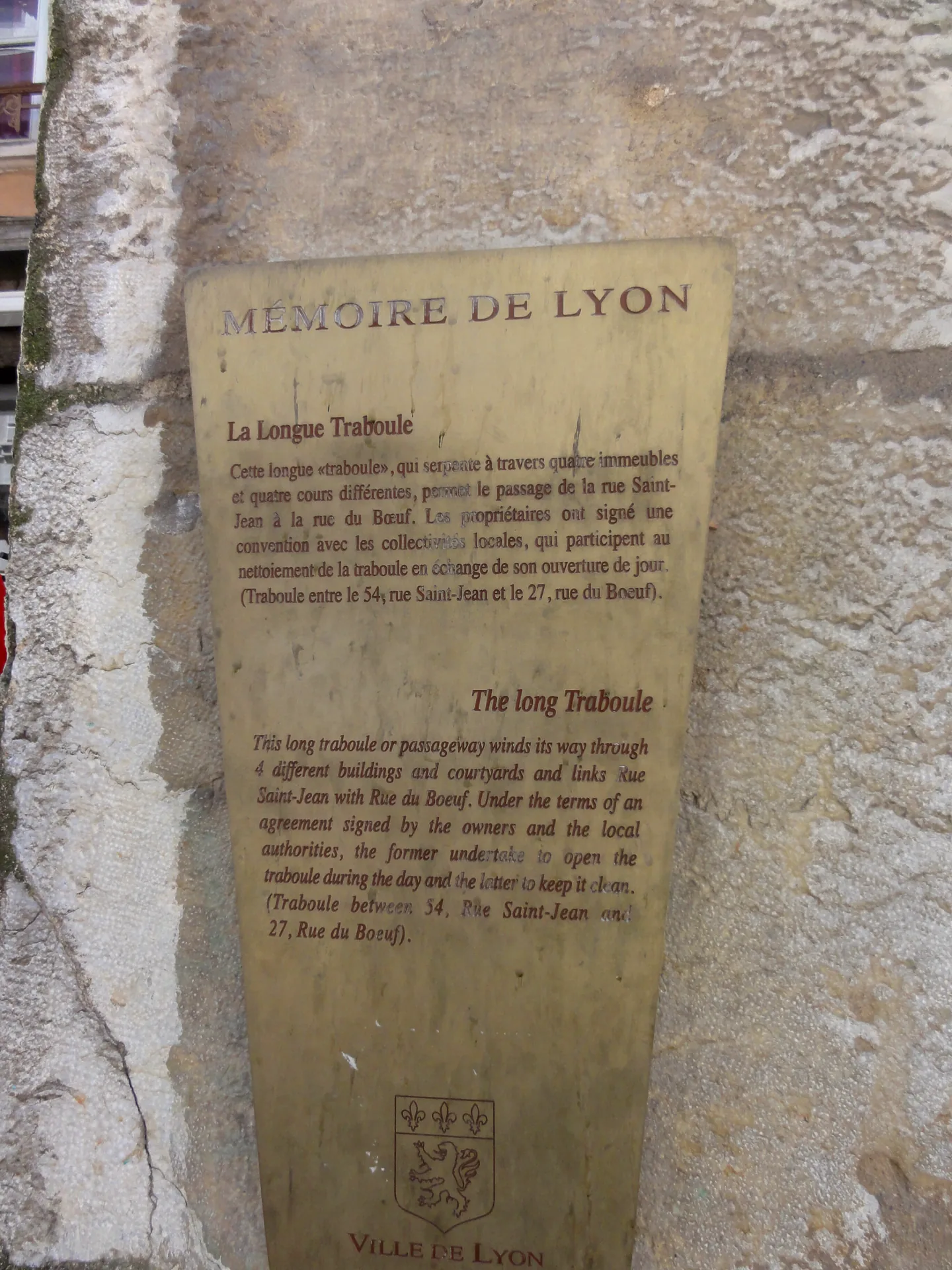
Tusco · CC BY-SA 3.0 · Edited
Both passageways admit independent visitors daily from 07:00–19:00, extending to 20:00 in summer. Keep quiet, wait for an occupied passage to clear and respect residents’ privacy and cleanliness. An earlier walk also gives you a better chance of exploring the lanes without the busiest crowds.
Fourvière makes a natural nearby pairing if you want to see the old quarter from above as well as at street level. Leave energy for the uphill approach, or use the funicular rather than turning your passageway walk into a strenuous climb.
2. Fourvière Basilica and the city view
Fourvière Basilica rewards close attention to its mosaics, stained glass and marble decoration. Look up as well as along the nave: the richness of the interior is a reason to linger before heading outside. On a clear day, the esplanade helps you understand the layout of Lyon below.
Take funicular F2 from Vieux Lyon to Fourvière if you want to avoid the climb. Walking up from Old Lyon involves steep ground, so comfortable, grippy shoes are useful, and the ascent is better tackled before peak heat.
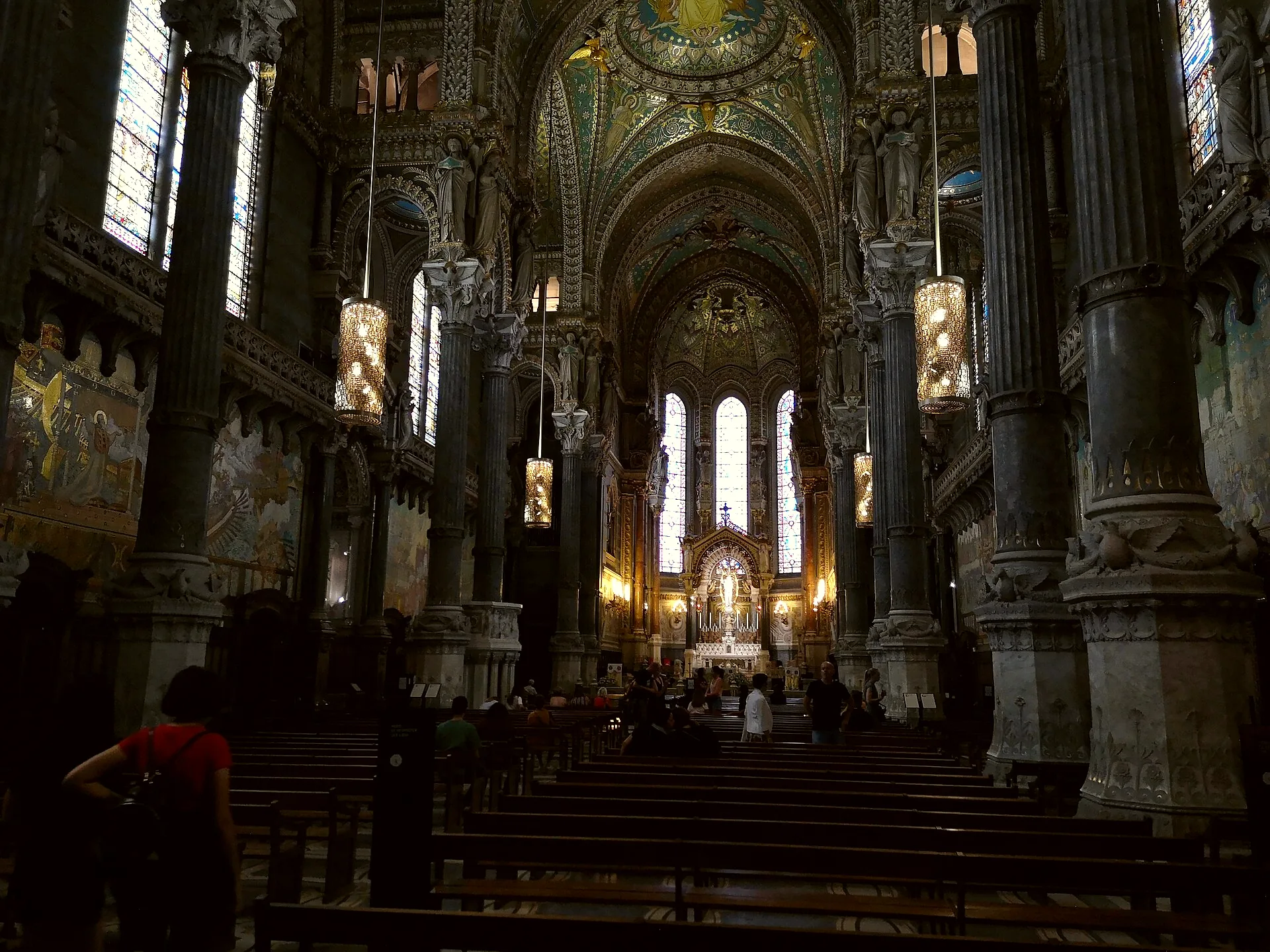
Chabe01 · CC BY-SA 4.0 · Edited
Individual visits need no reservation. Optional paid rooftop experiences are separate from the ordinary basilica visit, so you need not add one to enjoy the interior and esplanade.
- Name
- Fourvière Basilica
- Location
- 8 Pl. de Fourvière, Lyon Maps
- Site
- fourviere.org
- Hours
- Mon–Sat 07:00–20:00
- Sun 07:00–21:00
- Essential fact
- A hilltop basilica with a decorated interior and an esplanade overlooking Lyon.
3. The Roman theatres and Lugdunum museum
Lugdunum’s ancient theatre and smaller odeon give Roman Lyon a visible shape: you can look across the stepped seating and compare the two performance spaces. The adjoining museum adds mosaics, inscriptions and archaeological objects, turning the ruins into a fuller picture of the city’s Roman life.

Pymouss · CC BY-SA 4.0 · Edited
Combine the outdoor remains with the indoor galleries, particularly if rain interrupts your hilltop visit. Fourvière Basilica is nearby, so these are complementary choices on the same hill rather than separate journeys across Lyon.
The theatre grounds open 07:00–21:00 from 2 May–30 September, and 07:00–19:00 from 1 October–30 April. Ordinary individual museum visits do not require advance booking, but groups and guided tours do. During heatwave alerts, museum opening shifts to 09:00–18:00.
- Name
- Lugdunum Museum and Roman Theatres
- Location
- 17 Rue Cleberg, Lyon Maps
- Site
- lugdunum.grandlyon.com
- Hours
- Mon Closed
- Tue–Fri 11:00–18:00
- Sat–Sun 10:00–18:00
- Essential fact
- A Roman museum and adjoining ancient theatre complex on Fourvière hill.
4. Les Halles de Lyon Paul Bocuse
Les Halles de Lyon Paul Bocuse puts regional food within browsing distance. Look for saucisson, cured sausage, and pink-praline pastries, made with sugar-coated almonds. A morning visit suits comparing stalls and buying something small, while lunch offers a different experience, with time to sit down rather than simply sample.
Keep a market browse separate from your meal budget: anything you buy or eat is an additional expense. Individual traders have their own service arrangements, so the halls’ opening window does not mean every counter serves throughout it.
- Name
- Les Halles de Lyon Paul Bocuse
- Location
- 102 Cr Lafayette F, Lyon Maps
- Site
- halles-de-lyon-paulbocuse.com
- Hours
- Mon–Sat 07:30–19:30
- Sun 07:30–16:00
- Essential fact
- A covered food market in the Part-Dieu area with specialist stalls and places to eat.
- Price
- Free
| Service | Monday–Saturday | Sunday |
|---|---|---|
| Restaurants | 11:30–14:30 | 11:30–15:30 |
| Shellfish sellers | 09:00–22:00 | 09:00–16:00 |
Most shops open 07:30–13:00 on Sundays. La Boulangerie Victoire continues until 15:30, giving you a bakery option after most shops finish.
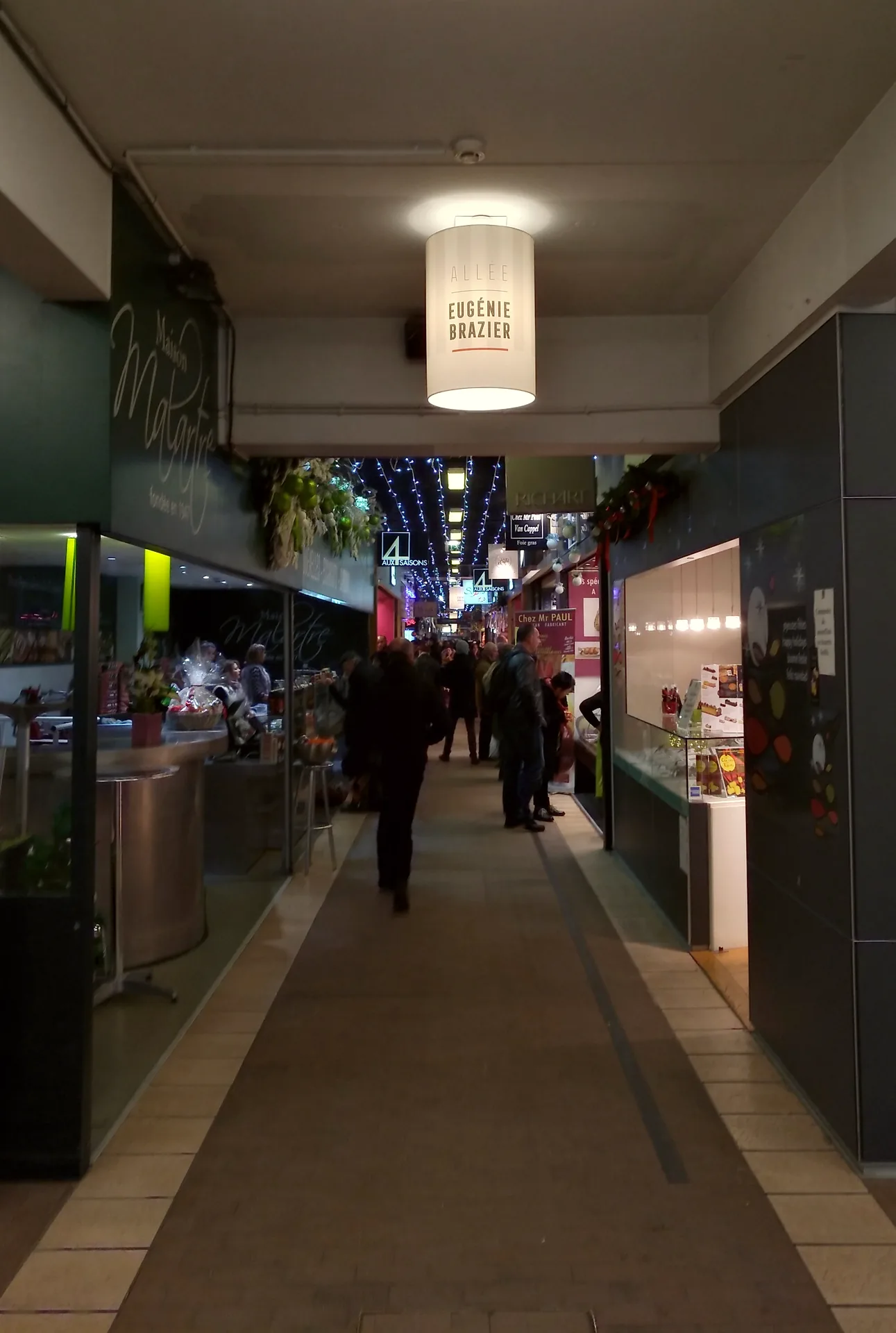
Sebleouf · CC BY-SA 4.0 · Edited
5. Presqu’île squares and a bouchon meal
The Presqu’île is the central peninsula between the Rhône and Saône. Its squares and connecting shopping streets make this a district to explore rather than one attraction to enter.
- Place Bellecour is the broad southern landmark of this central walk.
- Place des Jacobins centres on an ornate fountain.
- Place des Terreaux brings the town hall and Bartholdi fountain into view.
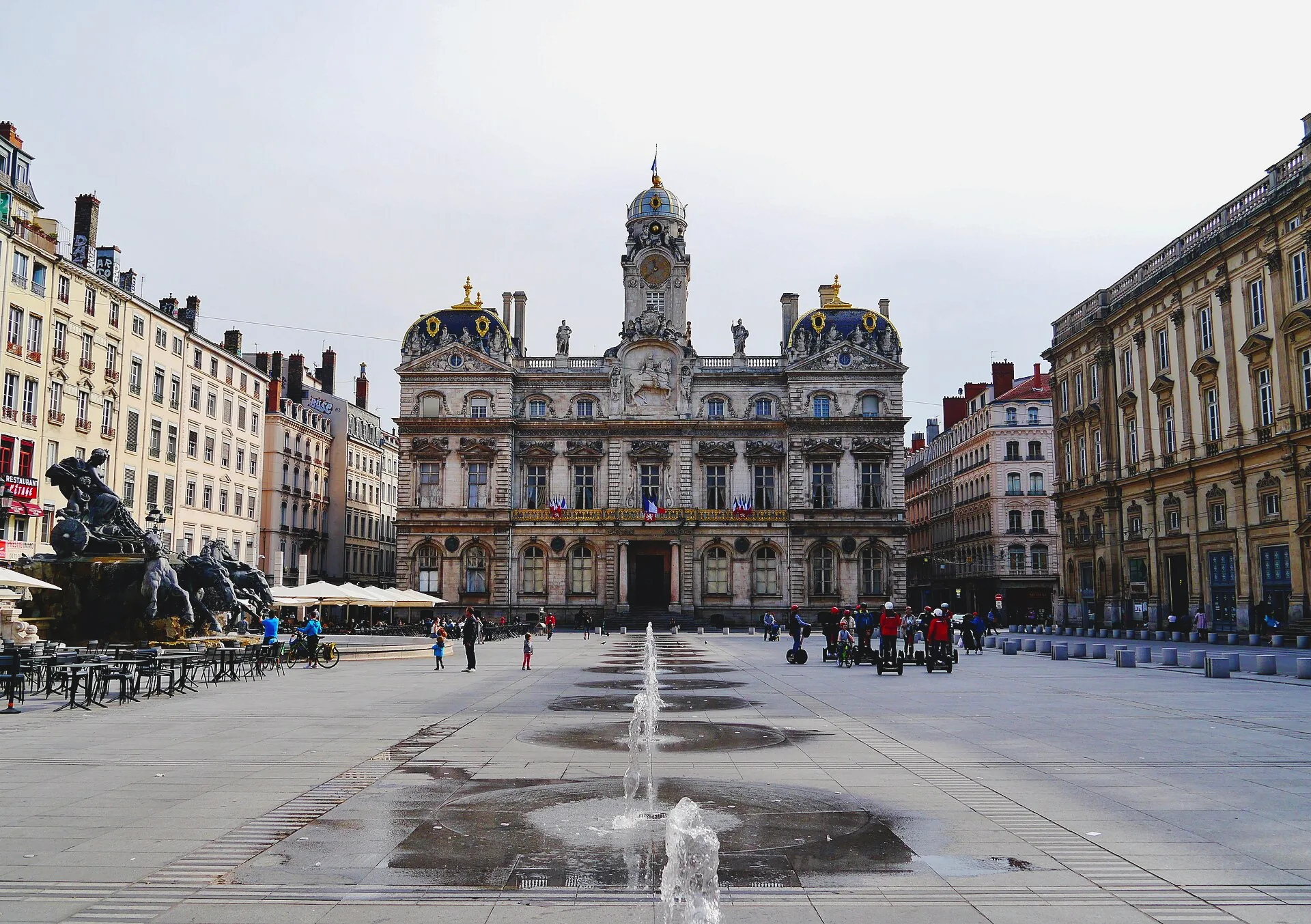
Zairon · CC BY-SA 4.0 · Edited
Make a bouchon meal part of your visit, not a hurried stop between sights. A bouchon is a traditional Lyonnaise restaurant. Quenelles are light dumplings, often made with fish and served with sauce. Salade lyonnaise usually combines salad leaves, bacon, croutons and a poached egg. These give you a more substantial introduction to local cooking than snacks alone.
Allow roughly an hour to an hour and a half for a seated lunch or dinner, longer if you want several courses. Choose by the menu rather than assuming every central restaurant is a bouchon. The Museum of Fine Arts at Terreaux is a separate indoor choice, and you can enjoy the squares without adding a museum visit.
6. Croix-Rousse and the silk-workers’ streets
Croix-Rousse adds the silk-working city to Lyon’s Renaissance and Roman stories. Its slopes contain steep streets, courtyards and tall former workshop buildings associated with the canuts, Lyon’s silk workers. Cour des Voraces is a memorable anchor, with a monumental open staircase that makes the building’s vertical scale clear.

Romainbehar · CC0 · Edited
Independent visitors may enter Cour des Voraces during daytime opening hours. Respect residents’ quiet and privacy, and do not enter when the passage is closed. This is access through a residential building, not a courtyard kept solely for sightseeing.
Place de la Croix-Rousse gives you a broader hilltop setting after the narrower slopes. For another outdoor focus, Mur des Canuts is a large trompe-l’œil mural, using painted perspective to suggest buildings and neighbourhood life.
Wear shoes suited to slopes and steps, and tackle the ascent in a cooler part of the day. The district can be enjoyed through its streets and mural without making a museum visit necessary, but in heavy rain, the Museum of Fine Arts offers a less exposed alternative.
7. The Museum of Fine Arts
The Museum of Fine Arts occupies a former Benedictine abbey, giving the collections an architectural setting of their own. You can move from antiquities to painting and sculpture, but choose a few collection areas that interest you rather than attempting every room. The sculpture garden provides a pause between galleries.
This is the art-focused choice for a rainy spell, and pairs naturally with Place des Terreaux outside. The permanent-collection ticket does not include temporary exhibitions, which require a separate ticket. Advance booking is recommended but is not compulsory for an individual visit.
- Name
- Lyon Museum of Fine Arts
- Location
- 20 Pl. des Terreaux, Lyon Maps
- Site
- mba-lyon.fr
- Hours
- Mon 10:00–18:00
- Tue Closed
- Wed–Thu 10:00–18:00
Show 2 more
Fri 10:30–18:00Sat–Sun 10:00–18:00- Essential fact
- A fine-arts museum beside Place des Terreaux with collections of antiquities, painting and sculpture.
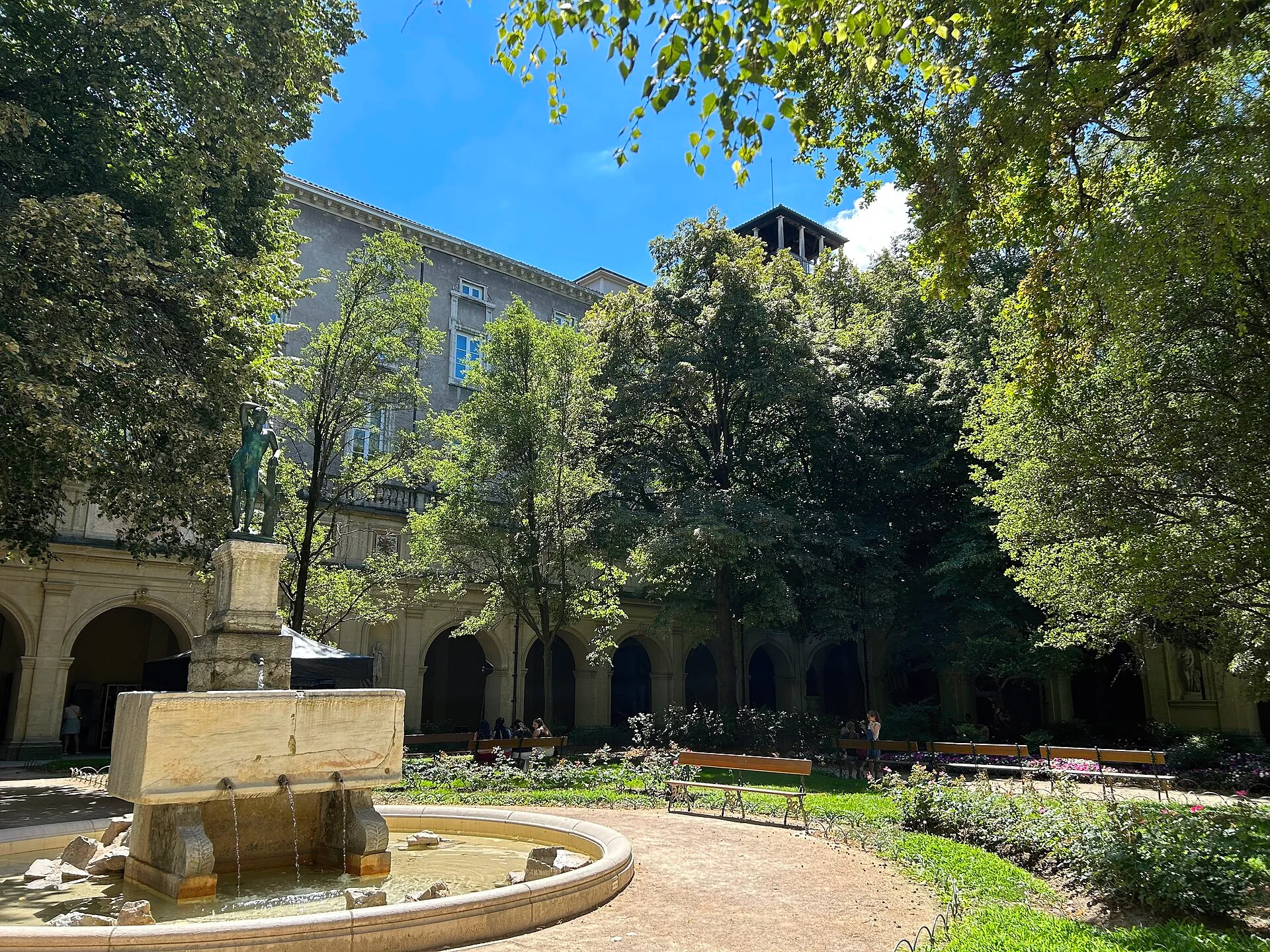
Corentin Eustacchi · CC BY-SA 4.0 · Edited
8. Parc de la Tête d’Or
Parc de la Tête d’Or offers a change of scale from the compact historic quarters. Choose the lake for a longer walk, the botanical garden for plant-focused browsing or the rose garden for a more concentrated outdoor visit. You need not cover every part of the park to enjoy a break here.

Flexikon · CC BY-SA 3.0 · Edited
Porte des Enfants du Rhône is the named entrance for the approach from the centre. From the Presqu’île, buses C1, C4 or C5 head towards the park, with a walking continuation of about 25 minutes (1.8 km) from the stops to this entrance. Lines 38 and 171 also serve the entrance area.
Choose an earlier or later visit in peak heat. A short garden browse is less demanding than a circuit around the lake, but this remains an exposed outdoor choice in rain. Keep your walk flexible rather than trying to match a museum-length visit.
9. Musée des Confluences
Musée des Confluences brings natural history, anthropology and science together through exhibitions about humanity and the world. Its angular glass-and-steel architecture is another reason to make the journey south, away from the historic centre, to the meeting of the Rhône and Saône.

Fred Romero from Paris, France · CC BY 2.0 · Edited
Choose this for broad themes rather than a traditional art collection. Admission includes permanent and temporary exhibitions for one day, and individual visitors do not need advance booking. The first Thursday of each month has a late opening until 22:00.
- Name
- Musée des Confluences
- Location
- 86 Quai Perrache, Lyon Maps
- Site
- museedesconfluences.fr
- Hours
- Mon Closed
- Tue–Sun 10:30–18:30
- Essential fact
- A contemporary museum of natural history and human cultures at the meeting of the Rhône and Saône.
From Bellecour, take bus C10 or 115, about 15 minutes; from Perrache, tram T1 or bus 63, about 10 minutes.
10. The Saône riverbanks
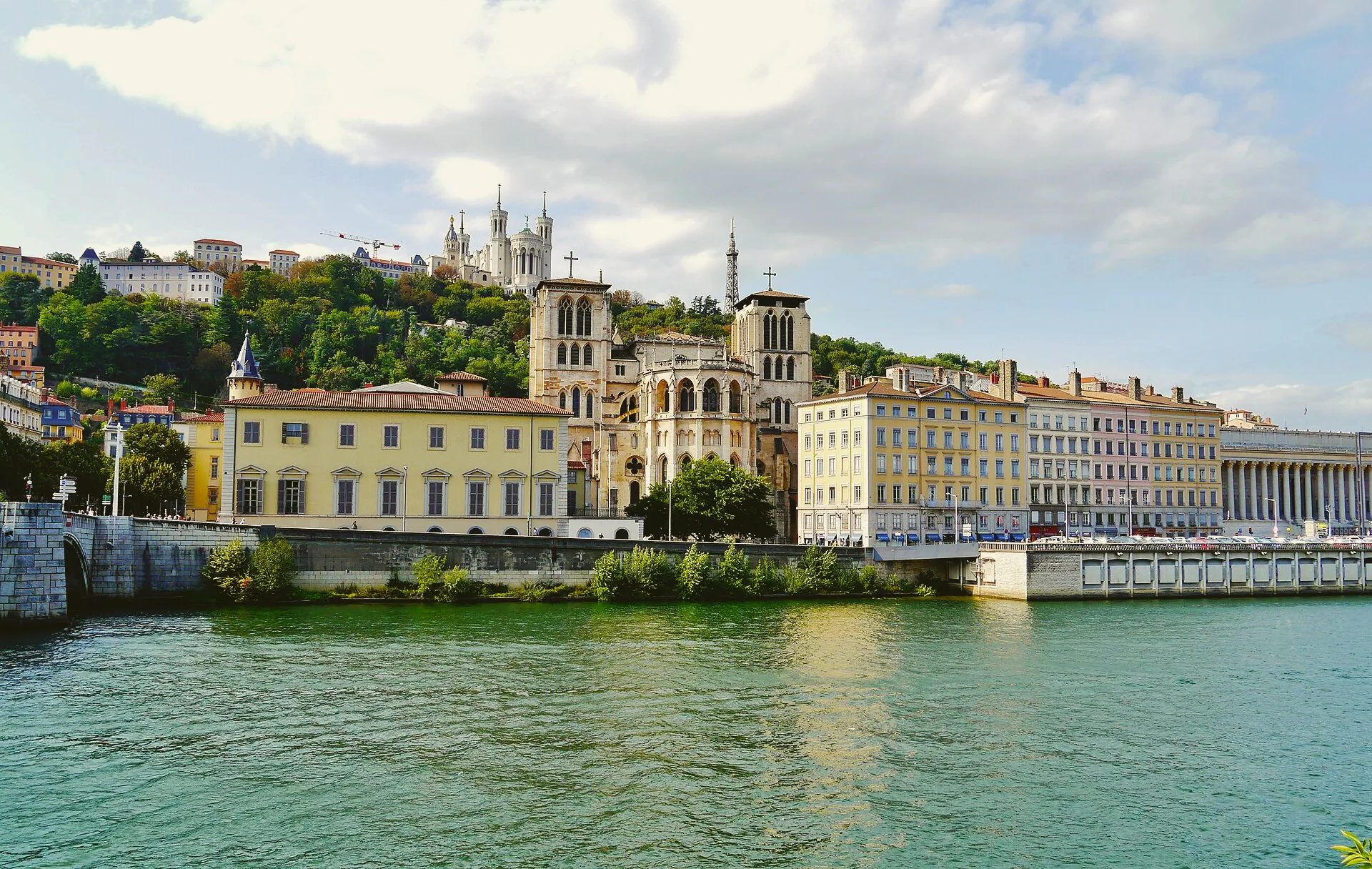
Quai Romain Rolland gives you a riverside view of Old Lyon rather than another passageway to explore. From Passerelle du Palais de Justice, the pedestrian bridge, look between the old quarter and the peninsula. Quai des Célestins offers another bank from which to pause and take in the buildings.
Keep this as a flexible walk around a meal, perhaps in late afternoon. Wear comfortable shoes and shorten the outing in rain or strong heat. Unlike a paid river cruise, the pleasure here is choosing your own viewpoints and stopping when you wish.
Zairon · CC BY-SA 4.0 · Edited
Lugdunum’s free Sunday
Lugdunum museum is free on the first Sunday of each month. Ordinary adult admission is €4 outside temporary-exhibition periods and €7 during them. Choose that recurring Sunday if you want to explore the indoor Roman-history galleries without paying the usual museum admission. It makes a good reason to go beyond the theatre seating and odeon, giving the archaeological objects and stories inside a place in your hilltop visit too.
Sources & fact-checking
Checks against the sources below cover: services, fares and charges, opening hours, and closures.
- Office du Tourisme et des Congrès de la métropole de Lyon — service
- Lyon Tourist Office — service
- Ville de Lyon — service
- Métropole de Lyon — fares and charges
- Lugdunum Museum and Roman theatres (Métropole de Lyon) — fares and charges
- Halles de Lyon Paul Bocuse — fares and charges
- Fondation Fourvière — fares and charges
- Notre-Dame de Fourvière — opening hours
- Fondation Fourvière — service
- Musée des Beaux-Arts de Lyon — fares and charges
- Musée des Beaux-Arts de Lyon — closures
- Musée des Confluences — fares and charges
- Musée des Confluences — opening hours
- Tarif Billet entrée Musée des Confluences – Réductions, Gratuités – Visites, Activités, Spectacles, Pass annuel, Carte cadeau…
- Comment venir ?
- City of Lyon — service