Florence rewards different bases for different reasons. Choose Duomo and Signoria for the simplest first visit, Santa Maria Novella for easy rail and airport-tram arrivals, or Santo Spirito for evenings centred south of the Arno. All three keep the historic centre within walking reach, but they differ sharply once you add luggage, late returns and the price of a double room.
The comparison uses Piazza della Signoria, Piazza di Santa Maria Novella and Piazza Santo Spirito as searchable base points, with the Cathedral of Santa Maria del Fiore as the common sightseeing landmark. Typical prices are for one standard double room per night on a comparable central stay basis, but weekends, major events and peak spring and autumn dates can move them beyond these ranges.
Duomo, Santa Maria Novella or Santo Spirito?
| Criterion | Duomo and Signoria | Santa Maria Novella | Santo Spirito |
|---|---|---|---|
| Typical nightly room | €180–€320 | €140–€250 | €130–€230 |
| Walk to Duomo | About 350 metres; about 5 minutesBest | About 500 metres; about 7 minutes | About 1.2 km; about 16 minutes |
| Walk to SMN station | About 1.2 km; about 16 minutes | About 550 metres; about 7 minutesBest | About 1.5 km; about 20 minutes |
| Useful evening transport | Central buses at core edges | Trams, buses and trains | Bus links to centre and station |
| Street character | Monumental, busiest by day | Mixed station and historic quarter | Neighbourhood-led Oltrarno |
| Best for | First-time sightseeing | Rail trips and luggage | Local evening life |
| Main drawback | Crowds and car restrictions | Transport activity near station | Longer walks and river crossing |
For most first-time visitors, Duomo and Signoria is the best all-round location because the headline sights require almost no transport planning. Santa Maria Novella gives up little sightseeing convenience while making arrival much easier. Santo Spirito is the deliberate alternative: its longer crossings buy a base where dinner and the late part of the day need not revolve around the cathedral streets.
The price overlap matters. A well-priced Santo Spirito room can cost as much as an entry-level room near the Duomo, so treat the ranges as a way to set expectations rather than a promise for a particular date. Compare addresses as well as area names: “Santa Maria Novella” can stretch westwards, while “Duomo” may be used loosely for much of the centre.
Duomo and Signoria
Staying between the cathedral and Piazza della Signoria puts Florence’s densest group of major sights at your door. The Uffizi, Palazzo Vecchio, Ponte Vecchio and the cathedral complex can be joined into a day on foot without planning around public transport. This is the strongest base when your priority is to step out early, return between visits and keep a first trip simple.
Staying in Duomo and Signoria
Pros
- Best fit for a first visit focused on the cathedral, Uffizi and Palazzo Vecchio
- Easy to return to your room between timed visits
- Lively pedestrian approaches make late returns straightforward to navigate
Cons
- Reject it if quiet streets matter more than immediate sightseeing access
- Daytime visitor traffic is intense around the cathedral and Piazza della Signoria
- Drivers face restricted access and a less convenient station transfer
Piazza della Signoria remains an active public space after dark, with illuminated façades and people moving between the Uffizi side, Via dei Calzaiuoli and the Ponte Vecchio approaches. The practical drawback is not an empty centre but persistent activity: rooms directly over the square or a main pedestrian route may suit a late schedule better than an early night. Side streets can change character quickly, so the precise address matters.

Txllxt TxllxT · CC BY-SA 4.0 · Edited
Walking is usually faster within the pedestrian core. At its edges, buses are the useful motorised option: central routes C1, C2, C3 and C4 continue beyond 22:00. C1 is strengthened every day from 22:00 to 02:00, every 15 minutes, linking the Duomo and nearby Piazza San Firenze with San Marco, San Lorenzo and the river. Trams serve outer interchanges rather than these central streets.
Drivers should arrange access before entering rather than assuming a room reservation opens the cameras automatically. Accommodation can register a qualifying transit retroactively for the preceding three hours, and permitted unloading near the property is limited to 30 minutes where stopping is allowed. If you want to leave the car outside the controlled centre, plan Florence parking outside the restricted zone and continue on foot or by public transport.
Accommodation demand is usually strongest here, especially for rooms with recognisable views or addresses immediately beside the main monuments. Reject the area if you would resent paying that premium for a location you mostly use at breakfast and bedtime. Santa Maria Novella preserves short walks, while Santo Spirito gives the evening itself a more neighbourhood-led focus.
Santa Maria Novella
Santa Maria Novella works best when the station is part of the trip rather than merely the place you arrive. Focus the search around Piazza di Santa Maria Novella and the streets between the square and the station, not the entire western centre. Choose it for an easy luggage arrival, early train departures or day trips, without giving up a walkable historic centre.
Staying around Piazza di Santa Maria Novella
Pros
- Best fit for travellers arriving by train or airport tram with luggage
- Direct access to both tram lines and a wide choice of evening buses
- The cathedral and central sights remain comfortably walkable
Cons
- The station approaches feel more functional and traffic-heavy than the cathedral quarter
- Reject it if a picturesque doorstep matters more than transport convenience
- Addresses west of the station can be less convenient for the main sights than the area label suggests
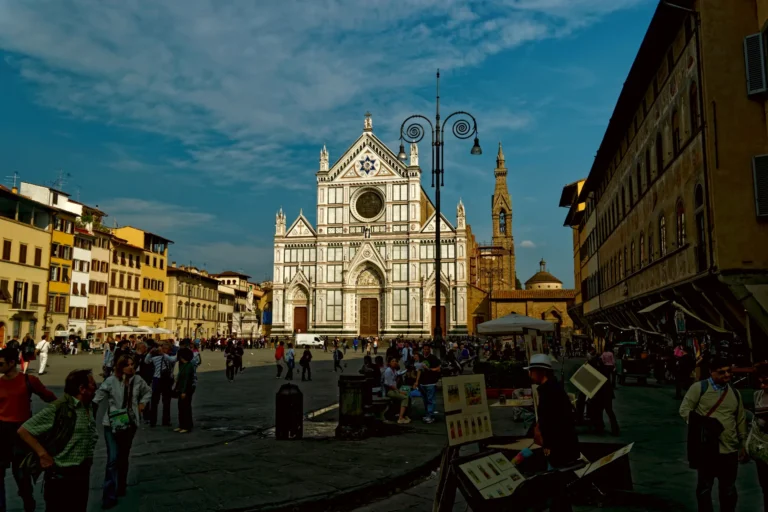
Piazza di Santa Maria Novella itself is broad, pedestrian-friendly and anchored by the church façade rather than the station. After dark, it is a more recognisable reference point than an address facing the transport forecourt. The principal station approaches remain active with passengers, buses and taxis. With luggage, follow the direct main route between the station and piazza rather than looking for a quieter shortcut through smaller streets.

Zairon · CC BY 4.0 · Edited
The area’s advantage is choice. T1 runs towards Scandicci and Careggi, while T2 connects Peretola Airport and San Marco. Both serve stops beside Firenze Santa Maria Novella. Local buses 17, 18, 23 and C1 are among the useful evening links, and trains continue to make this the natural base for regional day trips. The result is flexibility if dinner, an arrival delay or an early departure shifts your day.
Both tram lines operate every evening. Monday to Thursday and on Sundays and public holidays, service continues to around 00:30, while on Friday and Saturday the extension runs to around 02:00. Frequencies generally thin later in the evening. This makes the station area a stronger late-arrival base than relying on a long walk through the centre, though your exact address should still be on the historic-centre side if sightseeing is the priority.
Room prices tend to sit below the Duomo premium on the same dates, but the saving varies most around weekends and events. Reject Santa Maria Novella if you want the city’s most attractive streets immediately outside your door and will barely use the station. It is a practical base rather than a compromise on distance: what you trade away is setting, not access to the centre.
Santo Spirito
Santo Spirito puts you south of the Arno in the Oltrarno, with Piazza Santo Spirito as the centre of daily and evening life. The cathedral and station remain reachable on foot, but every sightseeing day begins with a river crossing. Choose it when you want your base to matter after the museums close, not when the shortest possible walk to each headline sight is the main goal.
Staying around Piazza Santo Spirito
Pros
- Best fit for neighbourhood-centred evenings around a real local square
- Restaurants, bars and small streets give the area a life beyond sightseeing hours
- Night buses connect the Oltrarno with the centre and station
Cons
- Longer walks to the Duomo and station, especially awkward with a hard suitcase
- Reject it for repeated early trains or if uneven paving limits your mobility
- Rooms facing the piazza can pick up late restaurant and bar activity
Piazza Santo Spirito changes through the day and remains a gathering place after dark, when its restaurant terraces and bars draw both visitors and residents. Via Santo Spirito and the approaches towards Ponte Santa Trinita provide legible walking routes back from the river. This is not the choice for guaranteed silence: select a side street rather than a piazza-facing room if an early bedtime matters.

Roberto Dughetti · CC BY-SA 3.0 · Edited
Bus travel is the directly useful public transport. Night line 18 serves Piazza Santo Spirito and links the Oltrarno with Santa Maria Novella, and C3 and C4 also serve the area. The night network operates daily from 22:00 to 02:00. The tram does not enter Santo Spirito, so reaching T1 or T2 still involves walking or changing near the station-side stops.
The direct sightseeing route uses Ponte Vecchio. The bridge has a shallow rise and is essentially step-free, but its stone surface is not perfectly smooth. The narrow cobbled approaches on the south bank make wheeled luggage harder work. Crowds can also slow the crossing. Travellers with limited mobility should favour Santa Maria Novella or verify that a Santo Spirito address avoids steep, uneven approaches.
Accommodation pressure is usually lower than beside the Duomo on comparable dates, although the most appealing streets and piazza views can erase that advantage. The point is not simply to save money: it is to spend the evening close to where you are staying. Use Florence dishes to try in the evening to turn that neighbourhood advantage into an actual dinner plan rather than crossing back north by habit.
Which area should you choose?
- First visit focused on major sights: choose Duomo and Signoria. It minimises daily route decisions and makes timed entries easier to combine.
- Train arrival, airport tram or several day trips: choose Santa Maria Novella. It keeps luggage transfers short while retaining quick access to the cathedral quarter.
- Restaurants, bars and a neighbourhood-led evening: choose Santo Spirito. Accept the river crossing as part of each sightseeing day.
- Limited mobility: choose Santa Maria Novella, then favour an address between the station and Piazza di Santa Maria Novella. Santo Spirito’s cobbles and bridge approaches make it the weakest fit of the three.
- Driving: reject Duomo and Signoria unless your accommodation has confirmed ZTL registration. Santa Maria Novella can simplify an onward rail plan, but an outer car park remains preferable to entering the controlled centre.
- Fallback when Duomo prices are too high: choose Santa Maria Novella. From its piazza the Duomo is about 7 minutes away rather than about 5 minutes from Piazza della Signoria, so the fallback costs about 2 extra minutes of walking while typically moving the room budget from €180–€320 to €140–€250.
For a first-time visitor, Duomo and Signoria remains the clearest default. Its value is not that Florence becomes inaccessible elsewhere, but that short returns to your room and changes of plan are easiest. If the central premium would force a poorer room or inconvenient dates, Santa Maria Novella is the sensible substitute because the extra daily walk is small and transport options improve.
Santo Spirito should be an affirmative choice, not a way to describe any cheaper room south of the river. Pick it because you expect to spend evenings around Piazza Santo Spirito and enjoy walking back across the Arno after sightseeing. If early trains, large luggage or reduced mobility shape the trip, its character does not cancel the practical cost.
Once the base is settled, a five-day Florence itinerary for first-time visitors helps test the decision against cathedral visits, the Uffizi and any rail day trips. A schedule heavy on central museums supports Duomo and Signoria, several station departures strengthen the case for Santa Maria Novella, and unhurried evenings make Santo Spirito worthwhile.
Use the exact address for the final check. An area name can cover several blocks, and those blocks decide whether you face a busy square, a station approach or a quieter side street. Choose the area for the dominant need, then choose the street for sleep and luggage.
Sources & fact-checking
Checks against the sources below cover: services.