In Turin, bicerin is a café order worth making time for rather than treating as a quick espresso. Caffè Al Bicerin is its historic reference house, but the drink also appears on other Turin café menus. The traditional café drink and the bottled liqueur called Bicerin are different products, an important distinction when choosing what to order or take home.
Bicerin at a glance
- What it is
- A hot Turin café drink
- When to have it
- Morning or an afternoon treat
- Historic reference house
- Caffè Al Bicerin
Expect to pay roughly €6–€10 for a bicerin, with central and historic cafés tending towards the upper end. It is a treat to sit with rather than the usual small coffee after dinner. If you want something more substantial afterwards, the other foods to try in Turin include local meal and snack choices.
At the counter, order directly from the staff. At an attended table, place your order with the server. Choose counter or table service before ordering, since sitting down can change the price. Menus may show separate counter and table prices, so the setting is part of the choice, not simply where you carry your cup.
For an ordinary espresso, ask for “un caffè”. Typically, allow around €1–€2 at the counter, with table service adding roughly €1–€3. Grand or central cafés can cost more. That café table-service pricing is different from a restaurant’s coperto, meaning cover charge: it is generally a higher price for the drink served at your seat, rather than a restaurant-style charge for a place setting.
Coffee, chocolate and cream
Bicerin combines espresso, drinking chocolate and whole milk or cream. Coffee brings bitterness, chocolate brings sweetness, and the dairy gives the drink its richness. Compared with a milky coffee, the chocolate is a much more prominent part of the taste, while compared with drinking chocolate, the espresso adds a sharper coffee edge. Choose it when you want both coffee and something sweet in the same glass.
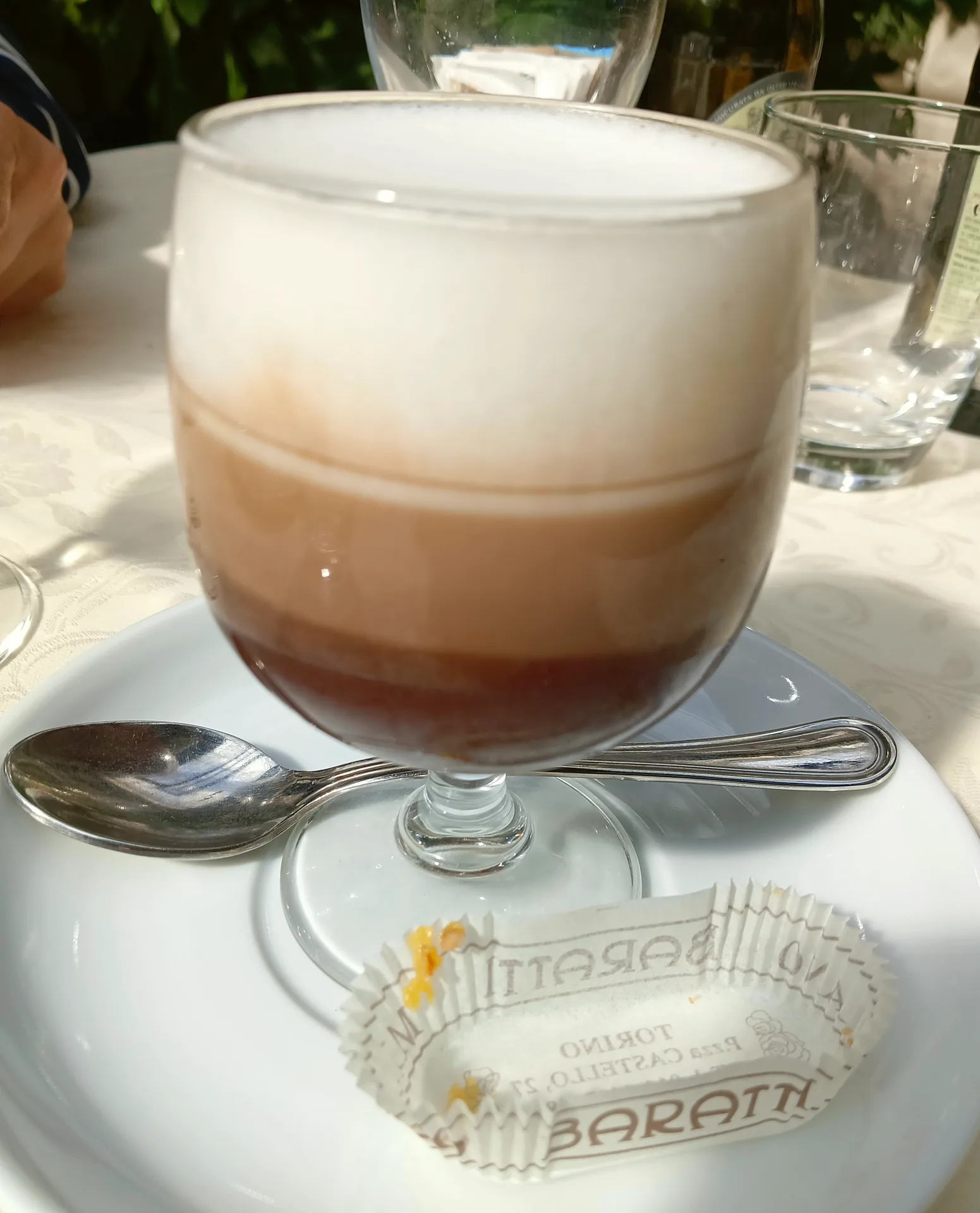
The presentation is part of its character: a small stemless glass shows the ingredients in distinct layers. That visible separation is a useful cue when you see a bicerin being served before you order.
Gartxoak · CC BY-SA 4.0 · Edited
Traditional café bicerin contains no alcohol, but it does contain dairy. If you avoid milk, the traditional recipe is not a suitable choice. Its creaminess is an ingredient, not merely a description of the texture.
Vincenzi’s bottled Bicerin is instead an alcoholic liqueur with plant-based cream, cocoa and hazelnut. Its flavour is gianduja, meaning chocolate and hazelnut. It belongs to the liqueur shelf rather than being a bottled version of the hot café order. The shared name does not make the two interchangeable.
Ordering and drinking bicerin
Say “bee-cheh-REEN”, with the stress on the final syllable. Bicerin is a Piedmontese word meaning “small glass”, rather than standard Italian for a kind of coffee. The name refers to the vessel and, by extension, the drink served in it.
A simple request is “Un bicerin, per favore”, meaning “A bicerin, please”. You do not need a longer description of the recipe to order the traditional drink in a Turin café. Look for it on the menu of a café or coffee bar, including historic cafés. It is not exclusive to its namesake house.
Caffè Al Bicerin’s advice is to leave the drink unstirred and sip it as served. This lets you experience the layers and their flavours in sequence, instead of turning them into a single mixture. Resist the usual coffee habit of reaching straight for the spoon: the way you drink it is part of what distinguishes the order. Take your time with the glass rather than drinking it as quickly as an espresso.
Bavareisa and Caffè Al Bicerin
Bavareisa, an older Turin drink of coffee, chocolate and milk or cream, is bicerin’s predecessor. It was served mixed in a large shared glass. During the 18th century, it developed into the individual layered drink: the change was not simply a new name, but a different way of serving and drinking the ingredients.
Caffè Al Bicerin, established in 1763, is traditionally credited with creating bicerin. The café’s long-standing association with the drink makes it the historic reference house, but the attribution is a tradition, not a documented moment of invention. Bavareisa places that association within a longer history of Turin’s coffee-and-chocolate drinks.
The café faces the Consolata sanctuary on Piazza della Consolata and still serves traditional bicerin. That makes it a natural café stop if you want the drink in the setting most closely associated with its history, rather than merely seeing the name on a bottle. Expect a mid-priced café rather than a budget espresso stop. You can make the drink itself the reason to pause in the square, before or after visiting the sanctuary.
- Name
- Caffè Al Bicerin
- Location
- Piazza della Consolata 5, Turin Maps
- Site
- bicerin.it
- Hours
- Mon–Tue 09:00–19:15
- Wed Closed
- Thu–Sun 09:00–19:15
- Essential fact
- A historic café at Piazza della Consolata 5 in Turin.
- Price range
- €€
Sources & fact-checking
Checks against the sources below cover: key figures.