Leave the car parked for a centre-focused stay in Seville. Drive to a chosen hotel entrance or public garage rather than between sights: central street-access controls are separate from the low-emission rules in Cartuja. For Cartuja, your vehicle’s Spanish environmental category and the recurring restriction window determine whether you can enter without an exception.
Historic centre and Triana access
- Historic-centre perimeter roads
- Excluded from the restricted-traffic area
- Historic Triana controls
- Active; authorisation-based access
- Triana boundary roads
- Excluded except Betis, which is included
- Triana enforcement
- Entry and exit cameras with automatic number-plate recognition
- Triana hotel guests with hotel parking
- Unlimited access under the hotel-guest exception
- Triana hotel guests without hotel parking
- Check-in and check-out access arranged by the establishment
The historic centre’s restricted-traffic area, Casco Antiguo, covers the streets inland from the river between the Paseo de las Delicias–Paseo de Colón–Torneo riverside corridor and the main-road ring around its northern, eastern and southern edges. Driving along a boundary road is not the same as permission to turn into the restricted streets. Choose a destination with an appropriate vehicle approach before leaving that corridor.
Across the river, historic Triana’s controlled area lies around Plaza del Altozano and Plaza de Cuba, extending inland towards Pagés del Corro. If you are staying here, have the establishment arrange the applicable hotel access, rather than treating your room reservation as authorisation.
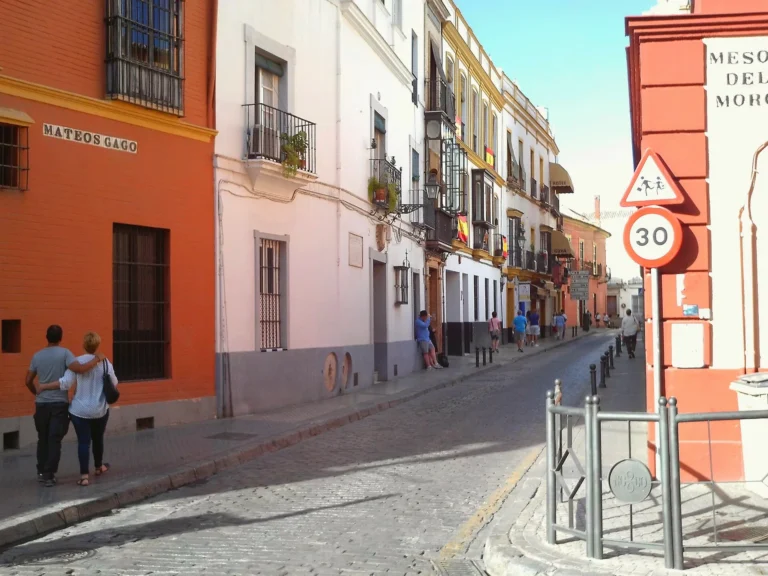
Driving in Seville is most demanding in the historic centre’s dense network of narrow, often one-way streets. Some streets are too tight for through traffic, so a route that looks short on a screen can be unsuitable for a car. Follow the signed direction of travel and aim for your garage or hotel entrance, not the nearest point to a monument. Calle Mateos Gago is one of the historic streets near the cathedral. Approaching this part of the centre on foot avoids using its street network as a driving shortcut.
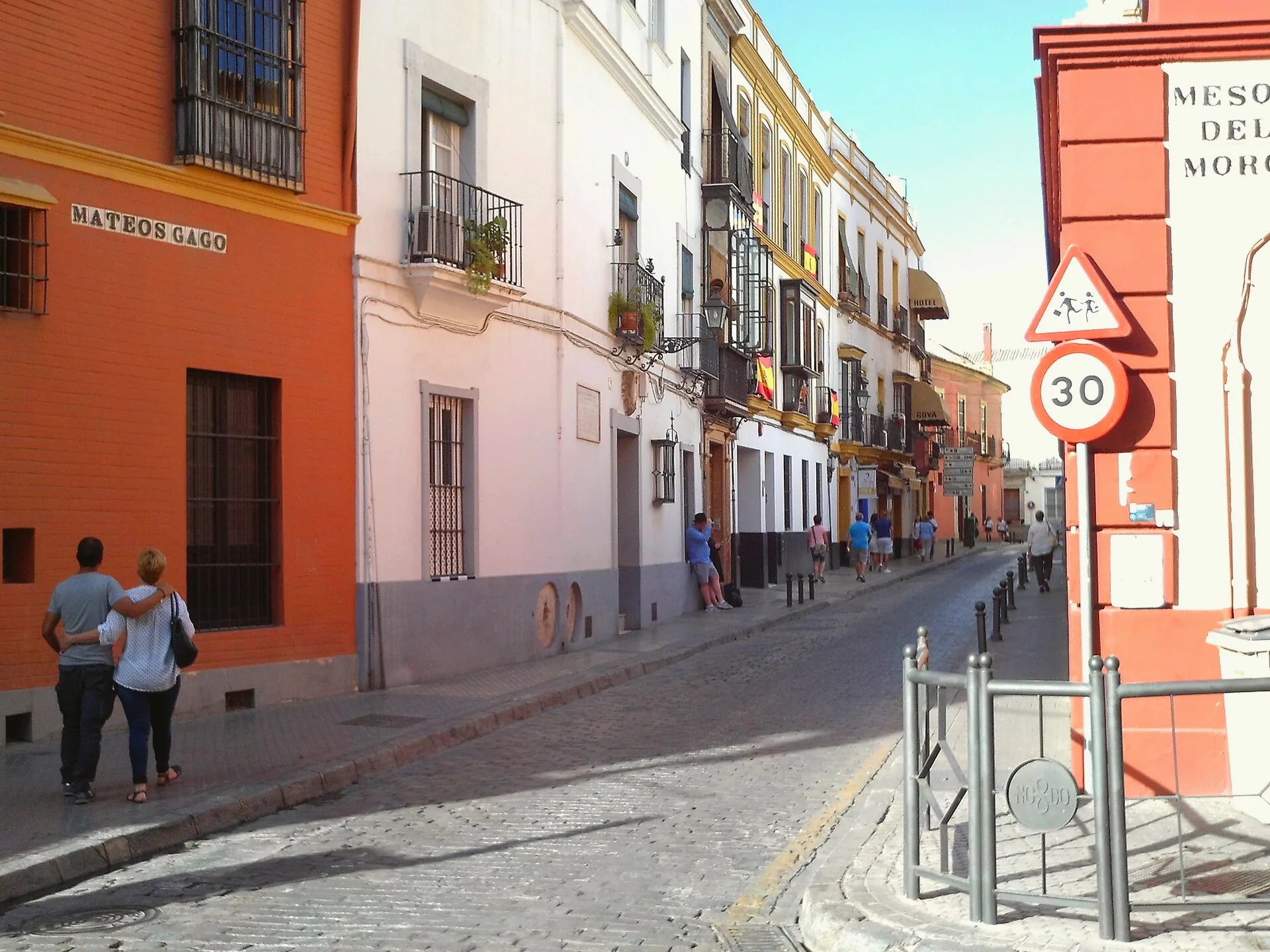
CarlosVdeHabsburgo · CC BY-SA 4.0 · Edited
Cartuja low-emission zones
- Zones
- Cartuja North and South: inner technology-park areas east of Avenida de Carlos III towards the river
- Division and northern extent
- Marie Curie separates the zones; the northern area extends towards the SE-30
- Excluded roads and parking
- Perimeter roads; west-side parking areas and their access roads
- Restriction window
- Monday–Friday, 07:00–19:00, excluding public holidays
- Outside the window
- Any vehicle may enter, circulate and park
- Permitted Spanish environmental labels
- B, C, ECO and Zero Emissions; no prior registration required
Cartuja’s low-emission zones regulate environmental eligibility, not the central street-access permissions described above. The Spanish term is zona de bajas emisiones (low-emission zone), abbreviated ZBE on signs. A vehicle without an eligible label needs an applicable exception to enter during restricted hours. Automatic image-capture cameras monitor access.
For an otherwise restricted private car, actual use of a qualifying public short-stay car park can authorise entry automatically. The exception covers qualifying public rotating car parks inside or around the zones. You must use the parking on a pay-per-minute basis or with a parking subscription: the entry cameras match your registration plate with the plate recorded by the car park. No prior application is needed for this exception, but merely driving towards a garage is not the qualifying parking use.
A vehicle specifically adapted for a person with reduced mobility can also qualify, but the required prior registration or authorisation must be in place. This is a different route to permission from the automatic car-park matching. Motorcycles and mopeds in the qualifying categories are also exempt. Use the exception that fits your vehicle and purpose, rather than assuming a central hotel-access arrangement also covers Cartuja.
Preparing a hotel or garage arrival
- Choose the exact hotel or garage destination before driving into the centre.
- Ask for its vehicle entrance and recommended approach, which may differ from the pedestrian address.
- Arrange any applicable access with the establishment, and follow the signed direction of travel.
Keep the entrance instructions available before setting off. If your approach is blocked, use visitor-accessible parking instead and continue without the car.
Do
- Stop safely before entering at a prohibitory sign or closed barrier.
- Follow police diversions, even when they take you away from your planned entrance.
Don’t
- Treat a reservation as permission to cross a restricted entry.
- Follow a navigation instruction against roadside controls.
Paseo de Colón parking and the walk into the centre
Paseo de Colón car park accepts visiting private cars as a public short-stay garage. It gives you a destination for the car before continuing towards the cathedral area on foot, rather than threading through the historic streets. Vehicle entry and exit are available 24 hours a day, every day.
The hourly indicative tariff is €2.70. The shorter-stay prices appear below. Only the tariff displayed at the entrance applies, so use that rate when deciding whether to leave the car for a brief visit or a longer stay.
- Name
- Paseo de Colón car park
- Location
- P.º de Cristóbal Colón 10, Casco Antiguo, Sevilla Maps
- Essential fact
- A car park on Paseo de Colón, beside the historic centre.
- Price
- €0.65 15 minutes
- €1.35 30 minutes
- €2 45 minutes
Show 1 more
€2.70/hour
From the garage, the walk to Puerta de Jerez is about 950 metres, about 13 minutes. Puerta de Jerez puts you at the southern edge of the central sightseeing area, where you can continue on foot towards the cathedral and Alcázar.
For a centre-focused stay, hiring a car mainly adds parking and arrival arrangements. Collect a hire car for onward travel outside the city rather than keeping one for central sightseeing. If avoiding garage charges matters more than a close-in arrival, free parking in Seville offers separate alternatives and their onward connections.
Semana Santa and Feria access changes
During Semana Santa (Holy Week), police access controls and street closures change ordinary approaches to the historic centre. Feria de Abril (April Fair) traffic arrangements introduce one-way approaches and reserved lanes around the fair, so your usual route may be unavailable to a private car.
An access authorisation does not guarantee passage through an event closure. Follow police diversions and choose visitor-accessible parking outside the affected streets if your hotel or garage approach is blocked. The municipal Tráfico en Sevilla traffic portal provides traffic incidents and diversion information for these temporary changes.
Sources & fact-checking
Checks against the sources below cover: services, fares and charges, and key figures.
- Seville City Council, Mobility Directorate — service
- Preguntas Frecuentes (FAQ) — Movilidad
- Zona de Bajas Emisiones de Sevilla
- Seville City Council — fares and charges
- Plan especial de Movilidad — Semana Santa
- Plan de Gestión del Tráfico Feria de Abril 2026
- El Ayuntamiento pone en marcha un dispositivo especial de movilidad para recibir la 17.ª etapa de La Vuelta 2026
- Ayuntamiento de Sevilla — key figures
- Parking Paseo de Colón — INDIGO Neo
- Seville City Council, Directorate-General for Mobility — service
- Ayuntamiento de Sevilla, Delegación competente en materia de Movilidad — service
- El Ayuntamiento avanza en el desarrollo del Plan Respira Sevilla con la aprobación definitiva de la delimitación y régimen de autorizaciones para zonas de tráfico restringido de Casco Antiguo y conjunto histórico de Triana
- Italian Highway Code (as administered/published by ACI) — fares and charges