Venice’s historic centre is generally safe for visitors, including women travelling alone, with opportunistic theft the main practical caution rather than an expectation of violent crime. The exposure is greatest during busy sightseeing around Rialto and St Mark’s, and when arriving with luggage or boarding crowded waterbuses. After dark, choosing a recognisable way back and watching canal-side footing matter more than avoiding whole districts.
Visitor safety at a glance
- Visitor verdict
- Generally safe historic-centre visits
- Main risk
- Opportunistic theft in sightseeing crowds and during luggage handling or waterbus boarding
- Immediate danger
- 112
- Non-emergency theft enquiry
- Venice Police Headquarters (Questura di Venezia): +39 041 271 5511
A telephone enquiry helps you arrange where and how to report a theft, but it does not complete the report. Use the emergency contact for urgent danger, not routine paperwork.
National travel advice for Italy provides country-wide context, not a warning that Venice’s historic centre is a no-go area. For an ordinary visit, the useful response is to recognise moments when crowds divide your attention.
Crowds at the station, Rialto and St Mark’s
At Santa Lucia railway station, settle your luggage and valuables before joining the waterbus boarding crowd. Arriving passengers move from the station towards the canal-side pontoons while carrying bags, reading signs and deciding where to queue. That divided attention creates an opportunity for someone who moves close or distracts you.

Armin Kleiner · CC BY-SA 4.0 · Edited
A waterbus, locally a vaporetto, concentrates people at its entrance. Boarding and alighting are the moments to focus on what you are carrying, especially when other passengers compress the queue or you need to manoeuvre a suitcase. Crowded boats are useful transport, not places you need to avoid.
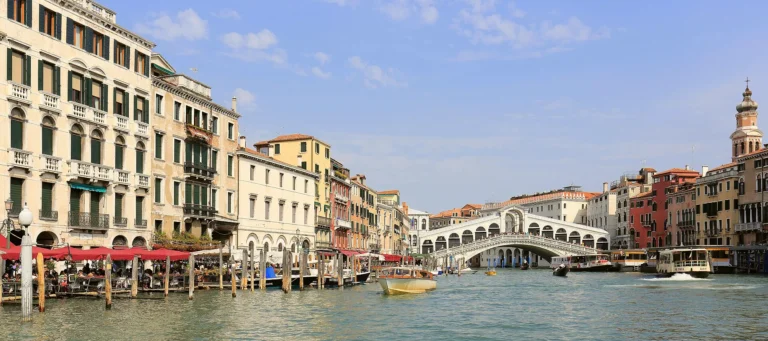
Rialto Bridge funnels pedestrians over the Grand Canal, while St Mark’s Square gathers sightseeing groups and people stopping to look or take photographs. During busy daytime sightseeing, the main walking route from the station towards these sights also brings slow-moving and hurried pedestrians together. Step out of the flow before stopping to consult your phone or reorganise bags, rather than trying to do both in a bottleneck.
Street games, free offers and unclear bills
- Street betting games: an invitation to wager on a major bridge draws you into a money game. Decline participation and leave the gathering. Watching closely is not a reason to join.
- “Free” items: a stranger on a busy tourist route offers or tries to hand you something, then involves you in an exchange. Refuse the item and move away rather than debating what you owe.
- Unclear restaurant bills: a special without a clear price, a dish priced by weight or a seating charge can surprise you at payment. Ask the total or charging basis before ordering, and query an unclear bill against what you agreed.
An openly stated higher price is not itself deception. At a café, table service may cost more than standing at the counter, and the distinction matters before you sit down. For weight-priced food, establish both the price per unit and the portion you are ordering, rather than assuming the displayed figure is the cost of the dish.
If a bill contains an unfamiliar item, ask staff to explain it before paying. Keep the conversation about the order and the stated charges, not whether another café might have been cheaper.
Areas to avoid and places to stay
You do not need a historic-centre no-go list to choose a room in Venice. Choose the approach and return journey you can comfortably manage instead. The historic island’s pedestrian lanes and water transport make arrival different from staying in mainland Mestre, where the final journey may involve a bus or road taxi.
Northern Cannaregio can have quiet passages late in the evening. Dorsoduro has student activity, so parts of it may feel livelier on an evening return. Neither quietness nor activity makes a district automatically safer: consider whether you can recognise the accommodation entrance and reach it without an uncertain detour.
Some visitors find the area around Mestre railway station less comfortable after dark. That is an impression, not a reason to label all Mestre dangerous. A mainland room needs a workable mainland return, rather than a plan that ends when you reach the island’s western transport hub.
Before choosing accommodation, picture carrying your luggage along the arrival route, including bridges on the island. Establish how late entry works and where the entrance is. A recognisable approach and an evening journey that fits the transport you intend to use are more useful than a district’s reputation alone.
Walking and getting back after dark
You can walk around Venice after dark, but favour a recognisable route with continuing foot traffic. From an evening stop, think through the final approach to your accommodation, not just the direction of the district. Quiet passages can be harder to navigate when you are unfamiliar with the turns.
Fondamenta della Misericordia in Cannaregio is a canal-side walkway, an example of how close a walking route can run to the water. Unguarded canal edges deserve attention, particularly when stepping aside for others. Alcohol makes both footing and finding your way less reliable, so stay back from the edge rather than treating it as somewhere to pause.

Wolfgang Moroder · CC BY-SA 3.0 · Edited
ACTV’s night vaporetto Line N offers an overnight alternative to walking. It serves San Zaccaria, Rialto, Ferrovia by Santa Lucia station, Piazzale Roma and Lido S.M.E., with service approximately from 00:00 to 05:00. Choose the stop that leaves you a recognisable final walk.
For a mainland return, night bus N1 connects Piazzale Roma with central Mestre and Mestre railway station. Departures from Piazzale Roma run every half-hour from 00:21 to 04:51. Reaching the bus departure point and getting from your Mestre stop to the room remain part of the evening journey.
A water taxi serves landing stages, while a road taxi serves mainland road addresses. For a licensed water taxi, use a municipal water-taxi rank or call the radio-taxi service on +39 199 48 49 50. Agree the landing point so you know where the final walk begins. For a road-taxi return to Mestre, use the licensed rank at Piazzale Roma. A taxi cannot take you through the historic centre’s pedestrian lanes to an island hotel door.
Solo female travellers
Venice is a workable destination for a woman travelling alone. You can sightsee and eat out without treating solo travel as a reason to restrict the visit. The useful decisions concern arriving independently and ending an evening somewhere from which you can comfortably get back.
For a solo late arrival, agree entry arrangements with your accommodation before setting off: know which entrance to use and how you will get inside if reception is not staffed. When choosing where to spend the evening, consider the return from that place rather than relying on a vague idea that your room is nearby.
If unwanted attention persists, disengage and move towards staffed premises, such as a hotel reception or an open café. Ask staff for help rather than continuing an exchange or heading into a quiet passage to lose someone. Immediate danger calls for the emergency pathway given above.
For support concerning violence or stalking, Italy’s national helpline is 1522. It is free, available 24 hours a day and offers English-language assistance. This is a support service for those situations, distinct from requesting an urgent emergency response.
Bags, phones and café tables
Separate a spare payment method from your everyday wallet, so losing one does not leave you without a way to pay. Keep accessible passport details separately from the original, too. These backups help you deal with a loss without having to reconstruct everything from memory.
At café tables, keep belongings within your control even when you are absorbed in the menu or conversation. A brief stop is still a moment when your attention shifts away from what you are carrying.
Do
- Close your bag and hold it in front of you in a crowd.
- Keep your phone and wallet in concealed, secure pockets.
- Keep your bag beside you or attached to you while sitting at a café.
- Use a cash machine independently and shield your PIN.
Don’t
- Leave valuables in exposed back pockets.
- Put a bag on an empty chair or a phone on the table edge.
- Accept unsolicited help at a cash machine.
If something is stolen or you need help
- Move to a safe, staffed place. For immediate danger, use the emergency contact above.
- Block affected payment cards through their issuer and ask about replacement assistance.
- Arrange a police theft report using the enquiry contact above, and retain the report for insurance and replacement paperwork.
- If your passport is lost or stolen, arrange a replacement travel document before travelling.
The State Police’s Denunce Online portal lets you submit a theft pre-report and book an appointment at a State Police office. The online submission needs in-person formalisation. The Venice Questura’s separate online loss-report service is not the theft-report route.
The Venice Questura reporting desk, Ufficio Denunce, also arranges appointments by telephone on +39 041 271 5586, with calls taken from 08:00 to 10:00 during ordinary opening hours.
British nationals can apply for an emergency travel document if they need to travel urgently within six weeks, their passport is lost or stolen, and they cannot renew or replace it abroad before travelling. You must have held a valid UK passport issued on or after 1 January 2006. Otherwise, eligibility is usually limited to exceptional circumstances involving urgent, unplanned essential travel, assessed case by case.
Applications go through the UK government’s online emergency travel document service. The document is usually valid for one single or return journey through up to five countries. Prepare a valid digital passport photo, telephone number, email address and a debit or credit card for payment.
For a child under 16, both parents or legal guardians must attend the appointment, or the absent parent or guardian must send a signed consent letter. Applicants without a qualifying previous passport must provide evidence of British nationality or eligibility and of the exceptional circumstances.
Sources & fact-checking
Checks against the sources below cover: services, opening hours, and key figures.
- AVM/Actv — service
- ACTV — service
- Comune di Venezia — service
- Municipality of Venice — service
- Department for Equal Opportunities, Presidency of the Council of Ministers — service
- Ministero dell’Interno – Dipartimento della pubblica sicurezza — service
- Questura di Venezia — opening hours
- UK Foreign, Commonwealth & Development Office — service
- UK government (Foreign, Commonwealth & Development Office) — service
- Polizia di Stato — Questura di Venezia — service
- City of Venice (Venezia Unica); Venice Municipal Police for the local operations-center number — key figures