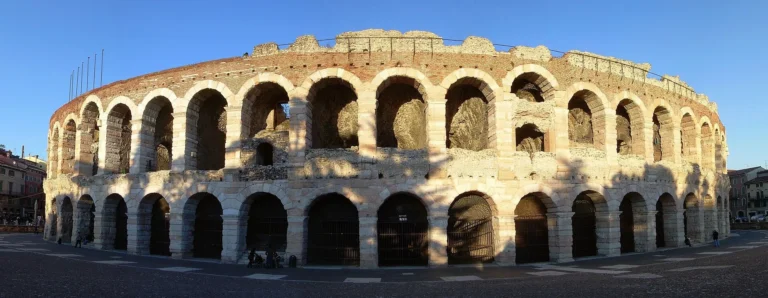
Choose Pompeii for a Roman city’s public buildings and scale. Choose Herculaneum for preserved interiors and a shorter outing. Pompeii’s Forum and Amphitheatre make civic life easier to picture, while Herculaneum’s surviving upper floors and wooden fittings bring you closer to the details of buildings people used.
From Naples, either can be a rewarding single-site day. Your interests and walking stamina matter more than which is called the better site: both involve uneven ancient streets and summer sun. Visiting both is possible, but it means selecting Pompeii’s highlights rather than exploring its full breadth.
Pompeii and Herculaneum at a glance
| Criterion | Pompeii | Herculaneum |
|---|---|---|
| Standard adult core-site admission | €20 per person, Pompeii Express | €16 per personBest |
| Selective visit allowance | Around 2–3 hours | Around 1½–2 hours |
| Fuller visit allowance | Around 4–6 hours | Around 2½–3 hours |
| Walking demands | Broad site; rough paving, stepping stones, slopes and steps | Compact site; irregular stone streets and level changes |
| Summer sun exposure | Largely exposed streets; scattered tree, wall and roofed-interior shade | Open-air streets; shelter mainly in accessible buildings and occasional shaded spots |
Herculaneum costs €4 less per adult for equivalent core-site admission. The visit allowances above are suggested time inside the parks, leaving travel, entry and meals separate. A fuller Pompeii visit gives you room to explore beyond the main public buildings, while a selective visit demands choices.
Herculaneum’s shorter visit reduces time in the sun, not the need to prepare for it. Take water and sun protection, and pause for breaks rather than relying on an open ancient building for a cool-down stop.
Wear sturdy, comfortable shoes at either park. Pompeii’s stepping stones and broad spread add to the effort, while Herculaneum’s smaller footprint still contains rough surfaces and changes of level. Shorter does not mean step-free or easy underfoot.
Pompeii’s public spaces and Herculaneum’s interiors
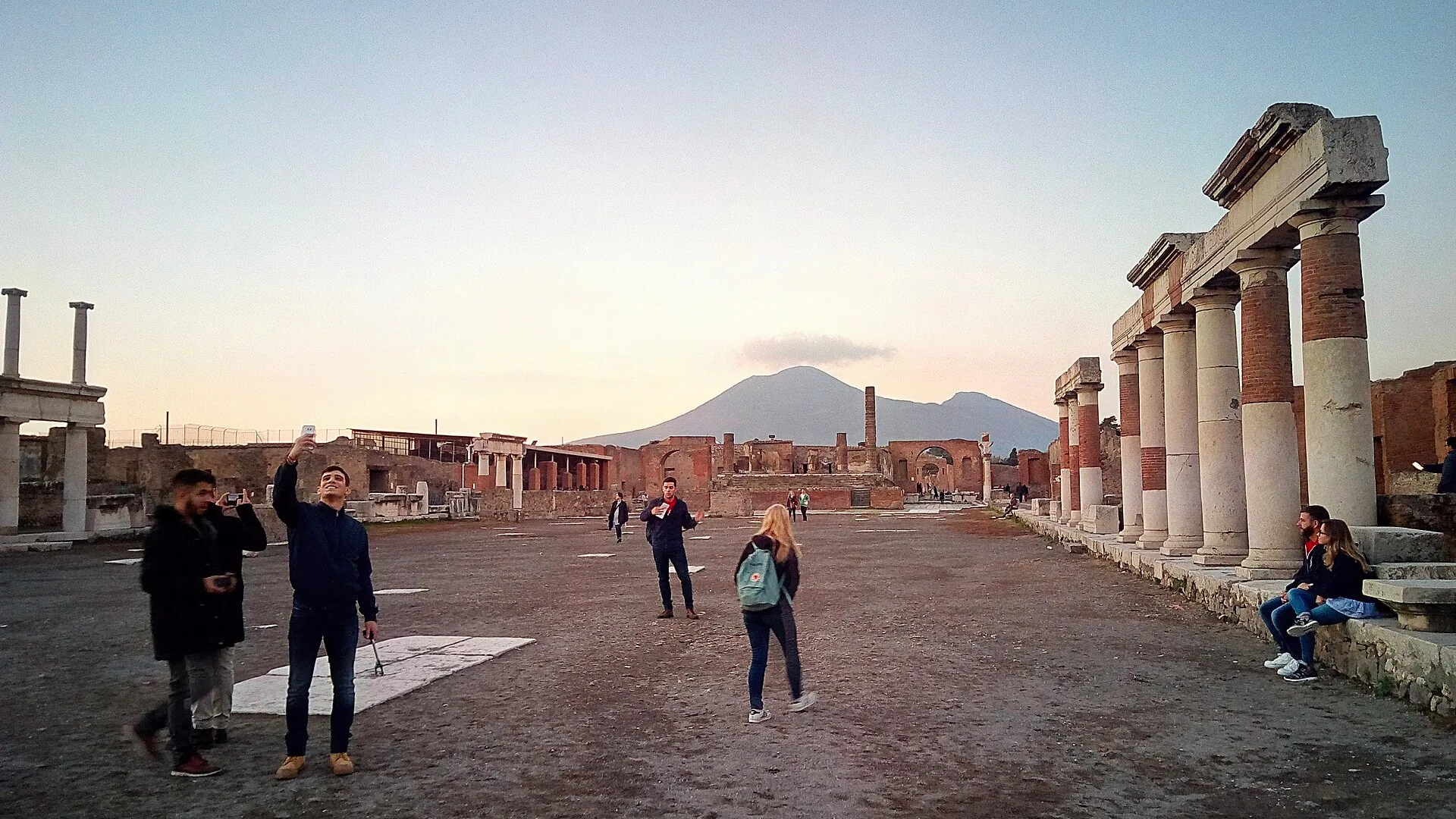
Pompeii’s appeal is the range of activities you can recognise across a whole city. The Forum brings temples and public buildings around a civic square into view. The Amphitheatre shows the scale of public entertainment, quite different from looking into a house. Moving between them makes the city’s extent part of the experience.
Cavaliere Nero · CC BY-SA 4.0 · Edited
The Stabian Baths reveal bathing as a shared urban routine, through spaces for changing and using different bathing rooms. Street-side food counters, often with vessels set into the masonry, give you another way to imagine everyday trade. These are useful contrasts to the monumental spaces: allow time to look at how a building worked, not just its outline.
The Villa of the Mysteries adds a different emphasis on a longer Pompeii visit. Its painted interiors, particularly the large figured frescoes, reward looking closely rather than moving between civic landmarks. Decide whether those paintings are a priority before choosing your ticket, because the core-site product does not include the villa.
Herculaneum is worth visiting in its own right for the survival of buildings beyond their ground-floor walls. Upper floors help you see vertical space, and carbonised wooden beams, doors and fittings preserve materials largely lost at Pompeii. These details make it more than a smaller substitute for the larger city.
The Central Baths combine bathing spaces with surviving decorative detail. The College of the Augustales, a meeting place associated with the imperial cult, adds painted interiors and a public function to the domestic emphasis. Herculaneum is not solely a collection of houses: its appeal lies in reading both rooms and the structures around them.

Mentnafunangann · CC BY-SA 4.0 · Edited
The different burial processes help explain the surviving wood. Herculaneum’s hotter, faster pyroclastic surges carbonised it, then deep volcanic deposits sealed the charred material. Pompeii was buried mainly by pumice and ash fall, which generally did not preserve wood in the same way, so much of its organic material decayed or was lost.
Pompeii
Pros
- A broad range of civic, commercial and domestic buildings makes the workings of a Roman city legible.
- The spread of streets and monumental spaces gives urban scale a central role in the visit.
Cons
- A short visit cannot take in that breadth; you must leave whole areas unexplored.
Herculaneum
Pros
- Surviving upper floors and wooden elements reveal building details often missing from ancient ruins.
- Interiors reward close looking within a concentrated excavated area.
Cons
- The smaller range of monumental public spaces offers less scope for a civic-scale exploration.
At Pompeii, crowds tend to concentrate in late morning and early afternoon, especially in peak season. Herculaneum is often busiest in late morning and around midday, with early morning and later afternoon generally quieter. Arrive early if either site is your only visit, giving yourself more room to pause at popular buildings.
Tickets and entry rules
Pompeii Express covers the core archaeological site, so choose Pompeii+ if the Villa of the Mysteries is part of your visit. Express holders can instead add the suburban villas for €8, paid by card at the route entrance. Choosing the inclusive product from the outset avoids that separate supplement.
Pompeii opens at the same time year-round. Its closing time moves to 17:00 from 15 October to 15 March, while the longer season runs from 16 March to 14 October.
- Name
- Pompeii Archaeological Park
- Location
- Pompei, Campania Maps
- Site
- pompeiisites.org
- Hours
- 09:00–19:00
- Essential fact
- The excavated Roman city of Pompeii, south-east of Naples.
- Price
- €20 Pompeii Express
- €2 Pompeii Express · EU citizens aged 18 to under 25, and qualifying non-EU residents in Italy
- €25 Pompeii+
Show 1 more
€2 Pompeii+ · EU citizens aged 18 to under 25, and qualifying non-EU residents in Italy
Herculaneum’s standard ticket covers its core archaeological area. Its opening time also stays the same year-round, but the park closes at 17:00 from 15 October to 15 March. From 16 March to 14 October, the longer opening window gives a later afternoon visit more room.
- Name
- Herculaneum Archaeological Park
- Location
- Ercolano, Campania Maps
- Site
- ercolano.cultura.gov.it
- Hours
- 08:30–19:30
- Essential fact
- The excavated Roman town of Herculaneum in modern Ercolano, south-east of Naples.
- Price
- €16
- €2 EU visitors aged 18–24 (under 25)
- Free eligible under statutory exemptions
Neither park requires advance reservation for standard admission. Pompeii tickets can be bought in advance to speed up entry, or at the park’s ticket offices. They specify your visit date and time slot. Herculaneum tickets are available online or at the ticket office. On Herculaneum’s free-admission days, online booking is unavailable: collect your free ticket at the ticket office that day.
Use the admission date and Pompeii time slot to shape your departure from Naples. An afternoon arrival needs enough time to look around before the archaeological area empties, not merely enough time to pass the entrance.
Trains from Naples and station walks
Start at Napoli Piazza Garibaldi’s EAV station beside Napoli Centrale, using the Circumvesuviana railway’s Naples–Sorrento line. If you arrive in Naples by mainline train, continue to the adjacent EAV station rather than looking for an archaeological-site train on the mainline platforms.
For Pompeii, get off at Pompei Scavi–Villa dei Misteri. Daytime departures from Napoli Garibaldi run roughly every 36 minutes. From the station to Porta Marina, the walk is about 250 metres and takes about 4 minutes, making this a straightforward approach to the core site.
For Herculaneum, get off at Ercolano Scavi. Choose a departure that stops there: not every Naples–Sorrento train does. Stopping services are less frequent than the Pompeii departures, so the same regular interval cannot guide this journey. The final walk to Herculaneum’s visitor entrance is about 1.1 km and takes about 14 minutes, through modern Ercolano towards the excavations.
Herculaneum’s shorter visit therefore comes with a longer station walk. Allow for that approach when travelling with children or anyone who tires on foot, rather than judging the outing only by time inside the ruins.
If these outings form part of a longer stay, choosing between Naples and Sorrento as a base also depends on whether you want city days or coastal time around your archaeological visits.
Pompeii and Herculaneum in one day
You can visit both in one day: see Pompeii first, have lunch before leaving, then visit Herculaneum. Set off again from Porta Marina after a selective morning visit. This order gives the larger site your freshest attention and lets you compare its public spaces with Herculaneum’s preserved interiors afterwards.
Use the selective visit allowances in the comparison rather than trying to fit two fuller visits together. Start Pompeii at opening, choose your priorities, and finish around lunchtime. Allow roughly 45–60 minutes for lunch before leaving, plus around 20–30 minutes at the station before the afternoon train. Keep the remaining time for an unhurried break rather than another distant Pompeii landmark.
From Porta Marina back to Pompei Scavi–Villa dei Misteri, walk about 250 metres, taking about 3 minutes. EAV’s Circumvesuviana Naples–Sorrento line connects the two stations. On the distinct C.EXP. service, the train journey takes about 20 minutes over about 14 km, but plan the recommended day around the ordinary Circumvesuviana departures above. At Ercolano Scavi, follow the longer station walk through modern Ercolano to Herculaneum’s visitor entrance, as described in the previous section.
The C.EXP. transfer and its two walking legs together take about 38 minutes over about 15 km. Keep lunch and train waiting separate from that travelling time. In the shorter season, the ordinary train connection leaves only a selective Herculaneum visit, bounded by the last-admission and evacuation rules in the ticket section.
The reward is seeing two different forms of preservation close together. The cost is leaving much of Pompeii unexplored, including the depth a villa-focused visit deserves. Choose one park instead if summer heat, limited stamina or an early return matters more than the comparison. Do not make the second site a race to its entrance.
Which site suits your visit?
- Choose Pompeii for public buildings and city scale, especially on a first visit centred on the Forum, baths and Amphitheatre.
- Choose Herculaneum for preserved interiors, upper floors and wooden fittings. It is better for those interests, not universally better.
- With limited time, choose Herculaneum for a concentrated visit, remembering its longer station walk.
- For equivalent adult core-site admission, choose Herculaneum if the €4 saving per person matters to your budget.
- With children who enjoy monumental spaces and can manage a longer walk, choose Pompeii. Let their interests, not age alone, lead.
- For a family preferring a shorter outing, or travellers with limited walking stamina, choose Herculaneum, without expecting smooth or accessible terrain.
- If summer heat is a deciding concern, Herculaneum’s shorter visit reduces exposure. Neither park promises frequent shade.
- Visit both only if you are happy with selective visits and the afternoon connection: Pompeii first, lunch, then Herculaneum.
A satisfying choice leaves you time to stop at the buildings that interest you, rather than treating every excavated street as something to complete.
Sources & fact-checking
Checks against the sources below cover: services, fares and charges, opening hours, and closures.
- La tratta Sorrentina
- Orario Ferrovia – L1 – Napoli-Sorrento valido dal 1° ottobre 2026
- Orario ferrovia L1 Napoli–Sorrento, valido dal 28 marzo 2026
- Orari linee ferroviarie
- Archaeological Park of Pompeii — fares and charges
- Parco Archeologico di Ercolano — fares and charges
- Parco Archeologico di Ercolano — opening hours
- Parco Archeologico di Ercolano — closures
- Archaeological Park of Pompeii — service