Choose summer for a beach-focused stay in Nice, or May–June and September if quieter beaches matter more. Historical daytime air temperatures favour summer beach days, while July and August bring the heaviest crowds. September offers a useful compromise, although summer crowds can linger into its early weeks.
Sea temperature and swimming comfort are a separate decision. A warm afternoon on the Promenade des Anglais does not tell you how the water will feel, or whether conditions allow swimming. Your tolerance, time in the water and the beach’s flags all matter. Plan for enjoyable time ashore as well as a dip, rather than making every beach day depend on a long swim.
Choosing a beach season
- Recommended beach-weather window
- June–September
- Quieter beach alternatives
- May–June; September
- Hottest daytime air period
- July–August
- Coldest daytime air period
- January–February
- Busiest beach period
- July–August
Choose your season for beach weather, then judge the water for your intended swim. Summer gives you warmer conditions ashore but busier beaches. The quieter alternatives suit a stay combining beach time with exploring Nice. A brief dip and sustained swimming make different demands on your tolerance: feeling comfortable on entry is not a reason to stay in indefinitely.
Beach weather by month
| Month | Mean daily maximum air temperature | Beach crowds | Beach-weather fit and cause |
|---|---|---|---|
| January | 13.3°C | — | Poor for lounging: cool air |
| February | 13.5°C | — | Poor for lounging: cool air |
| March | 15.4°C | — | Mixed: cool spring air |
| April | 17.4°C | — | Mixed: moderate warmth |
| May | 21.0°C | Quieter | Good for beach time: milder air |
| June | 24.7°C | Quieter | Good: warm daytime air |
| July | 27.5°C | Busy; early July less than August | Good weather: crowd trade-off |
| August | 27.9°C | Busiest period | Good weather: heavy crowds |
| September | 24.8°C | Quieter; early weeks can be busy | Good: warmth and fewer crowds |
| October | 21.0°C | — | Mixed: milder autumn air |
| November | 17.0°C | — | Mixed: cooler beach days |
| December | 14.1°C | — | Poor for lounging: cool air |
Use these averages to choose conditions ashore, not to decide how warm the sea will feel. They describe daytime air warmth across a historical observation period, rather than the weather on your holiday dates. A beach-weather verdict favours sitting outside and spending time by the shore, but it is not a swimming-temperature verdict.
Quieter shoulder periods offer more room to settle on the beach, while peak summer suits travellers willing to share the shore. If space matters more than the warmest air, let that difference guide your accommodation dates.
Water temperature and swimming comfort
Water at 21°C can be comfortable for a short swim, but it is not warm enough for everyone. If you feel the cold easily, you may prefer a brief dip or a wetsuit, while a swimmer accustomed to cooler water may feel differently. There is no single comfortable sea temperature independent of the swimmer and the length of the swim.
Comfort also changes during exposure. You may feel fine at first and become cold as the swim continues. Choose a swim length that leaves you able to return and get out comfortably, rather than using another person’s tolerance as your target.
Water below about 15°C can cause cold shock. Temperature is an important risk indicator, but exposure time, clothing, fitness, wind and currents also matter. Feeling willing to enter does not make those conditions safe.
A wetsuit slows heat loss and adds buoyancy. It does not prevent cold shock or eliminate hypothermia risk. You can still become dangerously cold, so insulation is not a reason to prolong a swim beyond your tolerance.
Have a dry layer ready after leaving the water. For the rest of your stay, what to wear in Nice extends that beach advice to seasonal clothing and walking footwear for time in town.
Spring, summer, autumn and winter beach days
In spring, plan a beach visit that can become a walk. Removable layers let you adapt when sitting still feels cooler than walking along the Promenade des Anglais. The later part of the season offers the quieter-beach trade-off. Keep any dip short enough to get dressed comfortably afterwards.
Summer suits longer time ashore, but crowded beaches make your choice of time important. You could enjoy an earlier beach session rather than spend the whole afternoon there. Bring shade and sun protection; warm air is not a reason to extend a swim once you feel cold.
Autumn rewards flexible plans, particularly in its warmer opening weeks. Allow for a beach day or a stroll instead, and bring warmer clothing to put on after a dip. Winter is better approached as a stay with beach walks than one centred on swimming. The pebbly shore remains worth seeing without entering the sea.
For budgeting, use these estimates for a mid-range double room per night:
- Spring: roughly €100–€180.
- Summer: roughly €150–€260.
- Autumn: roughly €100–€190.
- Winter: roughly €80–€150.
Seafront location, a higher room standard and strong demand push costs towards the upper end or beyond. A simpler room away from the waterfront can cost less.
Allow separately for Nice tourist tax, which depends on the accommodation category and the guests staying, rather than treating the room estimate as the full accommodation bill.
Beach access, wind and water quality
- Use the buoy-marked bathing area within the 300-metre coastal zone along Nice’s beaches.
- Keep out of nautical channels, which are excluded from the bathing area.
- Read beach notices before entering: posted restrictions determine whether bathing is allowed.
- Strong winds can produce strong swell. During wave-submersion conditions, do not swim, take part in water sports or go out to sea. Stay away from the seafront and choose an inland walk instead.
Nice’s public beaches include Plage de la Réserve and Bains militaires near the port, and Plage de la Lanterne towards the airport. The city’s 2026 bathing season runs from 1 June to 30 September.
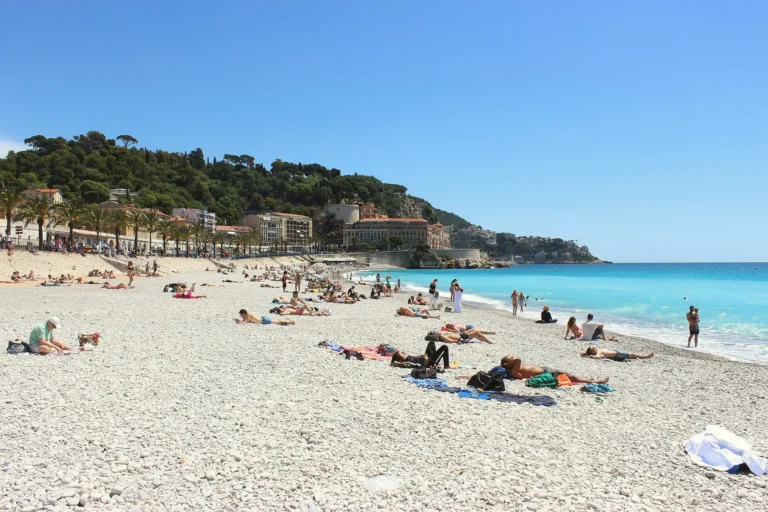
Nice’s central seafront has rounded pebbles rather than sand, and the shore drops steeply into deep water. Water shoes help with the uncomfortable footing, but do not make the entry gradual. Choose a place where you can manage both getting in and coming out, because a confident walk across the stones is not the same as being ready for deep water.
The Promenade des Anglais is also exposed to storm waves. Coastal overtopping can temporarily flood the shoreline and nearby streets, putting people at the water’s edge at risk even without entering the sea.
Bathing-water classifications are site-specific, not a single rating for Nice. The 2025 assessments include Excellent, Good and Sufficient classifications across monitored sites. These describe longer-term water quality, not permission to enter on a particular day.
The city’s La protection sanitaire de la baignade (bathing health protection) webpage provides bathing-water information and monitoring results. Results are also posted at beach lifeguard stations and the main town hall.
Sources & fact-checking
Checks against the sources below cover: services, opening hours, key figures, and closures.
- Plages, mer et littoral; Ville de Nice
- Ville de Nice — opening hours
- Se baigner en sécurité et prévenir la noyade
- La protection sanitaire de la baignade
- French Ministry of Health (Ministry responsible for health) — key figures
- Ville de Nice — key figures
- Ville de Nice — closures
- Météo-France — key figures