Tipping in Prague is discretionary: reward good service, rather than add a gratuity to every purchase. A modest tip is customary at a restaurant table, while counter purchases and routine hotel check-in need no extra payment. The clearest way to tip is to tell the server the total you want to pay before they take payment or give change.
Who to tip and how much
| Situation | Expectation | Customary amount or approach |
|---|---|---|
| Restaurant table service | Customary; discretionary | Round up; about 5–10% for good service |
| Café or pub table service | Customary; optional | Small rounding-up for drinks; around 10% for attentive service or a longer tab |
| Counter purchase | Not expected | Optional coins in a tip jar |
| Traditional taxi | Customary; optional | Round up; about 5–10% for longer rides or extra help |
| Paid group tour | Optional thank-you | Small cash tip for an especially good guide |
| Tip-based walking tour | Voluntary; guide’s main income | Choose a contribution for the tour received |
Table service, rather than the mere act of buying something, is the useful distinction. At a restaurant, café or pub, a tip recognises someone looking after your table. Buying a coffee at the counter does not carry the same expectation, even when a jar is visible. For a single drink, rounding a hypothetical 85 Kč bill to 90 Kč is a modest thank-you, not a required payment.
A 200 Kč tip only makes sense against the bill and the service. On a restaurant bill of 2,000 Kč, it is 10%, while on 1,000 Kč, it is 20%, a more generous gesture. For a small coffee order it would be unusually large. Judge the amount against what you received, rather than treating that sum as a standard Prague tip.
It is not inherently rude to decline a voluntary tip. Good table service commonly receives one, so leaving nothing can signal that you were dissatisfied, but you do not owe an extra payment simply to avoid embarrassment. Thank staff courteously whether or not you choose to add something.
Paying at restaurants, cafés and pubs
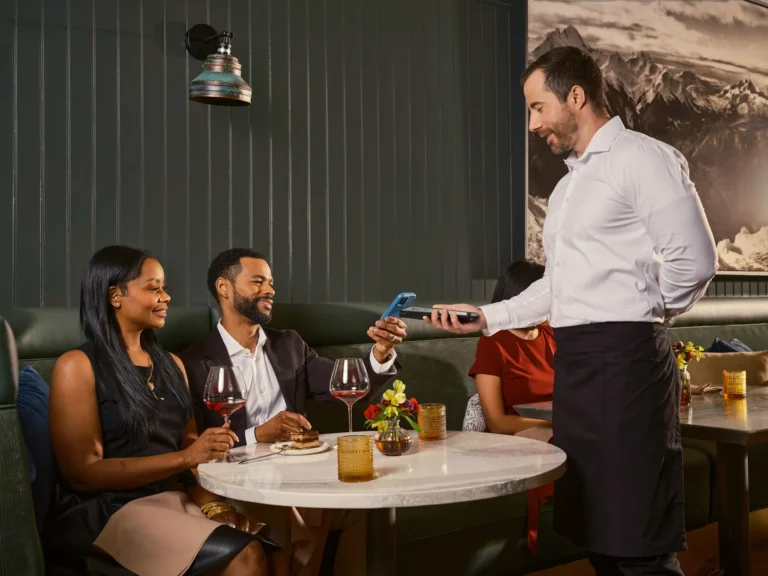
Tell the server your intended total, including the tip, before payment. If the bill is 920 Kč, say “1,000, please” before cash change is made or the card payment is processed. You are naming the total to collect, not asking for that amount to be added to the bill.
With cash, hand over your money and state the total clearly. If you give a larger note, the server can return the balance above your chosen total. This is clearer than an ambiguous instruction about keeping change, especially when the note is much larger than the bill.
Adding a tip by card depends on the venue’s payment setup. Some terminals support it, while others charge only the bill amount. Ask whether your chosen gratuity can be included before tapping. If it cannot, a separate cash tip is accepted: give it directly to the server. Keep a little local-currency cash for tips you choose to leave, rather than assuming every terminal offers the same options.

Alper Çuğun from Berlin, Germany · CC BY 2.0 · Edited
Make the handover unambiguous
Do
- Name the full total you intend to pay.
- Confirm the card amount before authorising payment.
- Hand a separate cash gratuity directly to the server.
Don’t
- Say “keep the change” without knowing how much that leaves.
- Tap before agreeing what will be charged.
- Leave a cash tip unattended on the table.
Service charges and tip prompts
A disclosed restaurant service charge and a voluntary tip are different parts of the payment. A service charge disclosed on the menu or bill is compulsory, but a gratuity is your choice. Read the bill before deciding on any extra, rather than treating every amount beyond the food and drink as a tip request.
If a charge is unclear, ask staff what it covers and clarify the total before authorising payment. A useful question is “Does this amount include service?” That gives you a clearer basis for choosing any voluntary extra than guessing from the final sum.
A terminal tip prompt creates no obligation. Use its no-tip option or enter zero if you do not want to leave a gratuity. A suggested percentage on a screen is a request, not a compulsory service charge, so choose deliberately instead of accepting the highlighted option by habit.
Taxi drivers and hotel reception
For a traditional taxi in Prague, start with the fare owed, then decide whether to offer a thank-you. Tell the driver your chosen total when paying, using the rounding-up approach in the reference table. The fare owed and a voluntary driver tip are separate amounts. Helpful luggage handling or an especially helpful journey may influence your choice.
Uber lets you add an optional tip in the app after the ride. This gives you a separate way to thank the driver once the journey is over, without arranging a cash handover.
At hotel reception, no tip is expected for routine check-in or check-out: a spoken thank-you is enough. Exceptional extra help is a different situation. If someone carries your luggage or helps you during your stay and you want to give a personal cash thank-you, hand it to that staff member, rather than leaving money at reception for an unspecified recipient.
Paid tours and tip-based walks
A paid tour’s fee is distinct from any extra thank-you. For a paid group tour, you can give a personal gratuity to an especially good guide at the end. A private guide whose fee has already been paid does not require an additional tip either, but a modest extra can recognise a particularly helpful tour.
Prague’s tip-based “free” walking tours usually have no fixed compulsory fee: you decide your contribution afterwards. The label describes the payment format, rather than a promise that the guide works without payment. Some operators or larger-group bookings require prepayment, so read the advertised payment terms before joining.
Prepare a means of contributing before you set off, such as local-currency cash, so your choice is practical at the end. Consider the tour’s length, group format and how helpful the guide was, rather than applying one universal sum to a short group walk and a longer, more personal tour.