In Lisbon, greet people before asking for help, wait your turn, share trams considerately and leave unwanted restaurant extras untouched. Choose shoes with grip for the hills and keep your voice down near homes after dark. Courtesy and practical advice are not the same as legal rules: Carris passenger obligations, restaurant charging conditions and late-night alcohol sales have specific requirements. You do not need to disguise yourself as a visitor.
Greetings and queues
- Start with bom dia (good morning) or boa tarde (good afternoon).
- Ask “Do you speak English?” before continuing, rather than assuming Spanish will work.
- Wait your turn in the service queue and give the person ahead space to finish.
- Use por favor (please) when asking and thank the person with obrigado if you are a male speaker or obrigada if you are a female speaker.
English is usually usable in Lisbon’s visitor-facing settings, especially central tourist areas. Ask about language rather than launching straight into English. A short greeting lets you start politely even with little Portuguese. Waiting your turn is ordinary courtesy, not a special visitor regulation.
For pronunciation and more ways to handle everyday exchanges, Portuguese greetings and language advice can help you prepare beyond these opening phrases.
Tram 28 and shared transport
Tram 28E is regular Carris public transport, not a sightseeing vehicle reserved for visitors. Leave room for people making ordinary journeys, particularly when the boarding point is crowded.
Do
- Signal your intention to board; board or alight only when the tram and doors have stopped moving, and watch the steps and height differences.
- Keep doors and aisles clear and hold bags securely close to you.
- Leave reserved seats available for passengers with reduced mobility, pregnant passengers and passengers with infants, unless clearly not needed.
Don’t
- Board or alight after the door-closing signal or another safety warning.
- Force your way onto a crowded tram; step away from the boarding point and wait for a later service instead.
- Treat an available reserved seat as yours regardless of who needs it.
Safe boarding and reserved seating are passenger obligations. Keeping your belongings out of other people’s way also makes the shared space easier to use.
Footwear and walking on hills
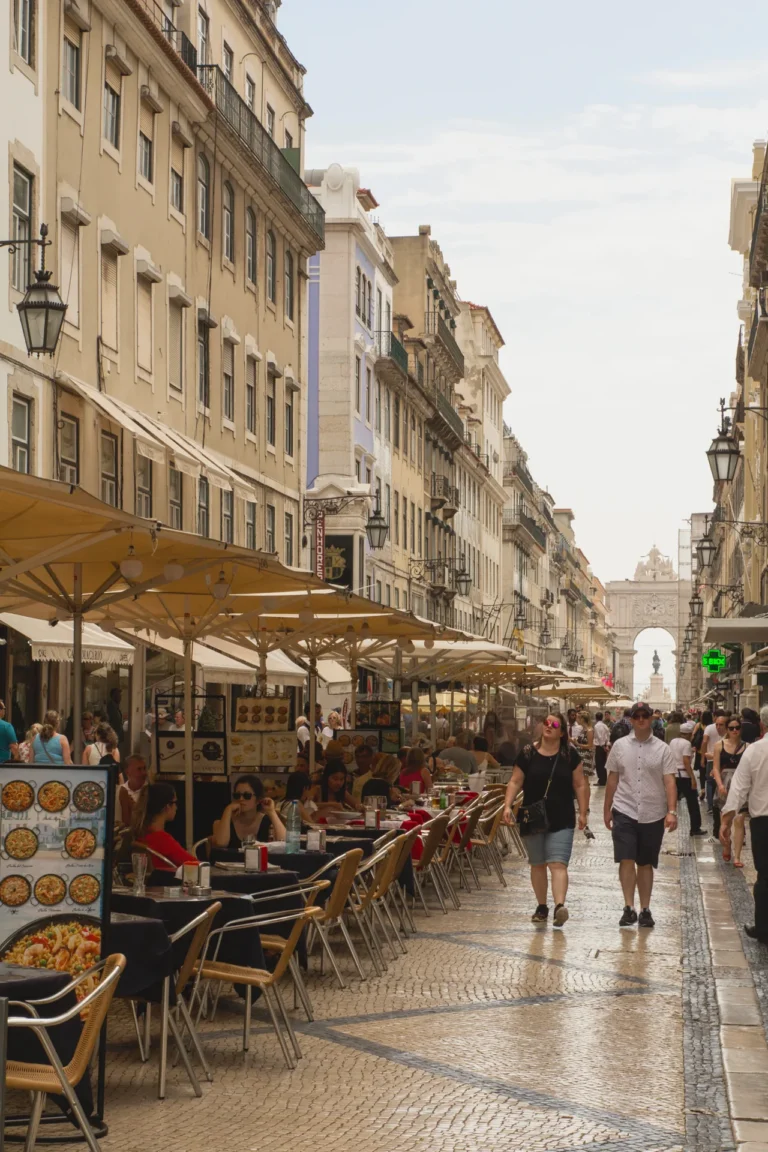
Dress for the walking and the venue, not to hide that you are a tourist. Lisbon’s historic centre has steep climbs and descents, with smooth, uneven calçada portuguesa, Portuguese stone paving. Comfortable shoes with good grip are a more useful choice than high heels or smooth soles.
Wet paving can become very slippery. Take particular care on slopes, shorten your stride and choose a less demanding walk if balance or mobility makes the hills difficult. A shorter outing can leave more energy for the places you actually want to enjoy.

Girassolei · CC BY-SA 4.0 · Edited
Clothing depends on where you are going as well as the weather. For churches, city streets or a journey back from the beach, what to wear for different settings helps you make the distinction without treating visitor status as something to conceal.
Restaurant extras and the bill
Couvert means bread, olives or other appetisers offered before a meal. Items placed on your table are not automatically free. A restaurant can charge for unrequested extras if you consume them or make them unusable, including by handling them or opening packaging. Unrequested extras left untouched and usable cannot be charged.
Restaurants must display Portuguese price lists at the entrance and inside, including couvert prices. Look at the listed items before accepting extras so you can decide whether you want them alongside your meal.
Do
- Accept table extras only if you want them at the listed price.
- Ask staff to remove unwanted items without using or opening them.
- Before paying, point out an incorrect item, explain what you ordered or used and ask staff to correct the bill.
Don’t
- Treat the arrival of bread or olives as permission to eat them without a charge.
- Pay an unrequested, untouched extra without querying it with staff.
Tipping is voluntary. You may leave something for good service, but there is no fixed-percentage obligation. Decide separately from resolving any disputed charge.
Late-night drinks and residential streets
- Scope
- Citywide; alcohol sales for consumption outside commercial establishments
- Responsible party
- Merchants selling the alcohol
- Enforcement
- Lisbon Municipal Police, alone or with Public Security Police and other authorities
- Indoor exception
- Consumption inside, within authorised opening hours
- Terrace exception
- Seated customers on licensed terraces, within authorised opening hours
- Delivery exception
- Home delivery for home consumption
- Seasonal exception
- Lisbon Festivities period
This is a restriction on sellers, not a visitor drinking offence. It affects whether you can buy an alcoholic drink to take away for outside consumption. The rule covers alcoholic beverages generally, not just one type of drink.
Choose a drink to enjoy at the venue rather than asking for it to take into the street. Do not assume that standing outside a bar gives you the same option as taking a terrace seat. These alternatives do not extend the establishment’s permitted hours.
When leaving a bar or returning to accommodation near homes, keep conversations quiet and avoid gathering noisily beneath windows. Quiet departures are courtesy separate from the alcohol-sales rule, and apply even when your purchase is permitted.
Belongings and help after theft
- Move to a suitable place to seek help if your wallet or phone goes missing. For an immediate threat or injury, call 112, Portugal’s emergency number.
- Secure affected payment cards through your bank and protect phone accounts, using another device or help from someone you trust.
- For non-emergency theft, report it in person at a police station and obtain paperwork for your bank or insurer.
Take particular care in crowded tourist areas and on Lisbon trams 15, 25 and 28. Boarding and alighting, busy tram and bus stops, and crowded rail or underground stations all deserve attention: keep valuables secured rather than in an open bag or exposed pocket.
Do not let the police report delay protecting your accounts. Once you are safe, preventing further use of a missing card or phone is the immediate practical task, and the report then helps you document what happened.
Sources & fact-checking
Checks against the sources below cover: services.
- Carris — service
- Rights and Duties
- General Conditions of Carriage for CARRIS Services
- Direção-Geral do Consumidor (DGC) — service
- Ministério da Economia — service
- Deliberação n.º 13/CM/2026 (Boletim Municipal n.º 1665)
- Limite de horário para a venda de bebidas alcoólicas no exterior dos estabelecimentos
- Time limit for the sale of alcoholic beverages outside establishments
- Deliberação n.º 13/CM/2026 (Proposta n.º 13/2026)