Berlin currywurst is a counter-food order built around sausage and curry-seasoned tomato sauce. The useful choice is often the texture: a sausage with a snappy casing or a softer, casing-free version. Konnopke’s Imbiss is a historic reference for the latter, rather than a necessary stop for every portion.
You can eat it as a snack or add a side for a light meal. Choose the casing, then the side and any offered heat level: those decisions tell the person at the counter what you want without needing a long order.
When to eat it and what to pay
- What it is
- Sausage with curry-seasoned tomato sauce
- When to have it
- An informal snack, lunch break or light meal; also after a night out
- Historic reference
- Konnopke’s Imbiss
At a snack counter, order your sausage and sides, then collect a small tray, usually with sliced sausage and a fork or wooden pick. Expect to eat standing or take it away, rather than rely on a seat.
- Stand portion: roughly €4–€6.
- Bread roll: about €0.50–€1.50 extra.
- Chips: about €3–€5 extra.
- Seated restaurant serving with a side: typically around €10–€16.
Larger portions and extra toppings move the price upwards. In a restaurant, the setting and table service account for the higher price. Snack counters usually have no separate cover charge.
If you want to vary your counter meals, other Berlin street foods offer alternatives beyond sausage.
What is currywurst made of?
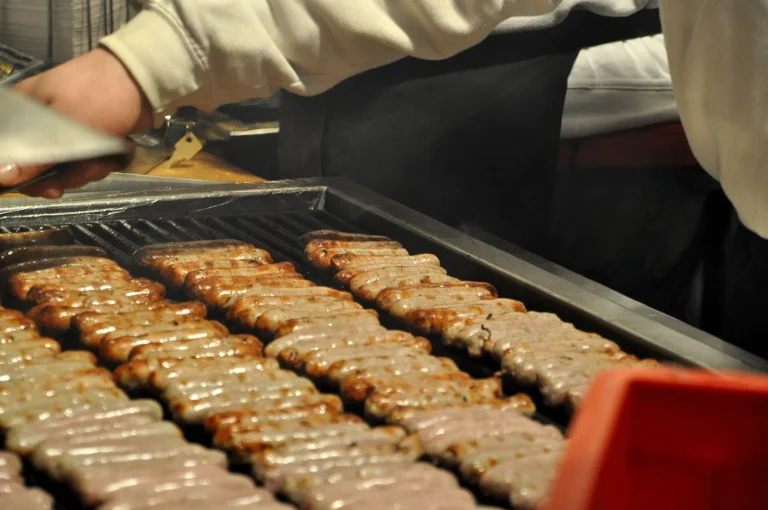
Traditional Berlin currywurst normally uses pork, so it is not a pork-free order. The sausage is steamed, then fried, giving it a tender, juicy interior and a crisp, browned exterior. It may be cased or skinless, but the choice changes the bite rather than the identity of the finished dish.
The topping is tomato-based, with curry powder providing the defining seasoning. Paprika is also common, and some servings receive an extra dusting of curry powder. You taste a sweet-tangy tomato base with warm spice, rather than a sauce resembling a full curry dish. Slicing lets the sauce coat the pieces and makes the tray easy to eat with a small fork.

Richard Mischau, Britta Mischau · CC BY-SA 4.0 · Edited
Bratwurst names a type of sausage, while currywurst names the finished dish with its sauce. A bratwurst is typically grilled or fried, whereas the word currywurst tells you how the cooked sausage is served. Although sliced portions are familiar at counters, currywurst can also be served whole: cutting it up is not what defines it.
Casing choices at the counter
At a counter offering both versions, mit Darm means “with casing” and ohne Darm means “without casing”. These are the words that settle the sausage choice, but neither tells you how hot the sauce will be.
Choose mit Darm for a firm, snappy bite. The casing gives the sausage a crisp, slightly chewy skin, so there is more resistance as you bite through it. This suits you if texture matters as much as the topping.
Choose ohne Darm for a soft, finely textured sausage. There is no casing to snap through. When asked for your preference, answer with the counter term rather than simply “currywurst”, which leaves that choice open. You can then add your side to the same order.
Curry sauce, bread rolls and chips
Ordinary currywurst sauce is generally mild and mildly tangy. Choose an explicitly hot version if you want chilli heat, because curry seasoning alone does not mean a fiery serving. The strength of hot sauces varies between vendors and offered heat levels, so name the level you want when the counter gives you a choice.
Brötchen means a bread roll, useful for picking up the remaining sauce. Pommes means chips: these make the tray a fuller meal and commonly come with mayonnaise. Where the counter offers mayonnaise or ketchup, say which you want with your chips rather than assume the condiment is fixed.
Its origins and Konnopke’s Imbiss
Herta Heuwer is generally credited with inventing Berlin currywurst on 4 September 1949, at a snack stand on the corner of Kantstraße and Kaiser-Friedrich-Straße in Charlottenburg. This is the attributed Berlin origin, not an undisputed national first: Hamburg also has a competing origin claim.
Konnopke’s Imbiss became an early pioneer of casing-free currywurst in East Berlin, offering it in the 1960s before the style became more widely popular. It still operates on Schönhauser Allee and serves its signature sausage ohne Darm. That makes it a walk-in reference if you want to try the softer version with a connection to the dish’s history.
- Name
- Konnopke’s Imbiss
- Location
- Schönhauser Allee 44b, Berlin Maps
- Site
- konnopke-imbiss.de
- Hours
- Mon Closed
- Tue–Fri 11:00–18:00
- Sat 12:00–19:00
Show 1 more
Sun Closed- Essential fact
- A currywurst stand on Schönhauser Allee in Berlin’s Prenzlauer Berg district.
- Price range
- €€
Sources & fact-checking
Checks against the sources below cover: key figures.