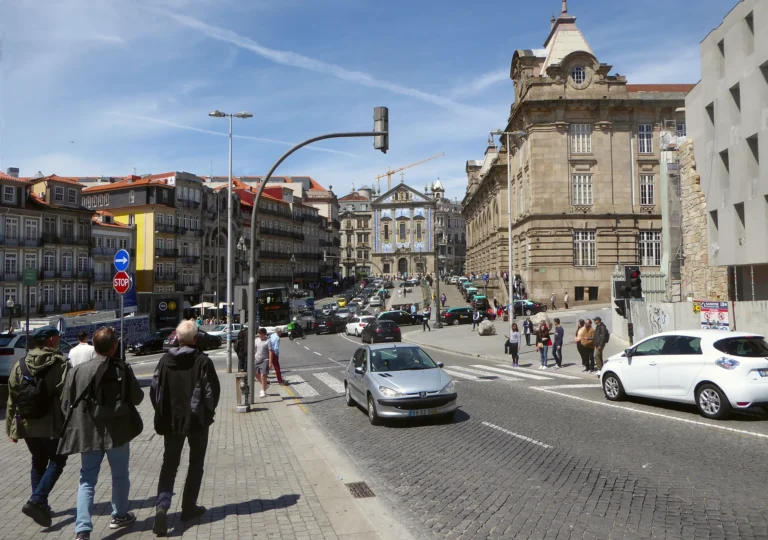
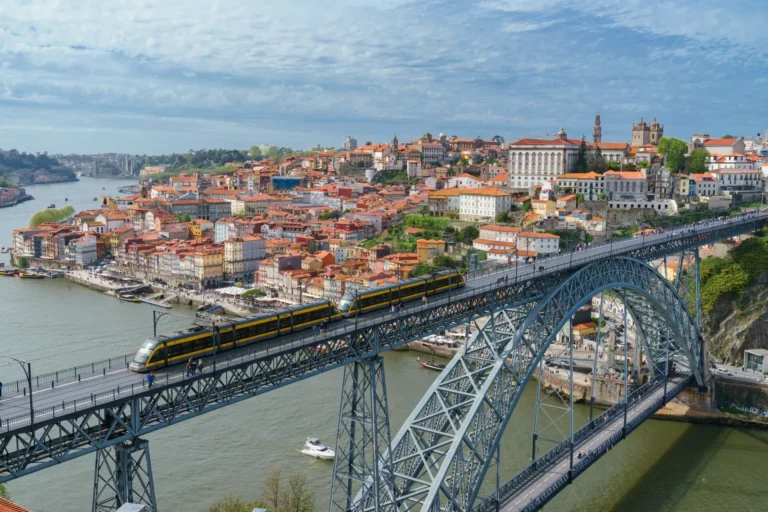
Driving from Lisbon’s Praça dos Restauradores to Porto’s Praça da República makes most sense if you already have a car or will continue beyond the city centres. For a centre-to-centre transfer alone, the direct train is usually the simpler choice. The A1 offers an inland motorway journey, with tolls and fuel to budget for and a separate access decision if your accommodation lies in Porto’s historic centre.
Car or train?
Driving the A1 between Praça dos Restauradores and Praça da República
Pros
- The drive covers about 353 km in about 3 and a half hours, before breaks or rental formalities.
- An existing car keeps luggage with you and serves onward travel beyond Porto.
- Allow roughly €60–€85 per car for tolls and fuel, before rental costs; sharing spreads this expenditure.
Cons
- CP’s direct Alfa Pendular alternative takes about 17 minutes by taxi to Lisbon Santa Apolónia, about 3 hours by train to Porto Campanhã and about 12 minutes by taxi to Praça da República. Taxi waits and boarding time come on top.
- Standard flexible adult one-way fares are €35.70 in Alfa Pendular Turística (standard class) or €26.35 in Intercidades second class. Allow roughly €10–€20 per taxi at each end, depending on traffic and luggage charges.
- A different-city rental return can add substantially to the cost, and collecting the car adds time.
Choose the car for onward travel, not simply to save time. The train involves luggage handling at both stations, while the car involves breaks and possible city congestion. Lisbon to Porto transport options also covers coach and flight alternatives and rail boarding, using a different central arrival point.
The A1 corridor
From Praça dos Restauradores, the driving corridor joins the A1 at Alverca and continues north towards Antuã. The A1 runs inland, rather than offering sustained coastal views. It is a transfer route, not a coastal sightseeing drive: choose it for a straightforward journey rather than for sea views.
A rest break gives you a chance to eat and stretch without turning the transfer into a sightseeing day. Antuã is a service-area waypoint on this corridor, not a required visit. Stop when it suits your passengers, and allow extra time for the break before arranging your arrival in Porto.
Collecting a rental car before leaving Lisbon means allowing for paperwork, luggage loading and getting away from the collection point. Congestion on either city approach can lengthen the journey too. A sightseeing diversion adds both its own driving and the visit itself, so if Porto arrival is the priority, keep that excursion for another day.
Tolls and the one-way budget
- A1 toll, Alverca to Grijó
- €23.55 per Class 1 car, northbound; 2026 tariff including VAT
For the A1 journey, allow roughly €35–€60 per car for fuel, depending on consumption and pump prices. A small or medium car using around 5–8 litres per 100 km, with fuel around €1.70–€2.10 per litre, gives a useful planning range. Together with the toll, this is the running-cost allowance used in the car-versus-train decision.
For a short rental, allow roughly €40–€100 per day for a small or medium car, with season, demand, rental duration and cover moving the price. A different-city return may add roughly €50–€150 or more. Keep these per-car costs separate from per-person train tickets, and add any rental-company toll administration charges.
Class 1 generally means a vehicle measuring under 1.10 m vertically at the first axle, not simply any passenger car. A two-axle passenger car measuring 1.10 m to under 1.30 m may qualify if it meets statutory weight, seating and no-four-wheel-drive conditions, uses automatic toll payment, and meets Euro 6 requirements if registered after 1 January 2019. Eligibility is established through the official model list or inspection, so a taller rental car should not be assumed to qualify.
Conventional toll-booth payment is available between Alverca and Grijó, and electronic payment is optional. Use the lane appropriate to your payment method. With a rental-company toll device, charges may be billed after the journey, with administration fees governed by your contract. Establish whether the device is active before choosing an electronic lane.
Central arrival and restricted access
From Antuã, continue towards Praça da República, the shared central endpoint for the car and train comparison. Reaching this square is not the same as reaching your accommodation. The remaining drive depends on its address, and an approach into the historic centre can bring you into a restricted-access area.
Porto’s Zonas de Acesso Automóvel Condicionado, or conditioned vehicle-access zones (ZAACs), include Cedofeita, Flores, Ribeira and Santa Catarina. These cover parts of the historic centre: Cedofeita to its north-west, Flores around the central historic streets, Ribeira beside the Douro, and Santa Catarina around the central shopping area. Vehicle access, circulation and stopping within the designated boundaries are regulated.
Register one vehicle in the ZAACPorto platform or app before entering these zones as a visitor. Registration allows access at any time, but does not make that access free. An accommodation reservation does not create a separate guest-access category, so establish whether your address requires entry before continuing from Praça da República.
Sources & fact-checking
Checks against the sources below cover: fares and charges, services, and key figures.
- ALFA PENDULAR LISBOA – PORTO – BRAGA
- CP is offering 7,000 promotional tickets on the Alfa Pendular service
- Brisa Concessão Rodoviária — fares and charges
- Autostrade per l’Italia — service
- Instituto da Mobilidade e dos Transportes (IMT, IP) — service
- Gdańsk Transport Company S.A. (AmberOne A1 motorway operator) — service
- Instituto da Mobilidade e dos Transportes (IMT) — key figures
- Município do Porto — service
- Porto City Council — service