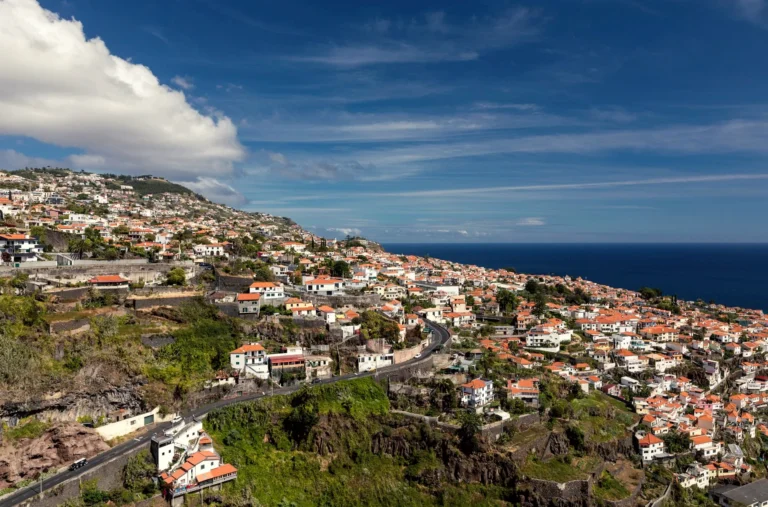
Choose June for a walking-led trip to Madeira, when Funchal’s coastal climate balances relatively dry days with less warmth than high summer. May offers a flower-season alternative, while September suits you better if warmer coastal days matter more. Neither choice guarantees clear mountain weather or safe sea bathing.
The best months for your trip
- Walking first
- June
- Spring alternative
- May, with Flower Festival demand
- Warmer coastal alternative
- September
- Drier sea-day weather
- Summer, subject to bathing conditions
- Quieter sightseeing and relative accommodation value
- Ordinary winter weeks, outside festivities
- Hottest coastal month
- August
- Coldest coastal month
- February
- Wettest coastal month
- December
For walks, favour a balance of mild daytime air and fewer rain interruptions rather than the warmest possible dates. Popular mountain outings still need careful timing: a comfortable season does not remove sunrise crowds or morning tour-group arrivals.
Comfortable weather is not a promise of cheaper rooms. Spring festival demand can tighten accommodation choices, whereas ordinary winter brings less pressure than the festive peak. Choose the flowers or celebrations deliberately. For an outdoor-led stay, avoid paying for an event you do not particularly want.
For swimming, summer’s appeal is its drier coastal pattern, not an automatic right to enter the water. For quieter sightseeing, winter works best when you can exchange an outdoor outing for a city or indoor visit.
Coastal weather by month
| Month | Mean daily high °C, 1991–2020 | Mean daily low °C, 1991–2020 | Rainfall mm, 1981–2010 | Rainy days, 1991–2020 | Crowd pressure | Outdoor sightseeing verdict |
|---|---|---|---|---|---|---|
| January | 20.0 | 14.3 | 74.1 | 6.2 | Lower after festivities | Mixed: rain interruptions |
| February | 19.9 | 13.9 | 83.0 | 5.5 | Lower, ordinary winter | Mixed: coolest air |
| March | 20.6 | 14.3 | 60.2 | 5.8 | — | Mixed: lingering rain |
| April | 21.0 | 14.9 | 44.0 | 4.7 | Festival-dependent | Mixed: spring showers |
| May | 22.0 | 16.2 | 28.9 | 3.3 | High around festival | Good fit: milder, drier |
| June | 23.7 | 18.2 | 7.2 | 1.0 | Popular outings busy | Good fit: mild and dry |
| July | 25.4 | 19.7 | 1.6 | 0.3 | Summer mountain pressure | Good fit: dry; warmer walks |
| August | 26.8 | 20.7 | 2.0 | 0.4 | Summer mountain pressure | Mixed: warmest walks |
| September | 26.6 | 20.4 | 32.9 | 3.1 | — | Good fit: warm coast |
| October | 25.2 | 19.2 | 89.5 | 7.0 | — | Mixed: rain returns |
| November | 22.8 | 17.0 | 88.8 | 7.3 | — | Poor fit: rain-dependent outings |
| December | 21.0 | 15.5 | 115.0 | 8.6 | High around festivities | Poor fit: wettest outdoors |
October to March is the rainier part of Funchal’s coastal year. Rainfall amount describes how much water falls, while rainy-day frequency describes how often an outing might be interrupted. They are different measures, and their observation periods here differ too.
The south coast is generally warmer, sunnier and drier than the north coast, which is cooler, cloudier and wetter. Higher terrain is substantially cooler and more changeable, often with cloud or wind. A dry day in Funchal does not settle conditions on a mountain walk. Use the coastal pattern to choose dates, but keep mountain outings flexible.
Spring walking and flower-season crowds
May is a better walking alternative than early spring if you want fewer coastal rain interruptions. March and April still call for more flexibility, while later spring brings a milder, drier pattern without the warmth of high summer. That weather advantage does not make late spring a quiet accommodation season.
The Madeira Flower Festival takes place annually in spring, usually between April and May, with dates varying by year. Choose that window if the flower celebrations are part of the reason for your trip. If walking is the priority, June separates your stay from the spring festival demand.
Madeira’s festival-period hotel demand was estimated at about 95% occupancy in 2025, with roughly 65,000 tourists expected for the opening weekend. A separate estimate again put May hotel occupancy at 95% in 2026. These island-wide estimates point to strong accommodation pressure, not simply a busy afternoon in central Funchal.
Choose festival dates for the event, not for an assumed spring bargain. When you want both flowers and walks, allow the accommodation choice to shape your dates early. When the flowers are incidental, a stay outside the festival window gives you less reason to compete for event-led demand.
Summer swimming, heat and busy days
Summer suits a trip with plenty of coastal time: the historical pattern is notably dry, but extended walks become warmer. Put strenuous activity earlier in the day, away from the hottest hours, and keep the warmer part for a shorter sightseeing stretch or a break rather than another demanding climb.
The Lido bathing complex in western Funchal gives a sea-day plan a clear destination, with outdoor pools beside the Atlantic. It is a useful counterweight to a holiday dominated by long walks: leave room to spend time by the water rather than treating a swim as something to squeeze between outings.

Dr · CC BY-SA 4.0 · Edited
Pico do Arieiro has summer visitor pressure as well as mountain weather to contend with. Starting a strenuous walk early helps you avoid the hottest hours, but the viewpoint is not necessarily quiet then: sunrise draws crowds of its own.
Drier coastal weather does not mean unrestricted sea bathing. Let the bathing signals determine whether you enter the water, and distinguish a pool or coastal outing from an exposed mountain walk. Summer is strongest when the trip can include both shorter outdoor stretches and time at the Lido, rather than depending entirely on strenuous walking.
Autumn sea days and returning rain
September is the alternative if you prefer warmer coastal days to June’s walking balance. It retains much of summer’s warmth, while the rainfall pattern has begun to change. Choose it for a holiday that mixes Funchal sightseeing with time by the water, rather than making every day a long walk.
October and November bring more frequent rain interruptions. Warm air alone cannot rescue a fixed-date sea outing, and exposed walks are a poorer foundation for a trip when unsettled conditions can change the day’s choice.
Later autumn is a weaker fit if uninterrupted outdoor days are essential. It can still suit coastal sightseeing when you are willing to change activities, but avoid making one mountain outing the whole reason for travelling. The distinction is not whether you can enjoy autumn. It is whether the holiday still works when the outdoor plan changes.
Winter sightseeing and the festive peak
Ordinary winter weeks suit flexible sightseeing better than a swimming-led stay. Cooler evenings and more frequent rain make a holiday built around the sea less dependable, while the relative accommodation advantage lies outside the festive peak. For winter in Madeira, the useful trade-off is less event-driven demand in exchange for a more adaptable outdoor plan.
Keep Funchal city sightseeing, an indoor visit at the Sacred Art Museum and a coastal outing at the Lido as different kinds of day. The museum’s religious art gives you a reason to go inside beyond escaping rain, while the Lido offers a coastal option when conditions suit. Do not make a mountain walk the fixed centrepiece of every day.
Christmas and New Year change the accommodation picture. For the 2025 festive season, advance island-wide hotel-occupancy estimates were about 75% over 24–26 December and 88% around New Year. Funchal hotels were also described as nearly full in early December 2025. The festivities are a demand peak, not an extension of ordinary winter value.
The Christmas and New Year programme runs from 1 December 2026 to 10 January 2027, with fireworks on New Year’s Eve, 31 December 2026. Seek this period if the celebrations matter to you, but choose ordinary weeks outside it if quieter sightseeing and lower accommodation pressure matter more. Settle festive accommodation earlier rather than expecting the same choice as on an ordinary winter stay.
Crowds, mountain access and sea conditions
- Respect the announced closure or restriction for each classified walking route. Weather alerts do not automatically close every route, because Madeira’s Institute for Forests and Nature Conservation assesses weather, safety and local risks route by route.
- At managed bathing areas, a green flag allows bathing while you follow safety rules.
- A yellow flag means bathe with caution.
A purple-and-white flag warns of cnidarians, such as jellyfish, in bathing waters. It is a different signal from the bathing-permission flags: sunshine is not a substitute for reading the signals at the bathing area.
Overlapping daytime cruise calls concentrate crowds at particular Funchal attractions, rather than across the whole city. The Monte cable car, Mercado dos Lavradores market and Old Town’s narrow Rua de Santa Maria can become busy during ship-in-port hours. Visit these earlier or later, or spend that part of the day elsewhere.
The central seafront around the cathedral and marina, together with the Old Town, holds much of the visitor activity. Santa Luzia’s residential setting is quieter, while the western Lido area spreads activity along a broader hotel and coastal district. Choosing either changes the concentration of people around you, not just the attraction on your list.
Pico do Arieiro’s viewpoint is busiest around sunrise. Later visits, including sunset, are generally quieter; summer and weekends tend to add pressure. A later viewpoint visit can avoid the pre-dawn rush, but it is not the same choice as setting off on a mountain walk. Route access and mountain conditions still determine that outing.

Anita Kieseler · Pexels License · Edited
At Rabaçal, the access area for the popular 25 Fontes walks, crowds build through the morning as tour buses arrive. Aim to be there before late morning, and favour a weekday over a weekend if you have the choice. That timing can reduce the crowding, but it does not override a restriction on the route you intend to walk.
Sources & fact-checking
Checks against the sources below cover: key figures and services.
- Direção Regional do Turismo, Madeira Regional Government — key figures
- Madeira Tourism Board — key figures
- Instituto Português do Mar e da Atmosfera, I. P. — key figures
- Instituto Português do Mar e da Atmosfera, I. P. (IPMA) — key figures
- Regional Directorate of Statistics of Madeira (DREM) — key figures
- Instituto das Florestas e Conservação da Natureza (IFCN) — service
- Governo Regional da Região Autónoma da Madeira — service