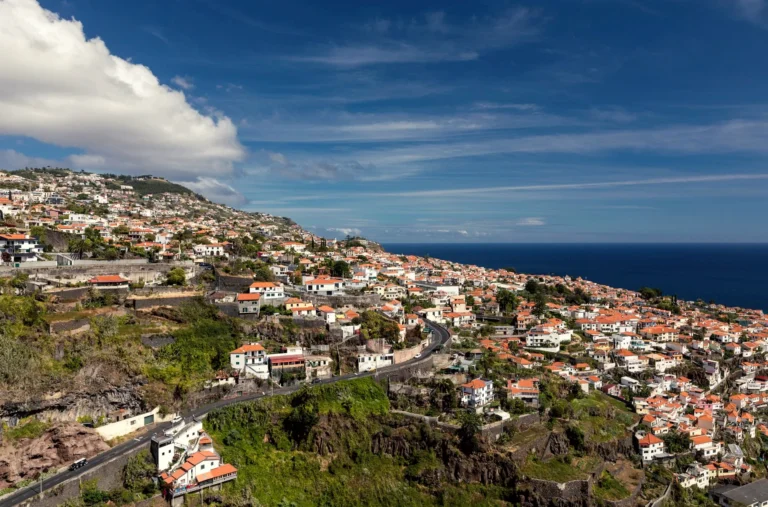
Choose ordinary winter weeks for a quieter Madeira break built around coastal sightseeing and walks you can move between days. Funchal makes a useful base for urban days on the milder south coast, while the highest mountains are a different proposition, with wetter conditions and occasional snow or ice. Come around New Year if celebrations are the purpose, not if you are seeking winter’s best accommodation value.
Winter dates and trade-offs
- Recommended winter window
- Ordinary January and February weeks, outside event-led stays
- Main trade-off
- Mild coastal sightseeing; weather-dependent mountain walks and swimming
- Hottest coastal month
- August
- Coldest coastal month
- February, by both mean daily maximum and minimum temperatures
- Wettest coastal month
- December
- Highest monthly accommodation demand
- August; separate festive surge around New Year
- Climate reference
- Funchal coastal station
Winter is a poor match if your holiday depends on a dry high-mountain walk or reliable swimming on fixed days. For sightseeing, the compromise is easier: you can enjoy Funchal and choose an outdoor excursion when conditions suit, rather than making one exposed route the reason for the whole trip.
Lower-demand dates generally offer better room availability and value than the festive peak. That advantage concerns accommodation, not access to the mountains. Choose the celebrations when you want an event-led stay, but choose a quieter break when being able to rearrange your days matters more than a particular date.
Coastal weather and mountain conditions
| Month | Mean daily high °C | Mean daily low °C | Rain mm | Rain days | Accommodation demand | Sightseeing verdict |
|---|---|---|---|---|---|---|
| January | 20.0 | 14.3 | 67.1 | 6.2 | Lower outside events | Mixed: movable rainy days |
| February | 19.9 | 13.9 | 72.4 | 5.5 | Lower outside events | Mixed: cool, rainy spells |
| March | 20.6 | 14.3 | 62.3 | 5.8 | Rising | Mixed: rain remains |
| April | 21.0 | 14.9 | 45.2 | 4.7 | Rising | Good fit: milder, less rain |
| May | 22.0 | 16.2 | 27.2 | 3.3 | Rising | Good fit: warmer, drier |
| June | 23.7 | 18.2 | 7.8 | 1.0 | High | Good fit: little rain |
| July | 25.4 | 19.7 | 1.7 | 0.3 | High | Good fit: dry, busier |
| August | 26.8 | 20.7 | 1.3 | 0.4 | Highest | Mixed: heat and demand |
| September | 26.6 | 20.4 | 23.1 | 3.1 | Easing from summer | Good fit: warm, easing demand |
| October | 25.2 | 19.2 | 91.2 | 7.0 | Easing | Mixed: warm but wetter |
| November | 22.8 | 17.0 | 80.3 | 7.3 | Lower | Mixed: wetter outings |
| December | 21.0 | 15.5 | 94.8 | 8.6 | Lower; festive surge | Mixed: rain and New Year demand |
January is mild rather than reliably hot in Funchal. Afternoons can suit coastal sightseeing, while evenings are cooler. Rainfall amount and frequency both matter for outdoor plans: allow for wet spells and keep the order of your excursions flexible, leaving room for coastal outings between showers.
The south coast is comparatively dry in winter, the north coast much wetter and the central uplands wettest. A pleasant coastal day is not a promise of safe conditions at altitude. Around Pico do Areeiro and the other central peaks, occasional snow and ice can make exposed routes hazardous, but snow is not a persistent winter cover. Treat mountain outings as movable plans rather than fixed commitments.

Luis Miguel Bugallo Sánchez (Lmbuga) · CC BY-SA 4.0 · Edited
Christmas, New Year and quieter weeks
Funchal’s Christmas and New Year festivities give a winter stay a specific purpose: illuminations, celebrations and the fireworks that draw visitors around the turn of the year. The forthcoming programme runs from 1 December 2026 to 10 January 2027. The Municipal Garden is one of the city’s settings for Christmas lights, making an urban evening part of the visit rather than simply a fallback from the mountains.

Paulo SP/ Wikimedia · CC BY-SA 4.0 · Edited
The final week of December around New Year is the exception to the quieter winter accommodation pattern. Rooms cost substantially more, and availability is tighter, than in ordinary January and February weeks. If the fireworks are not your reason for travelling, paying the festive premium buys little advantage for a sightseeing-led holiday.
Madeira’s Carnival follows Shrove Tuesday, with the main festivities in the days immediately before Lent, typically the preceding weekend. Choose that movable window if Carnival is the attraction, but favour ordinary weeks if you want the quieter accommodation conditions rather than an event-led break.
For a closer choice between an earlier festive visit and the end-of-year peak, Madeira in December helps separate the month’s dates. The useful distinction is whether you want the Christmas setting or the New Year celebrations strongly enough to accept their different accommodation pressures.
Walking access and rough-sea restrictions
- Treat each classified walking route individually: there is no blanket winter closure. The Institute for Forests and Nature Conservation (IFCN) can restrict or close a route for weather, ground risks, works or other safety circumstances, but a weather alert alone does not close every route.
- In heavy rain or strong winds, do not start a walk. If already on the trail, turn back by the same route and follow official instructions.
- High-altitude roads can close temporarily when severe weather, including snowfall, makes driving unsafe, and remain closed until conditions are safe again. Respect closures rather than driving past them to reach a mountain outing.
- At coastal bathing areas, obey beach flags and lifeguards’ instructions. A yellow flag prohibits swimming, while a red flag means danger and you must keep out of the water.
- Do not assume supervised winter swimming: none of the bathing seasons in the official 2026 lifeguard schedule extends into winter.
An open walking route is not an instruction to continue through worsening weather. Individual access restrictions and the advice to abandon a walk address different decisions: whether you may enter, and whether conditions make the outing sensible. Keep a coastal alternative available rather than transferring a cancelled mountain plan to another exposed route.
A mountain outing depends on both a safe approach and suitable conditions on the path. Staying on the south coast gives you a different kind of day when the high ground is inaccessible, rather than making the whole visit depend on reaching a summit.
For a winter coastal day, distinguish enjoying the waterfront from getting into the water. A stay centred on seaside walks and urban sightseeing is a different proposition from one whose success depends on bathing, even when the air feels mild.
Coastal days and flexible outdoor plans
Build a winter stay around Funchal, with outdoor excursions that can change places in your week. Its waterfront, old town and Municipal Garden give you urban sightseeing on the south coast without making every day depend on access to high ground. Keep some time uncommitted so that a suitable walking day does not have to compete with a fixed excursion.
On rainy days, shorten exposed outdoor stretches and leave indoor time flexible. You can divide urban sightseeing into smaller outings rather than replacing a cancelled mountain walk with another long outdoor commitment. When the weather improves, use that opening for the excursion whose conditions matter most.
For fixed dates, the deciding question is whether you would still enjoy the stay without the mountain walk or swim. If coastal sightseeing would make the trip worthwhile on its own, winter remains a reasonable choice. A short walking-led holiday tied to one high route, or a swimming-led holiday requiring dependable bathing, is better matched to a different period.
If your dates are flexible, choose quieter weeks for accommodation value or the festive window for celebrations. Lower demand gives you more room choice, but it does not make an exposed outing safer or drier. Let the purpose of the holiday decide the dates, and let conditions decide the outdoor day.
Sources & fact-checking
Checks against the sources below cover: services, closures, and key figures.
- Institute of Forests and Nature Conservation (IFCN, IP-RAM) — service
- Madeira Islands Tourism Board; Institute of Forests and Nature Conservation (IFCN) — service
- Direção Regional de Estradas — service
- Autoridade Marítima Nacional — service
- Regional Government of Madeira (Região Autónoma da Madeira) — service
- Madeira Islands Tourism Board — closures
- Normal Climatológica – Funchal 1991–2020
- Normal Climatológica – Funchal
- Regional Directorate of Statistics of Madeira (DREM) — key figures