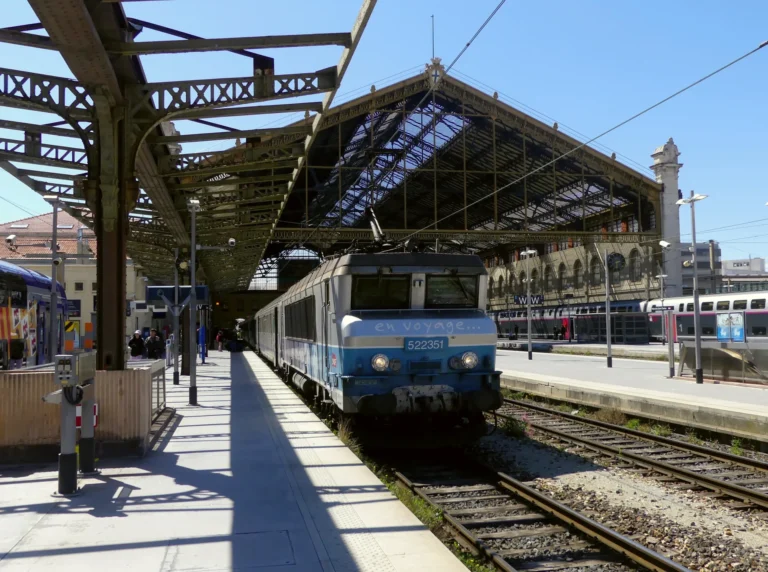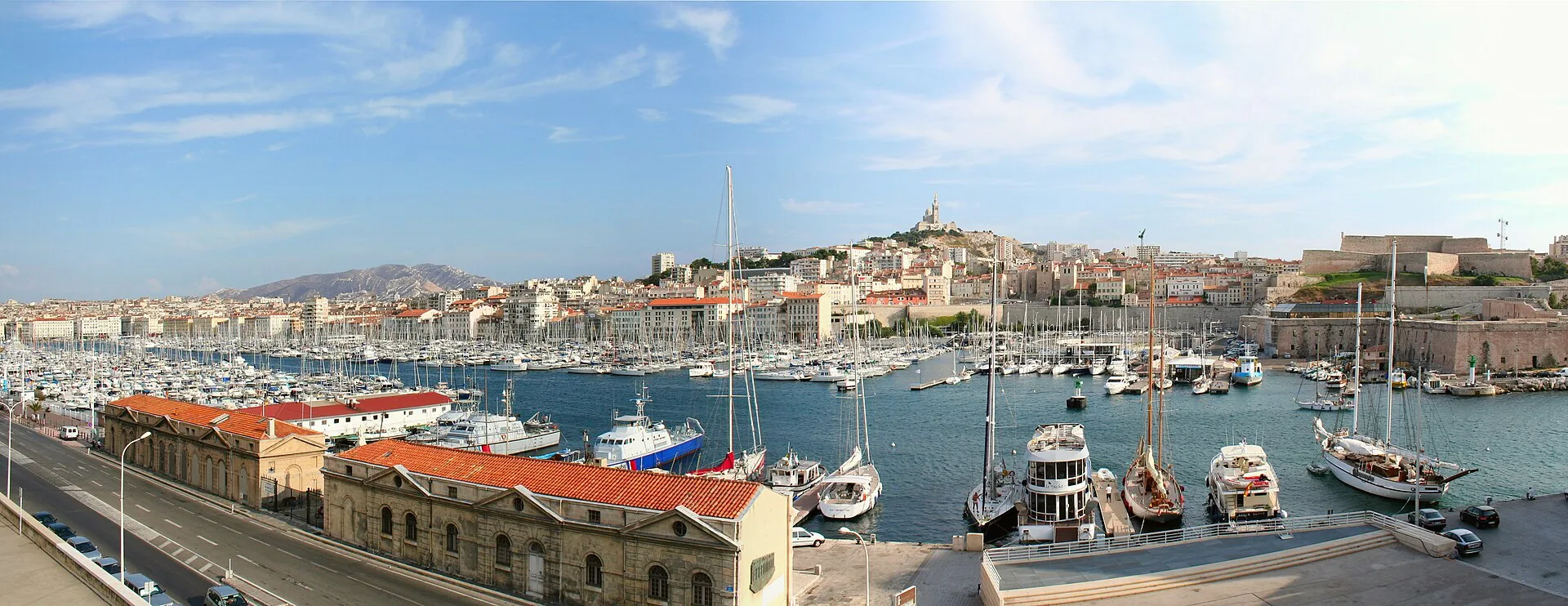
Choose Nice for a compact first visit built around the seafront. Choose Marseille for port-city culture and Provence outings. Both work without a car, but they ask different things of your day: Nice puts its Old Town beside the Promenade des Anglais, while Marseille spreads its sights and evening districts around the Old Port and beyond.
For a short stay, the deciding question is less which city has more to see than what you want within easy reach of your room. Beach access, museum visits and the journey home after dinner all help make that choice.
Marseille and Nice at a glance
| Criterion | Marseille | Nice |
|---|---|---|
| Sightseeing geography | Dispersed port, historic quarter and evening districts | Compact Old Town and seafront; art museums farther out |
| Central beach access | Catalans beach southwest of the Old Port | Pebble beaches beside the central Promenade |
| Evenings | Port restaurants; Cours Julien bars | Old Town dining; seafront walks |
| Mid-range double room | Around €100–€180 per room per night | Around €120–€220 per room per night |
| Casual main course and drink | Around €20–€30 per person | Around €25–€35 per person |
| Airport ticket purchase | €15 per adult, single A1 bus ticket | €10 per person, airport return ticket; €2 refundable card deposit |
| Representative day trips | Aix-en-Provence; Calanques when access permits | Antibes and the Riviera |
Nice is the easier choice if you want sightseeing and the beach to share the same central area. Marseille suits a stay in which the port, neighbourhood walks and cultural visits matter more than having the shoreline immediately beside you. Neither choice requires hiring a car.
The room estimates compare a mid-range double in a useful central location, not a luxury seafront hotel. Summer, weekends and the closest waterfront addresses push prices upwards, while shoulder-season dates and rooms slightly inland tend towards the lower end. Marseille’s estimated room range is €20–€40 lower at the corresponding ends, and its casual-meal range is €5 lower.
The meal estimates use the same main-course-and-drink basis. A simple neighbourhood restaurant is more likely to sit towards the lower end than a waterfront table. Adding courses changes the comparison. Both cities also have inexpensive takeaway food, so you need not make every meal a sit-down occasion.
If you fly into one city and out of the other, Nice’s return ticket may include an airport journey you will not use. Factor that into your arrival costs rather than treating the two ticket purchases as equivalent single fares.
Sights, food and places to stay
Marseille
Pros
- Le Panier’s hillside lanes and MuCEM’s Mediterranean focus give the port area more than a waterfront walk.
- Cours Julien offers street art and bars for an evening centred on a neighbourhood rather than the harbour.
- Chickpea fritters (panisses) suit a snack stop.
Cons
- Le Panier’s slopes and steps can make its attractive addresses less convenient with luggage.
Nice
Pros
- The Old Town, Cours Saleya and Castle Hill combine market streets with a view over the coast.
- The Matisse and Chagall museums add two distinct art visits to a seafront stay.
- Local takeaway food works well for a lunch between sightseeing stops.
Cons
- Old Town accommodation can put you close to evening noise, with luggage carried through pedestrian lanes.
Marseille is the larger, more dispersed city, but an Old Port base keeps much of its first-visit sightseeing together. Le Panier rises above the north side of the harbour. MuCEM explores Mediterranean civilisations beside Fort Saint-Jean. Choosing among Marseille museums adds depth if collections, rather than just waterfront landmarks, are your main reason to visit.
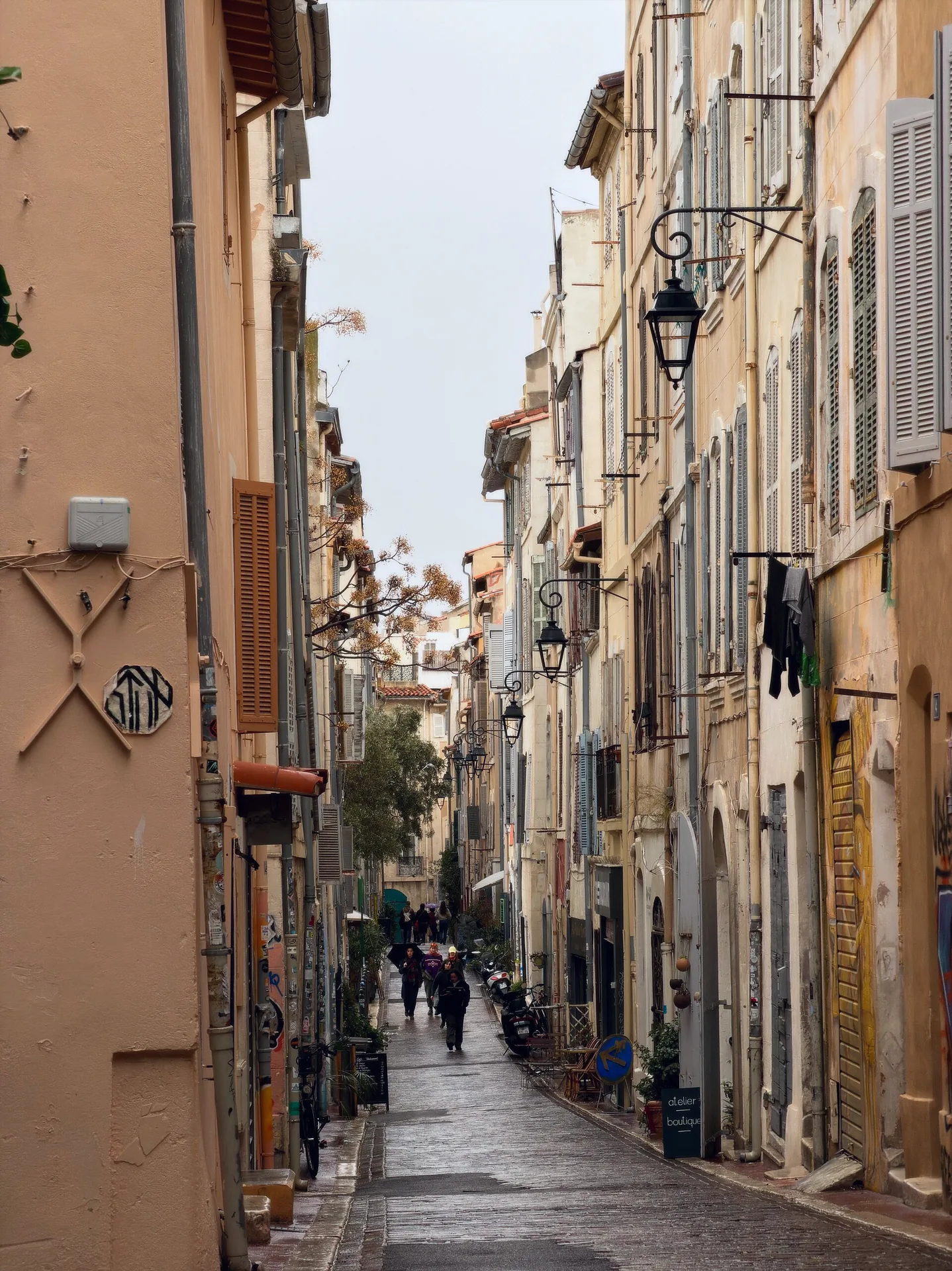
Mike is Michi · CC BY-SA 4.0 · Edited
The Old Port is the clearest accommodation reference point for harbour walks and access to Le Panier. Cours Julien has a different role, with street art and evening bars inland from the waterfront. Marseille nightlife helps you choose an evening district and think through the return to your room, rather than assuming every night ends at the port.
Panisses are usually made by cooking chickpea flour with water into a firm mixture, cooling it, then slicing and frying it.
In Nice, the Promenade des Anglais gives the seafront its long walking axis. The Old Town brings narrow streets and restaurants together behind it, while Cours Saleya provides the market setting. Castle Hill is worth the climb for the view over the bay and port, but it is a viewpoint, not a surviving castle to tour.
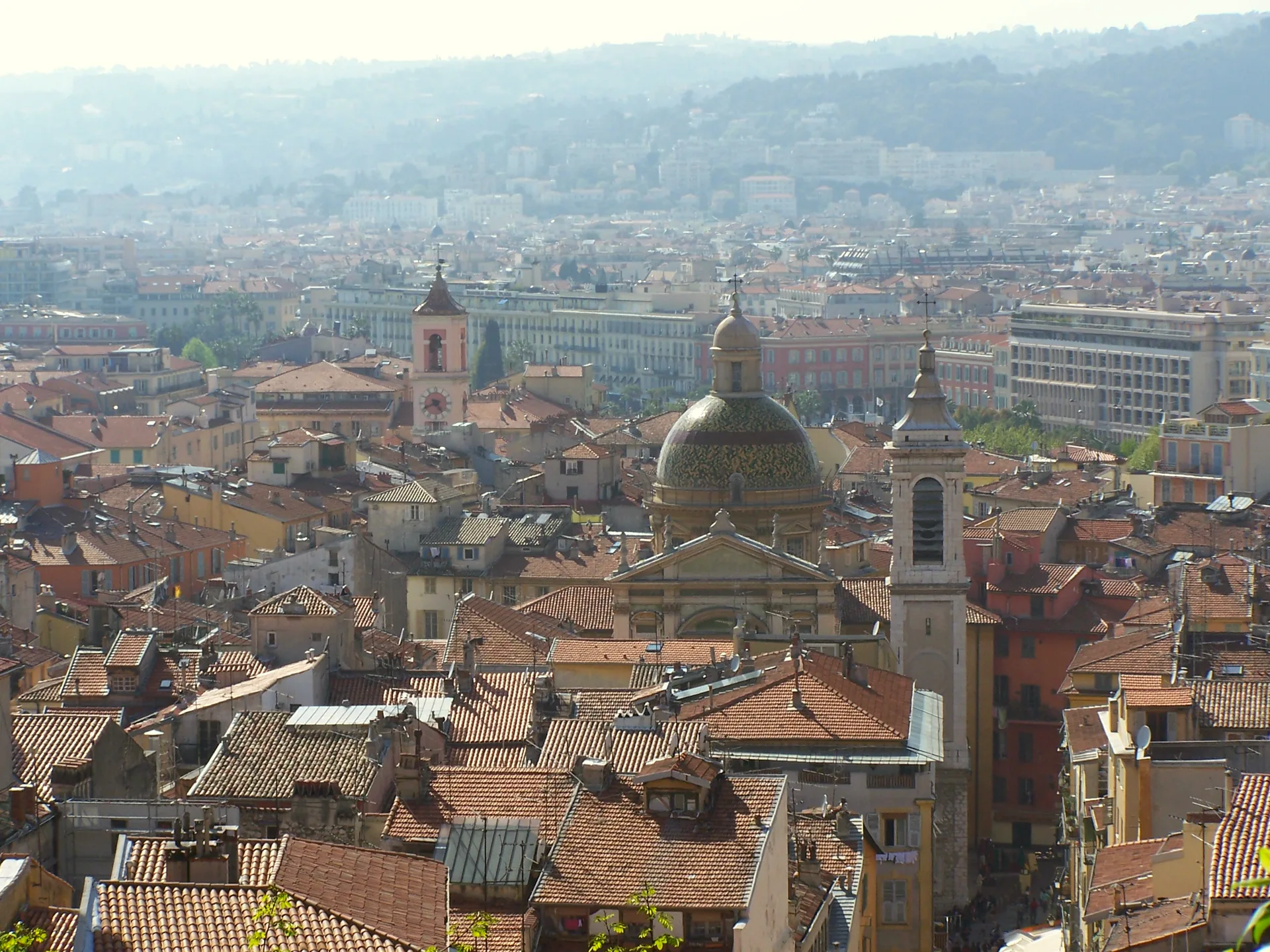
Baptiste Rossi · Public domain · Edited
Use Place Masséna as Nice’s central accommodation reference point. It sits between the Old Town, seafront and Jean Médecin shopping and transport corridor. The Matisse Museum is inland in Cimiez, while the Chagall Museum focuses on his biblical paintings. Neither belongs to a purely beachfront sightseeing day.
Pissaladière is an onion tart, typically topped with anchovies and olives on a bread-like base. Pan bagnat means bathed bread: a round roll dressed with olive oil and usually filled with tuna, vegetables, egg and anchovies. Both offer a recognisably Niçois lunch without a long restaurant stop.
France-wide visitor precautions apply on arrival at Marseille Saint-Charles and in busy central areas: keep phones and valuables secure on crowded transport, avoid demonstrations and follow police instructions during disruption.
Airport buses and trams
Marseille Provence Airport’s A1 shuttle runs directly to Marseille Saint-Charles. The standard adult single costs €15 per person. From there, continue to the Old Port or your accommodation by local transport or on foot as appropriate for your luggage and address. The airport bus delivers you to the railway station, not to the harbour.
Airport departures begin at 04:05, followed by 04:25 and 04:40. Buses then run every 20 minutes until 07:00, every 10 minutes until 20:00 and every 20 minutes through the late evening. In the other direction, Saint-Charles departures begin at 03:30 and 03:45, then follow the same daytime frequency pattern.
Nice Airport Terminal 2 has a direct line 2 tram to Jean Médecin, taking about 32 minutes to the central tram stop. Continue from there to your room. Place Masséna and the Old Town lie towards the seafront. Buy the €10 airport return ticket per person, with a separate €2 refundable deposit for an anonymous rechargeable card. The ticket allows connections within 74 minutes of first validation, which is useful if your accommodation needs another local leg.
For an overland departure from the UK, London to Marseille by train offers an alternative to flying, with the Paris connection and arrival at Saint-Charles as the key parts of the journey. It also leaves you at the same city station used by the airport shuttle.
Beaches, day trips and the season
Nice puts pebble beaches beside the central Promenade, not a sandy shoreline. The pebble slope can make getting out of the water difficult; exit ropes at 10 beaches help swimmers climb back up. Choose flagged, supervised swimming areas and respect bathing bans. Water shoes can make the stones more comfortable, but they do not remove the slope.
In Marseille, Catalans beach is the practical public bathing choice from the Old Port, about 1 km southwest, roughly a 15–20-minute walk. It gives a port-based stay a beach break, although swimming is a separate outing rather than something alongside the main harbour walk.
Aix-en-Provence offers a change from Marseille’s port to inland squares and old-town streets. Regular TER trains link Saint-Charles with Aix-en-Provence’s city station, not Aix-en-Provence TGV. The full-fare adult single costs €10.90 per person. Return trains from Aix run between 05:52 and 22:22, with an average journey of 45 minutes, leaving room for dinner before returning.
From Nice-Ville, regular direct TER trains reach Antibes in about 30 minutes. Its walled Old Town and harbour make it a distinct Riviera outing rather than another day on Nice’s Promenade. The full-price adult single is €5.70 per person. Return services from Antibes to Nice run between 05:31 and 22:56. Antibes therefore costs €5.20 less each way than the Aix outing, on the same adult single-ticket basis.
The Calanques bring limestone coastal scenery to a Marseille stay, but a summer walking plan needs an alternative city day if access is prohibited. Treat the park as an outing in its own right, not an extra stop squeezed in after a full museum day.
Summer brings crowded beaches in both cities and stronger demand for central rooms. Choose a shoulder-season stay if sightseeing matters more than swimming: neighbourhood walks and museum visits need not depend on a beach afternoon. In summer, Nice’s immediate seafront is convenient, while Marseille’s Calanques ambitions remain conditional on permitted access.
Combining Marseille and Nice
For a longer trip, visit Marseille first and finish in Nice. Put the more dispersed port-city sightseeing at the start, then end with the compact Old Town and seafront. Allow three nights in each city as a useful starting point: that gives each base a city day and an outing, without treating the move as sightseeing time.
If you have only three or four nights altogether, stay in one city. A split stay means packing, leaving your room, reaching Saint-Charles, travelling to Nice-Ville and getting to the next accommodation. Keep the transfer day lighter rather than promising yourself a full day trip at either end.
Direct TER trains connect Marseille Saint-Charles with Nice-Ville. Their full-fare adult single is €42.50 per person. Direct TGV INOUI trains also run, taking about 3 hours between these stations, and TGV INOUI requires a reservation.
An arrival through Marseille Provence Airport and departure through Nice Airport avoids retracing the intercity journey. Choose UK flights that serve those airports and leave enough time for the final journey from your Nice accommodation to the terminal. The open-ended route lets the stay finish on the coast rather than with a return transfer west.
Which base fits your trip?
- Choose Nice for a compact first visit if you want the Old Town, seafront walks and beach access together.
- Choose Marseille for port-city culture, Mediterranean collections, panisses and evenings around Cours Julien.
- Choose Marseille for Provence outings, especially Aix-en-Provence. Choose Nice for Riviera rail trips such as Antibes.
- Choose Nice’s beach setting only if pebbles and the shore slope suit you. Central access does not mean easy entry or exit for every swimmer.
- Choose Marseille for summer Calanques plans only with a fallback day when fire-risk rules prohibit access.
- Lean towards Marseille for the lower estimated stay budget, comparing the same room standard and meal rather than a waterfront hotel with an inland one.
- Choose Marseille then Nice if you have six nights to split, allowing a city day and an outing at each base. For a shorter break, avoid the accommodation move.
For a short break, let your preferred city day decide.
Sources & fact-checking
Checks against the sources below cover: fares and charges, as well as services.
- Horaires des trains Marseille-Nice | SNCF
- SNCF Voyageurs — service
- Bus et navettes – Aéroport Marseille Provence
- Métropole Aix-Marseille-Provence — fares and charges
- Marseille St Charles Station — Marseille Provence Airport
- Airport access – Lignes d’Azur
- Lignes d’Azur — fares and charges
- Evening transport network – Lignes d’Azur
- Ville de Nice — service
- Horaires des trains Marseille – Aix-en-Provence | SNCF TER
- Horaires des trains Aix en Provence – Marseille | SNCF
- SNCF TER Sud Provence-Alpes-Côte d’Azur — service
- Horaires des trains Nice – Antibes | SNCF
- Préfecture des Bouches-du-Rhône — service