Pack a travel adaptor for Tenerife if your devices have UK three-pin plugs. Before you pack, read the mains input label on each charger or appliance to see whether an adaptor will be enough.
Wall sockets and plug fit
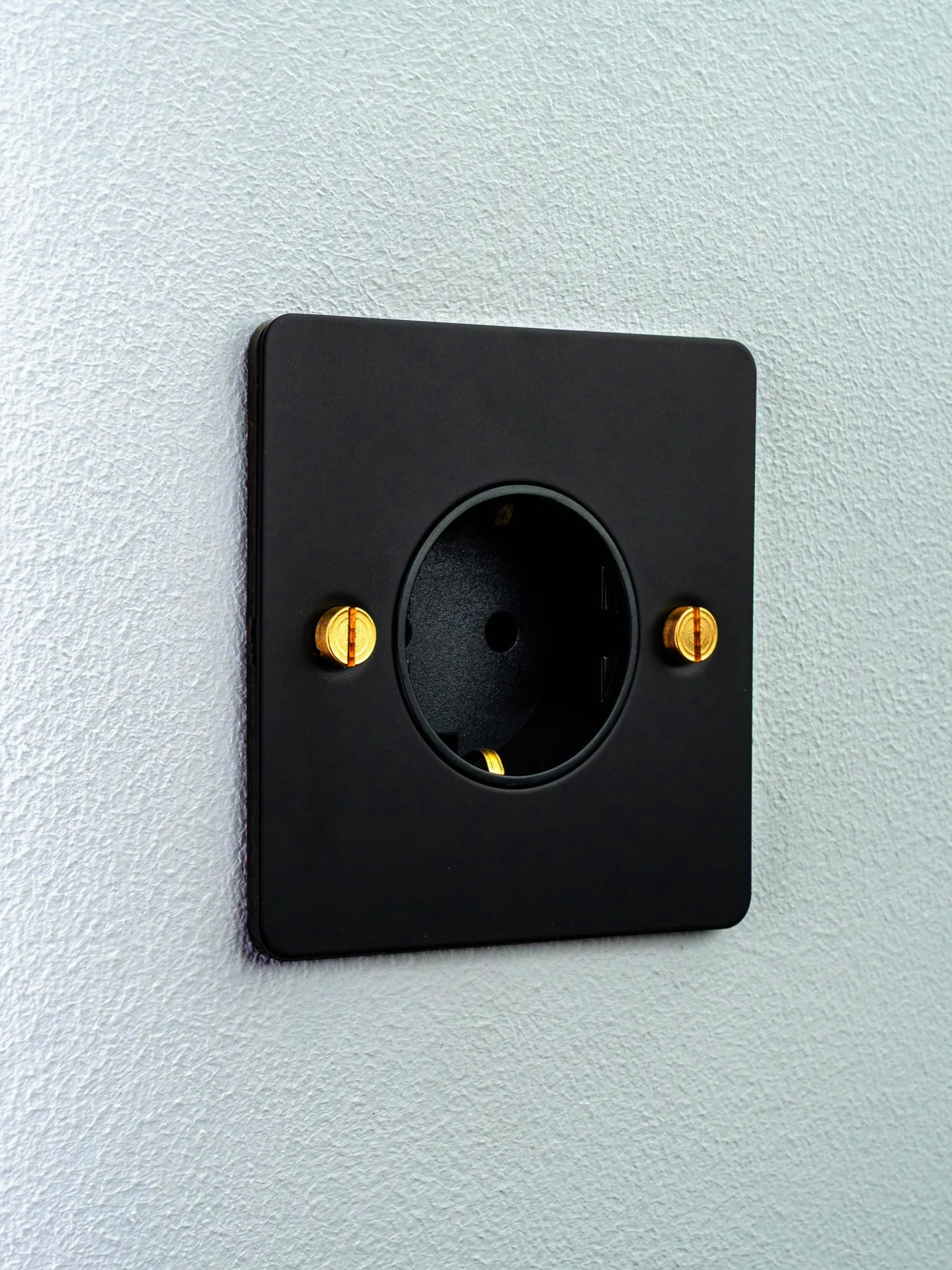
- Standard wall socket
- Type F (Schuko)
- Nominal mains voltage
- 230 V
- Mains frequency
- 50 Hz
- UK three-pin plug (Type G)
- Adaptor needed
- Flat-pin Type A or Type B plug
- Adaptor needed
- Type C Europlug
- Fits directly
The Type C Europlug has no earth contact. It’s used on equipment that doesn’t need a protective earth.
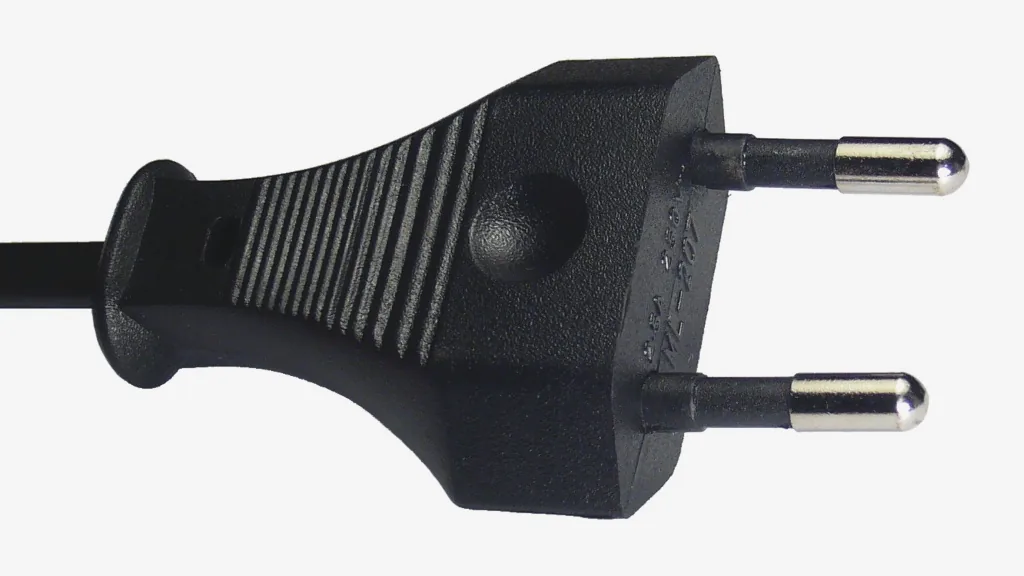
SomnusDe · Public domain · Edited
Some Tenerife accommodation has both Type C and Type F sockets. At Iberostar Waves Las Dalias in Costa Adeje, every room has a Type C connection. A Type C-only wall socket has contacts just for live and neutral. The round pins of a Type F plug can fit this socket, but the appliance won’t be earthed.
If your appliance needs an earth, use an earthed Type F socket. You can recognise it by the metal earthing clips at the edge of the recess. If you’re adapting an earthed plug, choose an adaptor that connects the plug’s earth contact to those clips. Look for an explicit earthing specification rather than judging by the shape of the holes.
Do
- Use a plug or adaptor that goes in without force.
- Use a compatible appliance instead if you can’t maintain the earth connection.
Don’t
- Push a plug past resistance or try to bend the pins to fit.
- Bypass the earth on an appliance that needs it.
Charger labels and voltage converters
Keep your usual phone or laptop charger if its input rating covers the local supply. Look for Input on the charger casing, often near the pins, or on the power brick in the lead. For an appliance, look for the rating plate on its body. The Output marking tells you what the charger sends to your device through USB or another connector, not what it can take from the wall.
On a label reading Input: 100–240 V, 50/60 Hz, the first part is the range of mains voltages the charger accepts. The second part gives the two frequencies it can run on, in hertz (Hz). Both cover Tenerife’s supply. With this input rating, you only need an adaptor if the plug doesn’t fit. An adaptor changes the fit, not the voltage.
If you need to bring a lower-voltage appliance, choose a converter designed for that kind of appliance. The converter’s rated load must be higher than the appliance’s input power. Compare the figures in watts, using the input power on the appliance label. A converter suitable for a small charger may not be able to run a hair dryer.
A step-down transformer lowers voltage but leaves the mains frequency unchanged. If your appliance needs a different frequency, you’ll need a frequency converter to run it.
Buying or borrowing an adaptor
Buy before departure if you’ll need to charge your phone as soon as you land. A basic single-destination adaptor typically costs €5–€10. Multi-country models usually cost more, but the extra is worth considering if you regularly travel to places that use different sockets.
Try the airport shops in Tenerife if you arrive without an adaptor, though you may pay more there than you would before departure. If you’ve already reached your accommodation, ask whether staff can lend you an adaptor before making a separate trip to the shops.
If you also want to refill your bottle at your accommodation, read about drinking tap water in Tenerife.
Sources & fact-checking
Checks against the sources below cover: key figures.