Choose September for a Venice sightseeing trip, or May if you prefer a longer outdoor day. Both offer a better balance for extended walks than midsummer, but neither makes the Rialto Bridge or St Mark’s Square quiet. Ordinary winter weeks outside Carnival suit travellers who put fewer crowds and lower room-cost pressure ahead of warmth and daylight.
The best months for sightseeing
- First choice for sightseeing
- September
- Spring alternative
- May
- Quieter alternative
- Ordinary winter weeks outside Carnival
- Warmest nights, mean daily minimum
- July
- Coldest nights, mean daily minimum
- January
- Most precipitation days on average
- June
September balances warmer nights and fewer precipitation days against a shorter day than the spring alternative. May gives you more daylight for walks and outdoor pauses, though rain occurs on more days on average. These are choices for comfortable sightseeing, not promises of empty squares or dry weather.
For crowd-sensitive travellers, winter is the stronger alternative if you can accept cold and short days. Build a stay around substantial indoor visits rather than continuous walking. The quieter months and days in Venice matter more to this choice than the warmest weather. Carnival is the important winter exception.
For the same double room in the historic centre, expect lower accommodation-cost pressure in ordinary winter weeks and higher pressure in the milder sightseeing periods. Easter and Carnival can upset that seasonal balance. Location and room standard still matter, so compare like with like rather than treating a cheaper room elsewhere as a seasonal saving.
July and August are a poorer fit if heat makes walking tiring. If your priority is being outdoors comfortably, favour a milder period. If it is space at the sights and less pressure on accommodation, accept the winter trade-off.
Night-time weather, rain and daylight by month
| Month | Mean daily minimum °C (1991–2020) | Precipitation days (1971–2000) | Monthly mean daylight hours | Crowd outlook | Sightseeing verdict |
|---|---|---|---|---|---|
| January | 0.2 | 6.0 | 9.0 | Quieter outside Carnival | Mixed: cold, short days |
| February | 1.0 | 5.2 | 10.0 | Carnival-dependent | Mixed: cold nights |
| March | 4.5 | 5.7 | 12.0 | Easter-dependent | Mixed: cool evenings |
| April | 8.4 | 8.3 | 14.0 | Easter-dependent | Mixed: more rain days |
| May | 13.3 | 8.2 | 15.0 | Busy landmarks | Good fit: long daylight |
| June | 17.2 | 8.6 | 16.0 | Busy landmarks | Mixed: warm, more rain days |
| July | 19.3 | 5.9 | 15.0 | Busy landmarks | Avoid if heat-sensitive |
| August | 18.7 | 6.1 | 14.0 | Busy landmarks | Avoid if heat-sensitive |
| September | 14.8 | 5.9 | 13.0 | Busy landmarks | Good fit: milder walks |
| October | 10.0 | 6.7 | 11.0 | Busy landmarks possible | Mixed: shrinking daylight |
| November | 5.0 | 5.8 | 10.0 | Quieter ordinary weeks | Mixed: cool, short days |
| December | 0.8 | 5.9 | 9.0 | Quieter ordinary weeks | Mixed: cold, short days |
Mean daily minimum temperature describes the cooler part of the day, not afternoon heat. It helps you weigh early starts and evenings outdoors, but an individual night’s temperature can differ considerably.
Precipitation-day frequency describes how often rain occurs, rather than its amount or duration. A wet day need not be an all-day washout: a shower can interrupt an outdoor pause without preventing the rest of your walk.
Daylight is the span available between sunrise and sunset, not hours of sunshine. Cloudy days still have daylight, but the monthly mean does not tell you how bright those hours will be.
Spring and autumn
Choose May over September when long outdoor days matter most. May’s extra daylight gives you more room for walks between sights and an unhurried outdoor pause after an indoor visit. September instead offers warmer nights and fewer precipitation days on average, a useful balance if you like to stay out into the evening without seeking midsummer conditions.
Easter is the major spring crowd exception: congestion typically surges in the historic centre and around major attractions. If you are choosing spring for easier sightseeing rather than holiday events, dates outside the Easter holiday period are the better fit. Comfortable temperatures alone do not make a holiday visit comfortable to navigate.
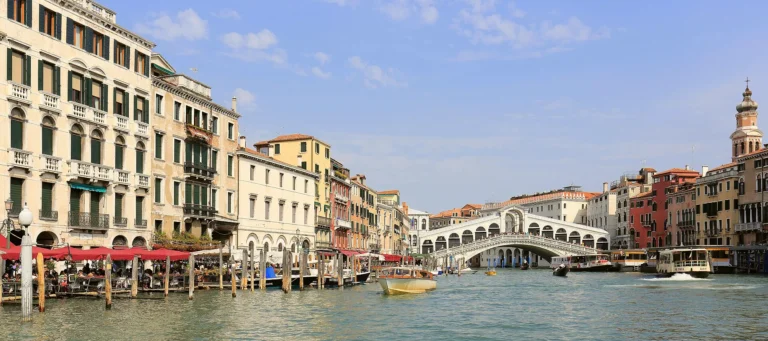
The Rialto Bridge is both a Grand Canal viewpoint and a busy pedestrian crossing. People stopping to look and people moving between the banks share the same space, so allow room for a slow crossing rather than expecting an uninterrupted stroll. Its crowds illustrate the difference between pleasant walking weather and room at Venice’s best-known sights.

Dmitry Romanoff · Pexels License · Edited
Later autumn changes the rhythm of a stay. As nights cool and daylight contracts, shorter outdoor stretches paired with longer indoor visits become more appealing than a day spent crossing the city on foot. September is the stronger choice if you want outdoor time to carry most of the trip, while later autumn suits you better if museums and churches are central to it.
The later-autumn choice also brings the high-water trade-off. Historical tide seasonality makes it more relevant then, while MOSE’s flood barriers have changed the effect of exceptionally high tides. Treat that as another reason to keep your walking plans flexible, rather than as a reason to rule out autumn altogether.
Summer sightseeing
Summer is workable for fixed travel dates, but split your outdoor sightseeing rather than planning one long walk. Longer daylight gives you scope to start outdoors earlier and return to the streets later, while warmer nights make an evening outing easier to fit around dinner.
Use the middle of the day for a substantial indoor visit and a proper break. The Doge’s Palace, with its council chambers and rooms of government, gives a sightseeing day a focus beyond walking between landmarks. Avoid making the rest of the afternoon a chain of lengthy crossings simply because there is still daylight left.
If you are sensitive to heat, July and August offer a less comfortable balance than May or September. Shorter visits and pauses help, but they do not turn a hot-weather trip into a mild-weather one. Choose summer because it suits your dates or your preference for long days, not because you expect easier walking.
Nor should you assume that an early or late outing will leave the main landmarks empty. Around St Mark’s Square and Rialto, keep the day’s pace loose enough to accommodate slow movement and time spent looking rather than just reaching the next sight.
Winter and Carnival
Ordinary winter weeks suit a sightseeing-led stay with shorter walks and substantial indoor visits. Cold mornings and evenings, damp conditions and limited daylight make a continuous outdoor day less appealing. They need not undermine a trip built around art, churches and time to sit down between sights.
Choose ordinary winter weeks over Carnival if lower room-cost pressure is part of your reason for travelling. On the same historic-centre double-room basis, Carnival is an event-driven exception to the quieter season: visitors come for the celebrations themselves, so treat it as an event-led trip.
Venice Carnival 2027 runs from 23 January to 9 February 2027. Choose that window if Carnival is a reason for travelling, or choose ordinary winter dates outside it if your main aim is quieter access to the city’s sights.
St Mark’s Square and the main routes carry the heaviest Carnival crowds, especially during weekend daytime events. Walking can be slow and tightly packed. Side neighbourhoods and evenings are generally quieter, allowing a different rhythm away from the main celebrations, though not a guarantee of empty streets.
For rain in any season, shorten the outdoor stretches and keep an indoor visit flexible. The Gallerie dell’Accademia, devoted to Venetian painting, makes a worthwhile focus rather than merely a shelter from a shower. Leave room for a café break instead of trying to preserve every planned walk. This approach is particularly useful in winter, when getting wet has a greater effect on the comfort of the rest of your day.
High water and visitor access
- When high water obstructs a route, use designated pedestrian routes and temporary raised walkways where provided.
- From 27 July 2026, after the trial ended, neither day-visitor access-fee payment nor an overnight guest’s exemption request is required until new provisions take effect. As of 4 October 2026, no further application period has been announced.
High water has historically been concentrated in late autumn and early winter. November has the most events, followed by December and October. Together they account for about 70%, while summer events are rare. The historical monthly distributions cover tides at or above 100 cm and 110 cm.
Acqua alta means high water. Venice conventionally defines it as a tide above 80 cm relative to the Punta Salute reference level. Tide height and whether a particular walking route is flooded are different questions: low-lying St Mark’s Square has historically experienced inundation.

KlausFoehl · CC BY-SA 3.0 · Edited
MOSE’s flood barriers have prevented exceptionally high tides from inundating Venice when raised, keeping city water levels substantially lower. They do not prevent ordinary high tides or flooding caused by rainfall and drainage problems. Their observed protection changes the autumn and winter trade-off, but keeping outdoor plans flexible still matters.
Sources & fact-checking
Checks against the sources below cover: key figures and services.
- Venice Carnival official site — key figures
- Venice and high water
- FAQ | Contributo di Accesso
- Comune di Venezia — key figures
- Italian Air Force Meteorological Service (Fuerza Aérea Italiana – Departamento de Meteorología) — key figures
- Italian Air Force Meteorological Service, with support from the Hong Kong Observatory — key figures
- Veneto Region Statistical System (Sistema Statistico Regionale) — key figures
- Thesis Text