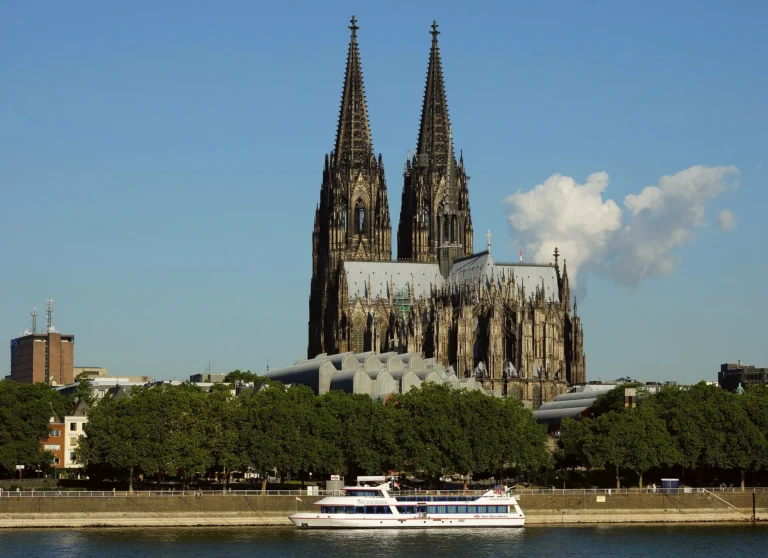
Cologne’s museums offer very different ways to spend a few hours. Museum Ludwig puts modern art beside the cathedral, while Kolumba makes the building and its historic layers part of the visit. Elsewhere, you can explore Roman everyday life, confront the city’s Nazi-era history, watch chocolate production or follow the origins of eau de Cologne.
Choose one museum for its subject, or two with contrasting collections. These six visits are independent choices, ordered from art through local history to specialist experiences, not a route to complete in a day.
Which museum should you choose?
| Museum | Full adult admission | Time inside | Regular closed day | Walk from cathedral forecourt |
|---|---|---|---|---|
| Museum Ludwig | €15.40 | 2–3 hours | Monday, except public holidays | about 200 metres |
| Kolumba | €8 | 1½–2 hours | Tuesday | about 600 metres |
| NS Documentation Centre | €4.50 | 2–3 hours | Monday | about 700 metres |
| Romano-Germanic Museum | €6 | 1–1½ hours | Tuesday | about 1.1 km |
| Chocolate Museum | €17.50 Mon–Fri; €19 weekends/public holidays | About 2 hours | None regularly | about 1.3 km |
| Farina Fragrance Museum | €12 regular weekday tour; €18 historical tour, weekends/Thursday afternoons | About 45 minutes | — | about 400 metres |
Museum Ludwig is the strongest choice here if you want modern art, particularly Pop Art or Picasso. Choose Kolumba for architecture and art across periods, or the NS Documentation Centre for a serious account of Nazi-era Cologne. The Romano-Germanic Museum’s interim display suits an interest in archaeology, while chocolate demonstrations and Farina’s fragrance tour offer more focused subjects.
None of these selected experiences is free at the standard adult tariff. On a rainy day, pick the collection you actually want to see rather than trying to fit in several museums. For two contrasting visits, an art collection followed by chocolate production gives you a change of subject and pace.
Museum Ludwig
Museum Ludwig is worth your time if Pop Art, Picasso or German Expressionism are what you want to see. Photography adds another strand to a collection spread across several floors. Rather than moving quickly through every gallery, give the works that interest you room, then decide whether to add a special exhibition.
Its cathedral-side position makes it easy to combine with a first look at Cologne’s centre. Arriving near opening leaves you an unhurried stretch for the collection, rather than squeezing it between other visits. An audio guide can add context if you prefer more explanation alongside the works.

Raimond Spekking · CC BY-SA 4.0 · Edited
The standard ticket covers the permanent collection and all special exhibitions on the same day. You can buy an ordinary visit ticket online or at the ticket office without advance booking. Adding an exhibition is therefore a question of your remaining time and interest, not a separate standard admission.
Exhibition opening extends to 20:00 on Friday–Sunday. On the first Thursday of each month the museum opens from 10:00 to 22:00. Public holidays are the exception to its usual Monday closure.
- Name
- Museum Ludwig
- Location
- Heinrich-Böll-Platz, beside the cathedral Maps
- Site
- museum-ludwig.de
- Hours
- Mon Closed
- Tue–Sun 10:00–18:00
- Essential fact
- A modern and contemporary art museum beside Cologne Cathedral.
Kolumba
At Kolumba, looking at the building is part of looking at the art. Peter Zumthor’s architecture draws together the remains of St Kolumba, archaeological layers, a courtyard and displays ranging from antiquity to the present. It is an alternative to a broad survey of paintings: pay attention to how old fabric and new rooms meet, as well as to the individual works.
Give it an unhurried afternoon rather than adding it after several large collections. Moving between the historic remains and the displays is the activity itself, so a hurried circuit loses much of the reason to choose it.

Raimond Spekking · CC BY-SA 4.0 · Edited
For an ordinary individual visit, you can arrive without reserving a guided tour, but certain guided tours require registration. The admission ticket includes the Kolumba booklet and is valid for the whole day, allowing you to pause rather than rush straight through.
The chapel called “Madonna in the Ruins” is incorporated into the building but has a separate entrance. Treat that entrance as distinct from the museum’s gallery entrance when approaching the site.
- Name
- Kolumba
- Location
- Kolumbastraße 4, central Cologne Maps
- Site
- kolumba.de
- Hours
- Mon 12:00–17:00
- Tue Closed
- Wed–Sun 12:00–17:00
- Essential fact
- An art museum in Peter Zumthor’s building incorporating the remains of St. Kolumba.
NS Documentation Centre
The NS Documentation Centre occupies EL-DE House, the former Gestapo headquarters. The preserved prison cells and prisoner inscriptions make this a particularly direct encounter with Nazi-era Cologne. The permanent exhibition explains rule and persecution in the city, while the basement memorial and courtyard keep the people imprisoned here at the centre of the visit.
Choose it for serious local history, not a light family activity. Reading the exhibition and then entering the cells can be emotionally demanding, so leave room afterwards for a break rather than immediately moving on to another collection. The inscriptions deserve attention in their own right, not simply a glance after the exhibition.

Raimond Spekking · CC BY-SA 4.0 · Edited
Individual visitors buy tickets at the museum desk without advance registration, and there is no online ticketing. For step-free access to the basement memorial, including the former prison, use the courtyard entrance at Elisenstraße 1a. This is the approach to choose if stairs would otherwise prevent you from visiting the cells.
Public holidays follow the weekend opening window. The first Thursday of each month brings an extension until 22:00, except on public holidays, giving you an evening option for the exhibition and memorial.
- Name
- NS Documentation Centre
- Location
- Appellhofplatz 23–25, central Cologne Maps
- Site
- museenkoeln.de
- Hours
- Mon Closed
- Tue–Fri 10:00–18:00
- Sat–Sun 11:00–18:00
- Essential fact
- A museum and memorial in EL-DE House, Cologne’s former Gestapo headquarters.
Romano-Germanic Museum
The Romano-Germanic Museum’s public exhibition is at Belgisches Haus, or Belgian House. Choose this compact display to understand Cologne’s ancient origins through Roman and early-medieval finds. Its focus on history and everyday life gives you a manageable archaeology visit rather than the full collection of the original museum.
Spend your time with the selected objects and their labels, making connections between the ancient city and the Cologne around you. Going near opening suits a visit in which you want to read carefully. The smaller display also makes a useful contrast with a large art collection, without requiring another extensive circuit of galleries.

Raimond Spekking · CC BY-SA 4.0 · Edited
You can plan an individual visit without an advance reservation, but groups are asked to register. Busy periods can bring a wait, so leave some flexibility before your next commitment rather than planning to enter and leave at exact times.
The first Thursday of each month extends opening to 22:00, except on public holidays. That offers an evening alternative if your daytime hours are already taken up by other sights.
- Name
- Romano-Germanic Museum at Belgisches Haus
- Location
- Cäcilienstraße 46, central Cologne Maps
- Site
- roemisch-germanisches-museum.de
- Hours
- Mon 10:00–18:00
- Tue Closed
- Wed–Sun 10:00–18:00
- Essential fact
- The Romano-Germanic Museum’s interim archaeology exhibition at Belgisches Haus.
Chocolate Museum
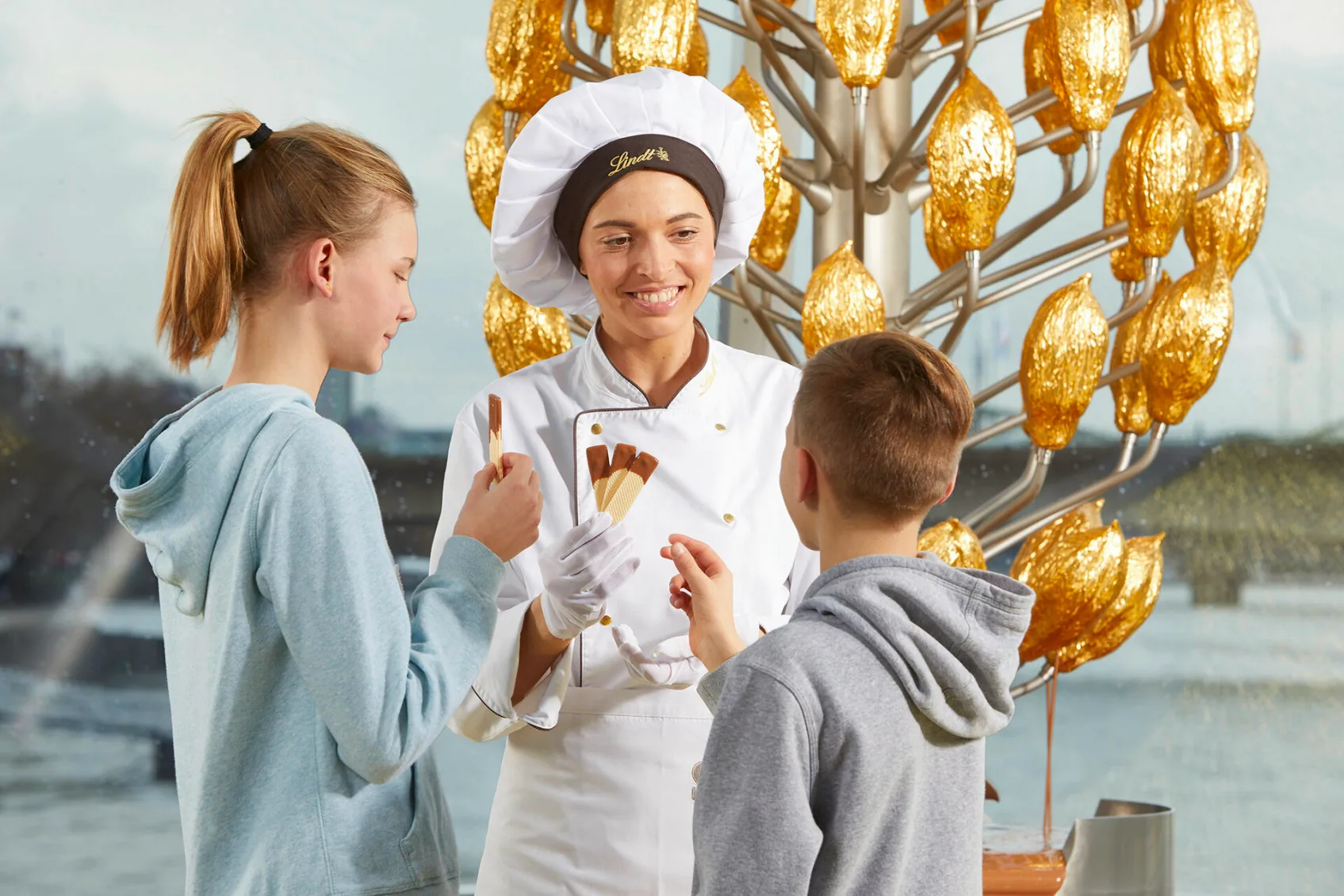
The Chocolate Museum follows cocoa from plant to finished product, with a tropical house, historical displays and a glass production line. Choose it if you enjoy seeing how something is made, rather than only looking at objects in cases. The chocolate fountain and demonstrations give families a clear focus, but the history of cocoa deserves time too.
An early weekday visit leaves room to follow the process without hurrying straight to the tastings. Its Rheinauhafen position also lends itself to a riverside break afterwards, making a change from the galleries and display rooms.
Schokoladenmuseum Köln · CC0 · Edited
You can buy ordinary admission at the ticket office or online. Advance booking is not required. Buying online ahead of time can reduce waiting, which is useful if you want to spend your available hours inside rather than in the ticket queue.
Chocolate-making courses need their own advance ticket as well as museum admission for each participant. Ordinary entry lets you explore the museum and watch production, but it is not a reservation for a hands-on workshop. Decide between observing and making before arranging your visit.
- Name
- Chocolate Museum
- Location
- Am Schokoladenmuseum 1a, Rheinauhafen Maps
- Site
- schokoladenmuseum.de
- Hours
- 10:00–18:00
- Essential fact
- A museum of cocoa and chocolate with a glass production line at Rheinauhafen.
Farina Fragrance Museum
At the Farina Fragrance Museum, a guide connects the maker’s history with Eau de Cologne, the fragrance whose name means “water of Cologne”. A smelling session lets you try to identify fragrance ingredients, turning perfume-making from an abstract subject into something you can investigate yourself.
Farina is a compact specialist visit, not a broad museum collection to browse independently. You follow a guided tour through the history of the house and the making of perfume. Its Old Town position makes it easy to leave space for a break near the cathedral before or afterwards.

Johann Maria Farina · Public domain · Edited
Tours run hourly. Standard tours take place on weekdays, while historical costume tours take place at weekends and on Thursday afternoons. The tour ticket includes admission and a small fragrance gift. Plan your museum visit around the guided tour, not the boutique’s opening hours.
Reserve a standard weekday tour in English if that is the language you need. English is available on these tours, and advance booking is strongly recommended. It is not compulsory for individuals: walk-ins can join when places remain, but you cannot rely on there being space.
- Name
- Farina Fragrance Museum
- Location
- Obenmarspforten 21, Old Town Maps
- Site
- farina.org
- Hours
- Mon–Sat 10:00–19:00
- Sun 11:00–17:00
- Essential fact
- A fragrance museum in historic Farina House in Cologne’s Old Town.
Sources & fact-checking
Checks against the sources below cover: fares and charges, opening hours, closures, and services.
- Museum Ludwig — fares and charges
- Museum Ludwig — opening hours
- Museum Ludwig — closures
- Museum Ludwig — service
- NS-Dokumentationszentrum der Stadt Köln — fares and charges
- NS-Dokumentationszentrum der Stadt Köln — opening hours
- Farina Duftmuseum — fares and charges
- Farina Fragrance Museum — opening hours
- Kolumba (Art Museum of the Archdiocese of Cologne) — fares and charges
- Wallraf-Richartz-Museum & Fondation Corboud — closures
- Schokoladenmuseum Köln GmbH — fares and charges
- Schokoladenmuseum Köln — service
- Museums of the City of Cologne — closures
- City of Cologne — fares and charges
- Römisch-Germanisches Museum, City of Cologne — opening hours