Choose ordinary January dates after New Year and outside Mozart Week for a quieter Salzburg winter break. Mozart’s Birthplace gives you a substantial indoor visit, with short Old Town walks around it. February is the alternative if you want more daylight, while Advent weekdays suit a trip whose main attraction is the Salzburg Christkindlmarkt.
Winter is worth choosing for those purposes, rather than for long days outdoors or dependable snow. The trade-off is a colder, shorter sightseeing day and a reduced outdoor attraction offer, balanced by lighter visitor demand and better relative room value away from festive dates and major events.
Which winter dates suit your visit?
- Quieter cultural break
- January after New Year, outside Mozart Week
- Longer daylight alternative
- February, outside holiday periods
- Christmas-market visit
- Advent weekdays
- Wettest month in this winter series
- November
- Driest month in this winter series
- February
- Shortest representative day
- December
Winter suits a substantial indoor visit with short walks, not a day dependent on being outdoors. Make Mozart’s Birthplace the main cultural stop, and let conditions decide how much time you spend in the Old Town or gardens.
January and February are generally quiet for city sightseeing outside holidays and major events, with fewer visitors and lower hotel prices than peak summer. The quieter streets are part of the appeal, but the cold limits lingering outdoors. January’s post-holiday lull has a Mozart Week interruption, and February school holidays can also bring a temporary rise in demand. For a festive trip, choose the market season instead of expecting ordinary winter dates to offer the same experience.
Winter precipitation and daylight
| Month | Precipitation normal | Daylight on 15th, 2026 | Visitor demand | Fit and cause |
|---|---|---|---|---|
| November | 73.2 mm | 9h 17m 33s | Busier on market weekends | Mixed: market-season lead-in |
| December | 72.5 mm | 8h 25m 45s | High on Advent weekends | Good for festive visits |
| January | 71.0 mm | 8h 50m 35s | Low outside holidays/events | Good for indoor culture |
| February | 53.7 mm | 10h 16m 23s | Low outside holidays/events | Good for longer walks |
February gives you a more generous outdoor daylight window alongside a lower precipitation normal. That makes it a useful alternative to January if walking matters as much as museums. It remains a winter visit, so the extra daylight is a reason to allow a longer outdoor portion, not to build the entire day around it.
Precipitation totals include water falling as rain or snow, but they do not describe how often it falls or how long wet spells last. Sunrise-to-sunset daylight is not sunshine: cloud can make an outdoor afternoon less inviting even while it is light.
Keep your Old Town walk movable around an indoor visit. Cold and wet conditions make a long unbroken sightseeing walk less appealing, while a shorter circuit still lets you see the streets and squares. Snow is possible, but a city break should have a purpose that works without it.
No machine-readable author provided · CC BY-SA 3.0 · Edited
Advent, Christmas and New Year
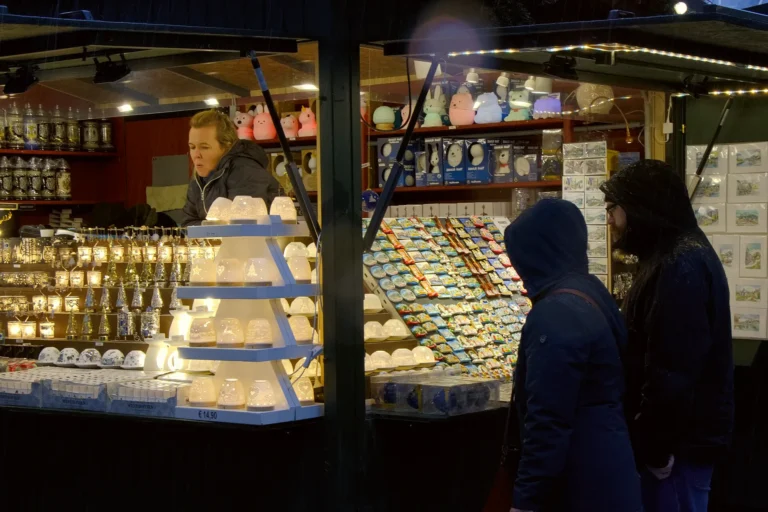
The Salzburg Christkindlmarkt (Christmas market) at Cathedral Square and Residence Square is the reason to choose the festive period: browsing its stalls becomes a central part of the visit rather than an addition to museum sightseeing. For the market atmosphere with more room to browse, favour an Advent weekday.
- Announced market season
- 19 November 2026–1 January 2027, daily
- Monday–Thursday
- 10:00–20:30
- Friday
- 10:00–21:00
- Saturday
- 09:00–21:00
- Sunday and public holidays
- 09:00–20:30
Special hours apply on certain dates within that season. Early afternoon is generally easier for browsing, while Tuesday–Thursday evenings after about 17:00 offer a quieter evening choice. Saturday afternoons and early evenings draw more people, with the sharpest pressure on opening weekends and just before Christmas. A weekday lets you enjoy the market without making the busiest part of the week your main sightseeing window.
Advent, Christmas itself and New Year offer different trade-offs. Advent is the clearest choice for a market-led break, while Christmas falls within the announced market season but brings shortened sightseeing hours. New Year also sits at the season’s end, with a holiday opening exception at Mozart’s Birthplace. Avoid treating either holiday as an ordinary museum day.
Festive dates generally offer less favourable accommodation value than ordinary post-holiday winter dates. If the market is your reason to come, that trade-off can be worthwhile, and choosing a weekday also avoids the strongest weekend crowd pressure. If your priority is Mozart and the Old Town rather than stalls, moving beyond the festive period gives you a quieter setting without sacrificing the main indoor cultural visit.
January and February
Ordinary January dates are the strongest choice for a quiet, culture-led stay. Mozart’s Birthplace makes the visit worthwhile even when cold weather keeps your Old Town walks brief. January is particularly quiet after the Christmas and New Year period, so you can give the museum proper attention without expecting the bustle of Advent.
Mozart Week is the important exception. It returns each year around 27 January, Mozart’s birthday, bringing concert visitors into the city. Upscale Old Town hotels face particular pressure on festival weekends and can fill completely. If accommodation choice and relative value matter more than attending the festival, stay outside that window. The hotel pressure does not make Mozart’s Birthplace a reason to avoid January: choose your dates around the event rather than assuming the whole month is busy.
February is better suited to a visit with a larger walking element. You have more daylight to enjoy the Old Town and a garden visit without squeezing all outdoor sightseeing into the middle of the day. Its lower precipitation normal improves the seasonal balance, though cold or wet weather still calls for an indoor centrepiece. School-holiday periods can interrupt the otherwise quieter pattern.
Both months usually offer better relative room value outside festive dates and major events. They serve a different purpose from Advent: time with Mozart’s childhood and family history, and city walks shaped by the weather, rather than a trip organised around Christmas stalls. Choose February for more outdoor flexibility, or January for the especially quiet post-holiday spell.
Winter sightseeing and seasonal access
- Hellbrunn Palace’s trick fountains are a seasonal attraction, not a midwinter option: their published daily season is 28 March–1 November 2026. Do not build a winter visit around the fountains.
- Mirabell Gardens offer an outdoor garden visit free of charge year-round, with winter hours of 07:00–22:00 and partial closures. Keep the visit flexible rather than expecting access to every area.
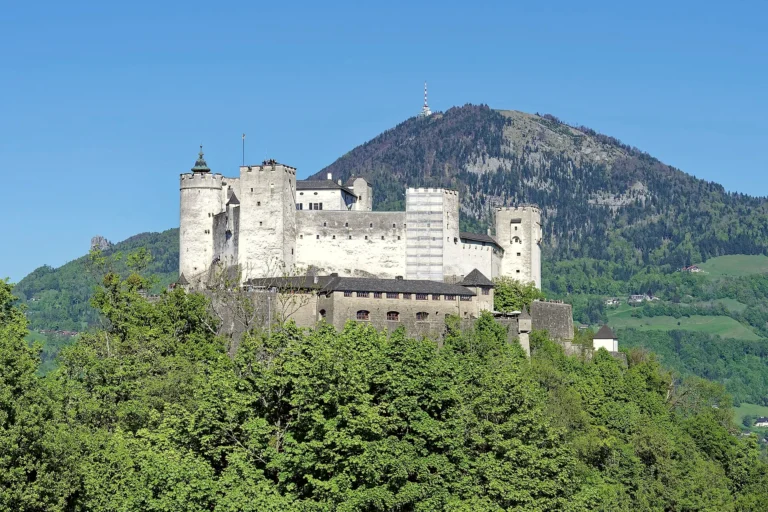
- Hohensalzburg Fortress offers an outdoor winter visit, open daily November–February, 09:30–17:00. Its museums, Panorama Tour, Princes’ Rooms and Romanesque chapel are closed in winter. Individual areas can also close for safety in ice or snow.
- Mozart’s Birthplace brings Mozart’s childhood and musical beginnings indoors. It is open daily through winter, ordinarily 09:00–17:30, but allow for the holiday exceptions below.
Make Mozart’s Birthplace your substantial indoor visit, rather than relying on the fortress for shelter and exhibitions. Its three-storey exhibition explores childhood and home life, family relationships, friends and patrons, and Mozart’s passion for opera. His childhood violin gives the story a distinctive physical focus, and other instruments include his concert violin, viola, fortepiano and clavichord.
Mirabell Gardens and the fortress are daylight choices, not substitutes for a long indoor visit. Give the outdoor portion the brighter part of the day, and leave room to shorten it when conditions are unpleasant. Around the birthplace, a brief Old Town walk lets you combine streets and squares with the exhibition without committing to prolonged cold-weather sightseeing.
Hellbrunn Palace is a different proposition from the central museum visit: its trick fountains depend on the published season. For a break focused on those outdoor attractions, winter is the wrong choice. For a city stay centred on Mozart’s Birthplace, their absence matters less, so you can give the cultural visit more time and keep your outdoor plans modest.
- Name
- Hellbrunn Palace
- Location
- Fürstenweg 37 5020 Salzburg Maps
- Site
- hellbrunn.at
- Hours
- Mon–Tue 09:30–17:00
- Wed 09:30–18:00
- Thu–Sun 09:30–17:00
- Essential fact
- Hellbrunn Palace is a palace complex on Salzburg’s southern outskirts.
Sources & fact-checking
Checks against the sources below cover: opening hours, services, key figures, and closures.
- Hellbrunn — opening hours
- City of Salzburg — service
- International Mozarteum Foundation — opening hours
- Salzburg Castles and Palaces Management — opening hours
- Festung Hohensalzburg — service
- GeoSphere Austria — key figures
- Japan Meteorological Agency, Tokyo Climate Center — key figures
- Time and Date AS — key figures
- Salzburger Christkindlmarkt — closures
- International Mozarteum Foundation Salzburg — closures