Choose June for walking-led sightseeing in Salzburg, accepting its high rainfall average. It offers cooler daytime conditions than the later summer months and sits outside the main visitor peak. If the Salzburg Festival is your reason for travelling, choose its performance season instead: the better sightseeing month is not necessarily the right month for your trip.
Choosing your summer dates
- Summer sightseeing choice
- June: cooler walking, with a rain trade-off
- Hottest month
- July, by mean daily maximum
- Coldest month
- January, by mean daily maximum
- Wettest month
- June, by monthly precipitation
- Broad summer visitor peak
- July–August, in visitor accounts
For an Old Town visit built around walking, June gives you a gentler balance of daytime warmth and demand. Keep substantial indoor visits movable rather than relying on an entirely outdoor day. The wetter climate average makes that flexibility part of choosing the month, not merely an emergency alternative.
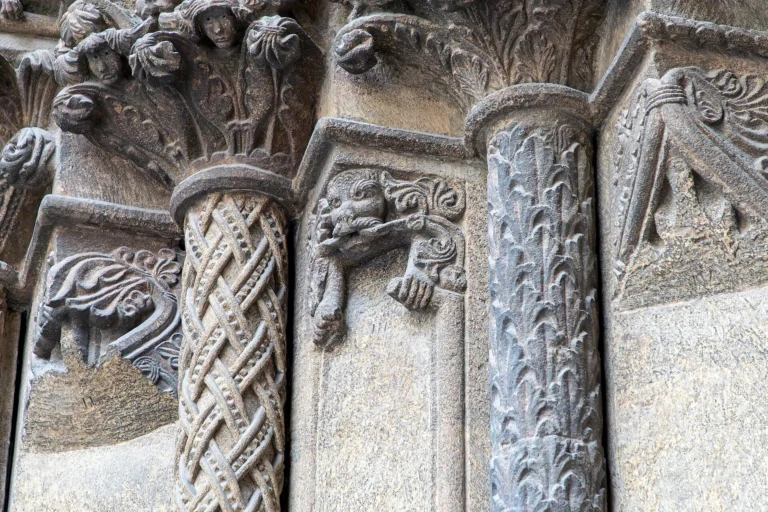
Getreidegasse’s narrow street and historic buildings make it a natural focus for exploring the Old Town on foot. Allow time to look along the street rather than treating it only as a passage between sights. A less crowded visit leaves more room for that slower pace.
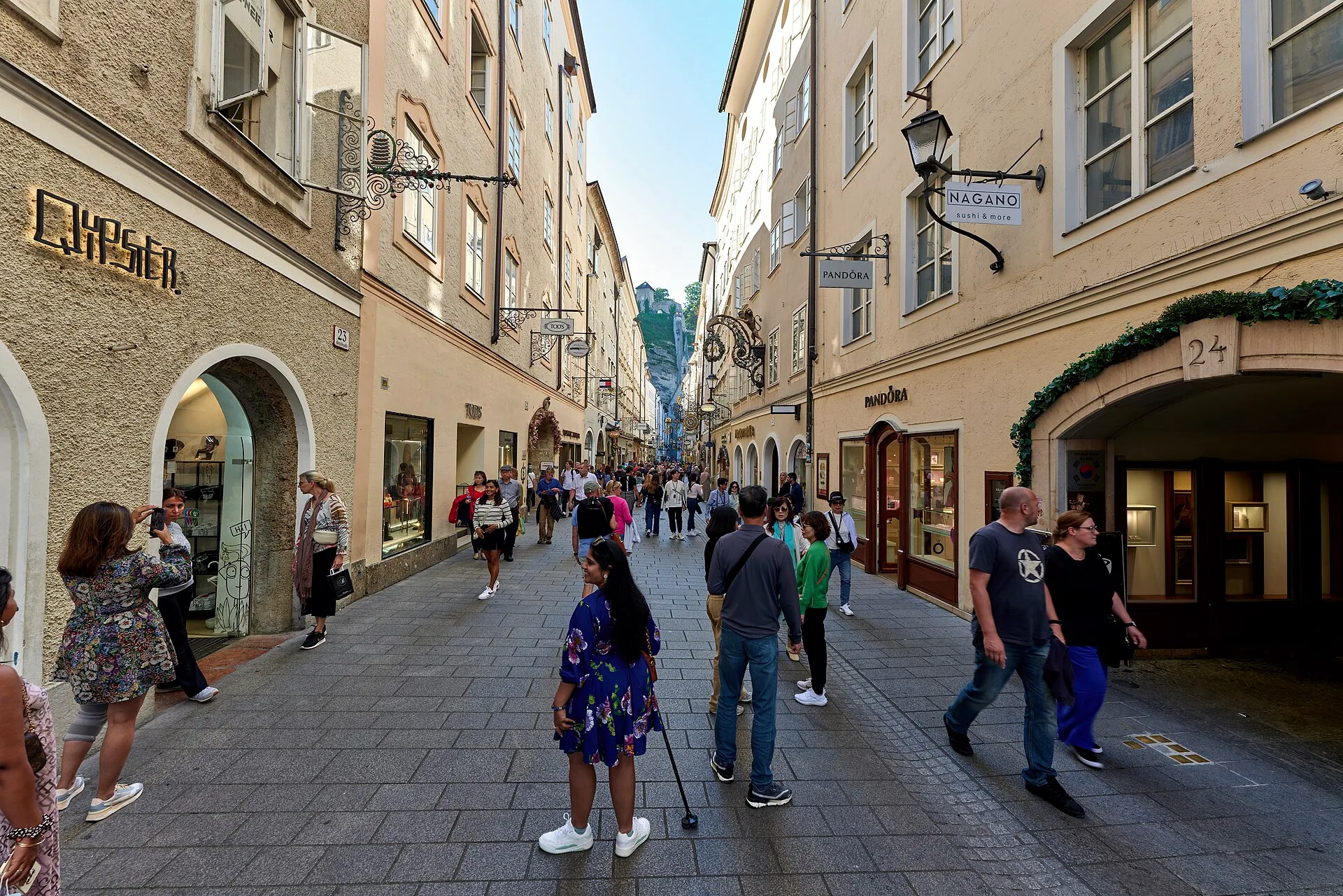
Leonhard Lenz · CC0 · Edited
Festival attendance changes the decision: performances, rather than cooler walking conditions, become the reason to select your dates. If you can travel outside summer, the best time to visit Salzburg offers a whole-year comparison before you commit to one of these three months.
June, July and August weather
| Month | Mean daily maximum | Monthly precipitation | Crowds | Weather-led verdict |
|---|---|---|---|---|
| June | 22.2°C | 186.3 mm | Below main summer peak | Good fit: cooler, but wet |
| July | 24.4°C | 169.0 mm | High | Mixed: warmer walking |
| August | 24.2°C | 178.8 mm | High | Mixed: warmth and rain |
July is warm on average, not reliably hot or dry throughout your visit. Its temperature cell describes the average of each day’s highest temperature across the observation period. It is neither a forecast for your dates nor a temperature that lasts from morning to evening. Individual days can be cooler or hotter.
June’s cooler conditions favour walking, but its rainfall total makes a dry-weather-only plan a poor match. July and August have similar daytime warmth, so temperature alone offers little reason to choose between them. Your interest in performances and tolerance for busy sightseeing places matter more.
Summer rain calls for an indoor visit you genuinely want to make. Monthly rainfall totals describe the volume of water, rather than the frequency or duration of showers. Keep Haus der Natur movable within your plans so you can switch from walking to its natural-history and science exhibits when rain interrupts your day.
The Salzburg Festival window
The Salzburg Festival traditionally runs from late July through the end of August. Choose this window if performances are central to your trip, and arrange sightseeing around them rather than selecting dates for walking weather alone.
For a flexible city break, the accompanying demand makes accommodation the other trade-off. Central locations and festival demand can make a room more expensive, so settle your accommodation early if you want to stay near the Old Town. A performance-led visit has less freedom to move dates for a cheaper room. If sightseeing is your priority, travelling outside the Festival window gives you more freedom to choose both your dates and where you stay.
Sightseeing in heat and rain
Put exposed outdoor sightseeing in the cooler part of the day and keep indoor visits movable. Explore the Old Town earlier, then use a garden pause or museum visit when walking becomes less comfortable. Carry a light rain layer so a shower need not end every outdoor stop.
Mirabell Gardens offer more than the open central flowerbeds: tree-lined perimeter avenues and shaded benches provide places to pause, while the hedge-enclosed dwarf garden has shade from surrounding trees. Access is free, and the April–September opening window is 05:00–23:00. Head towards these edges for a seated break rather than expecting shade throughout the formal garden.
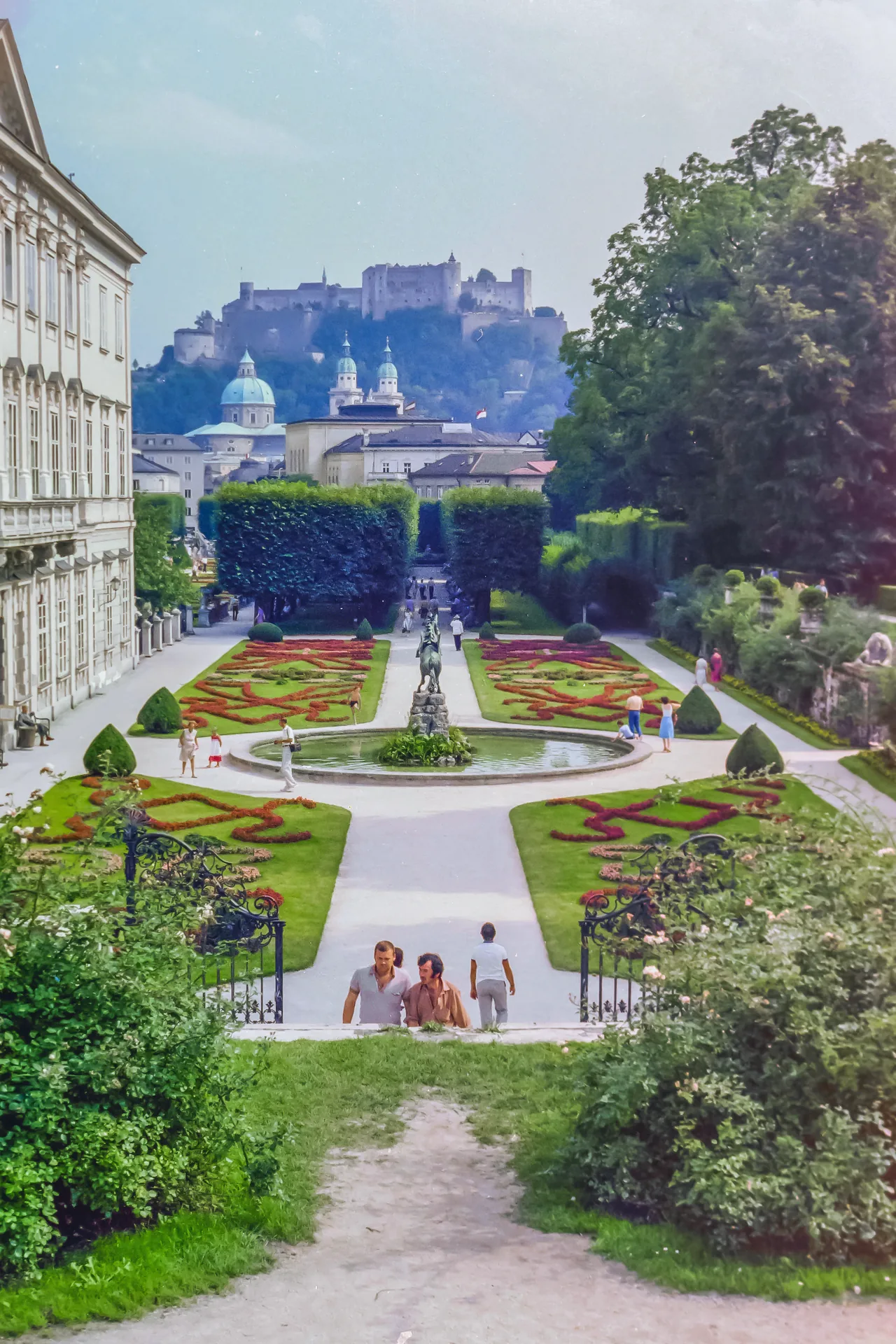
Raimond Spekking · CC BY-SA 4.0 · Edited
Tree shade is a heat break, not dependable rain shelter. If sustained rain interrupts your walk, move a planned indoor visit forward instead of waiting on a garden bench. Keeping the garden pause optional makes it easier to enjoy it when the weather suits.
Haus der Natur pairs natural-history displays, including dinosaurs, minerals, animals and the human body, with interactive science exhibits and a hands-on Science Center. It gives you an indoor visit with things to examine and try, rather than simply somewhere to escape a shower. Use a designated entrance with a valid admission ticket. Children under 14 must be accompanied by an adult.
Hellbrunn’s summer access
- Choose Hellbrunn’s trick fountains as a ticketed visit, not a free garden pause: a valid admission ticket includes the fountains and a mobile audio guide.
- Allow about 50 minutes for the listed audio-guide tour. Private guided tours are another available format.
- Dress for possible splashing. The fountains operate in any weather during the published season, so rain alone is not a reason to expect them to stop.
Hellbrunn’s trick fountains make water itself part of the visit, with playful water features rather than an indoor exhibition. Treat this as an outdoor outing, not your rain-shelter alternative to Haus der Natur. It fits a day when you are happy to stay outside and accept some water on your clothes.
The published operating season is 28 March–1 November 2026, covering all three summer months. Those boundaries belong to that year’s season. The admission tariffs below also apply to 2026. The choice between summer months is therefore more about the rest of your Salzburg visit than whether the fountains are in season.
- Name
- Hellbrunn Palace and Trick Fountains
- Location
- Fürstenweg 37 5020 Salzburg Maps
- Site
- hellbrunn.at
- Hours
- Mon–Tue 09:30–17:00
- Wed 09:30–18:00
- Thu–Sun 09:30–17:00
- Essential fact
- Hellbrunn is a palace and garden complex in southern Salzburg with trick fountains.
- Price
- €16.50 Adults
- €6.50 Children and pupils aged 4–18
- €9.50 Students aged 19–26
3 more fares
€36.50 Family ticket (2 adults + 1 child)€3.50 Additional child on family ticket€14.50 Group ticket (20+ people)
Sources & fact-checking
Checks against the sources below cover: services, opening hours, fares and charges, and key figures.
- City of Salzburg — service
- Haus der Natur Salzburg — opening hours
- Hellbrunn Palace Administration — opening hours
- Hellbrunn Palace Administration — service
- Schloss Hellbrunn — fares and charges
- GeoSphere Austria — key figures
- Zentralanstalt für Meteorologie und Geodynamik (ZAMG), Austria; data displayed by Japan Meteorological Agency (JMA) Tokyo Climate Center — key figures